Pepe Escobar – Goodbye SWIFT, Goodbye Hegemony: The Sino-Iranian Plan for the New World
 by Pepe Escobar [5-8-2026] Pepe Escobar(bio).
A few days ago, Mr. Araghchi traveled to Russia. Earlier this week, Mr. Araghchi traveled to China.
These two trips reflect in all their grandeur the strength of the new Russia-Iran-China triangle, which has emerged as the engine of Eurasian integration and multipolarity.
Some of Foreign Minister Abbas Araghchi's remarks to the Iranian media were quite fascinating. For example:
"Our Chinese friends believe that Iran after the war is different from Iran before the war. Its international standing has improved and it has demonstrated its capabilities and power. Therefore, a new era of cooperation between Iran and other countries is approaching."
This essentially means that Beijing now recognizes –and supports– Tehran as a major world power.
Chinese Foreign Minister Wang Yi, for his part, provided the final definition of the war of the United States and Israel against Iran: "illegitimate".
This means, in essence, that everything related to this war of choice, from its causes to its countless consequences, is mired in a swamp of lawlessness.
Wang framed China's diplomatic push with his characteristic courtesy: "We stand ready to continue our efforts to reduce the intensity of tensions."
But he was much more affirmative on the road to a resolution: "China believes that a complete cessation of hostilities is imperative, that restarting the conflict is unacceptable, and that persisting in negotiations is particularly important."
This should be the preamble for real negotiation leading to an end to the war –and all wars– in West Asia against the entire Axis of Resistance. That is exactly the Iranian position.
Wang Yi emphasized that "China supports Iran in safeguarding its sovereignty and national security and appreciates Iran's willingness to seek a political solution through diplomatic channels."
This means, in essence, China's full support for sovereign rights and diplomacy – not intimidation.
The Strait of Hormuz is absolutely vital for China due to energy imports not only from Iran but also from the Gulf petromonarchies. So Beijing's position must be nuanced:
"The international community shares a common concern for the restoration of normal and safe passage across the Strait, and China hopes that the parties involved will respond promptly to the international community's strong demands."
This means, in essence, the end of the American blockade, while showing respect for the new legal system of Hormuz which is framed by Tehran.
On the nuclear issue, "China appreciates Iran's commitment not to develop nuclear weapons, while recognizing Iran's legitimate right to the peaceful use of nuclear energy."
This is exactly Tehran's position – in stark contrast to Trump 2.0.
Welcome to the New Order of Western Asia
China, through Wang Yi, has clarified three essential points: support for all reasonable claims by Iran; support for the withdrawal of US military bases through the Persian Gulf; and active participation in the post-war reconstruction of Iran.
At the same time, Beijing is urging Arab countries to get a grip and work on creating a new security framework – that excludes the Empire of Chaos, Lies and, lately, Piracy (as openly admitted by the President of the United States). Once again: this is exactly Tehran's position.
With its usual finesse, Beijing is effectively aligning itself with former IRGC commander Mohsen Rezaee, chief military adviser to new leader Mojtaba Khamenei.
Beijing fully understands how Tehran is framing the resistance as a strategic asset. For the new energy configuration in Tehran, the war was all about surviving maximum pressure – and devastating bombing; absorbing and controlling the escalation trap; and refusing to give in under military and economic coercion.
All of this, taken together, could not be more strategic. Here we see tenacity transformed into political capital. And this translates immediately to the negotiating table, despite tactical losses (none of which are strategic).
This view is reflected in what are probably the two key statements of Araghchi and Wang Yi. Let's examine them side by side.
Iran "supports the establishment of a new post-war regional architecture that can coordinate development and security."
China "supports the establishment of a regional peace and security architecture through which the countries of the region jointly participate, protect common interests, and achieve common development."
This new architecture is the new order of Western Asia.
So it's no wonder the Trump 2.0 universe is messed up.
Because this new order of Western Asia is a microcosm, directly linked to the macrocosm of the New Global Order, of which China is a main driver, along with Russia.
Russia is focused on implementing, in the long term and against all odds, a Partnership for Greater Eurasia, which extends to Afro-Eurasia.
Beijing is much more ambitious. Basically everything is framed through the Four Global Initiatives. The latest is the Global Governance Initiative, launched at the SCO Plus summit in Tianjin in September last year.
It follows the New Silk Roads, or BIS (Belt and Road Initiative), which then evolved into the first three Global Initiatives: the Global Development Initiative; the Global Security Initiative; and the Global Civilization Initiative – up to Global Governance.
Overall, this is China's map for "building a community with a shared future for humanity"; the de facto alternative to the collapse of Western liberalism. Ambition is, yes, global.
China-Iran: Totally Aligned on Western Asia
What is already quite clear is that China and Iran share a totally aligned vision for Western Asia; this is indeed the foundation of their mutual trust. Beijing and Tehran are aware that the post-World War II story was essentially a fairy tale in which Washington exploited Western Asia to control the world through its obsession with oil.
As much as Tehran has learned a lot from the art of Chinese warfare –“show yourself weak when you are strong” and disinterested when you are neck-deep in war – Araghchi's trip to Beijing was crucial in re-consolidating the strategic partnership. As committed as Russia is – as confirmed by the meeting in St. Petersburg between Araghchi and Putin – China is in a position of “we have your back”.
Chinese oil tankers, by the way, continue to transit through the Strait of Hormuz on a daily basis. Not a Washington sound.
Then there is China's total defiance of the final chapter on sanctions.
Until recently, China circumvented U.S. sanctions unofficially and/or through intermediaries. It now officially declares that it does not recognize unilateral US sanctions against Iran or Russia, for example, nor sanctions against its own oil refineries.
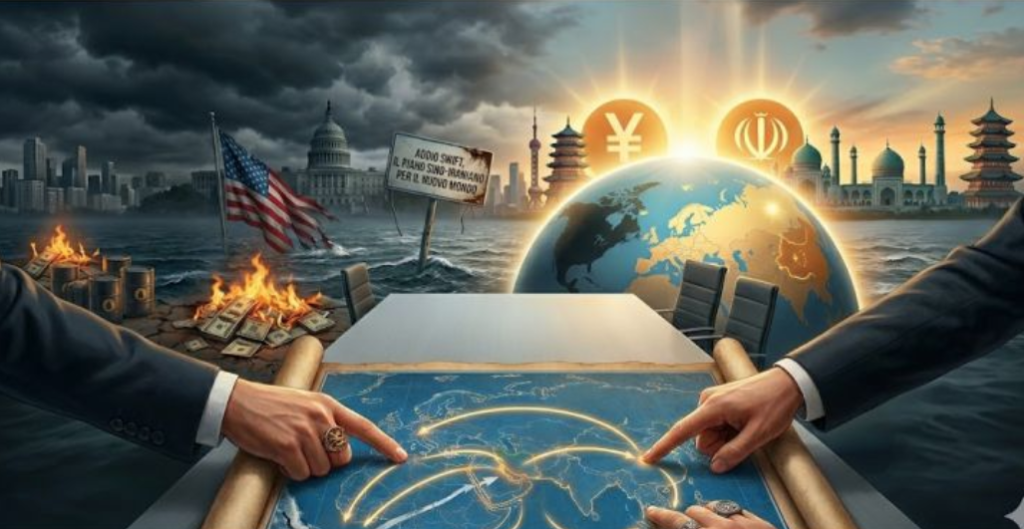
We are immersed in a financial Cold War and a RIC (Russia, Iran, China) offensive to permanently amputate the power of the sanctions obsession.
Iran was completely expelled from SWIFT in 2012. So Tehran had the system reconfigured, taking advantage of the experience of building a parallel commercial architecture.
Iran conducts most cross-border trade in yuan, rubles, rupees, Emirati dirhams (no longer), and Iraqi dinars. China accounts for up to 35% of Iran's total trade. Everything is settled in yuan or by barter.
Iran and Russia formalized a currency settlement system in 2023, completely bypassing SWIFT and linking Iran's SEPAM to Russia's SPFS. In the early period of the toll booth in the Strait of Hormuz – the mechanism is constantly modified and rationalized – a key payment method was through the Chinese CIPS.
Toll booth is inevitable. Tehran is fully aware that Trump will never agree to pay reparations for the illegal war he started, and it is also aware of the inevitable gross manipulations when it comes to lifting the freeze on Iranian funds.
The toll booth could serve as a substitute for obtaining reparations and collecting something equivalent to Iranian funds frozen in Western banks; and it will also force the West to lift sanctions on Iranian banks and the Iranian financial system.
After all, Tehran has already made it clear that only its banks are allowed to collect fees in the Strait of Hormuz.
Translation: Every nation that has to transit will have to face the Iranian financial system.
Furthermore, the taxes will help Iran rebuild its destroyed infrastructure.
Addressing the structural vulnerability of the United States
The United States doesn't even play checkers, let alone poker. China plays at the weiqi ("go"). The weiqi It consists of shaping the playing field, slowly but surely, sacrificing a few details here and there to achieve overall supremacy. Over the past twenty years, China has patiently shaped the playing field. In weiqi, once you have properly shaped the playing field, the rest of the Great Game unfolds itself.
That's where we stand.
If he harbors intellectual curiosity, Trump will be able to see China's powerful industrial power (called productive capitalism) and full control over the supply chains on which the United States depends.
It will face the structural vulnerability of the United States: the usual list of rare earths, industrial supply chains, access to essential materials for F-35, the Patriot missiles, vast sectors of the American military-industrial complex.
And he will be reminded that US law no longer enjoys automatic extraterritorial authority within China. Yes, this hurts.
Meanwhile, the seven centuries of opposition between Imperial Rome and Persia will continue to repeat themselves, at lightning speed, in the 21st century. The US war has proved utterly impotent: impossible to win against attrition, and this will lead Persia to supremacy in West Asia.
This astonishing geopolitical reversal is being achieved thanks to a powerful mix of ideology, social cohesion, total disregard for crude barbarians, and a willingness to bankrupt them using impossible logistics. Not to mention total control of the Strait of Hormuz.
Bubbles are bursting rapidly in the Empire of Chaos, Lies and Piracy, mercilessly struck by the reality of the RIC.
(Translation by: Nora Hoppe)