Pepe Escobar: The new “indispensable nation” for the Multipolar Planet enters the scene
 by Pepe Escobar [5-22-2026] Pepe Escobar(bio).
The New Silk Roads/BRI and their offshoots, such as the Northern Maritime Route/Arctic Silk Road, are still alive and well.
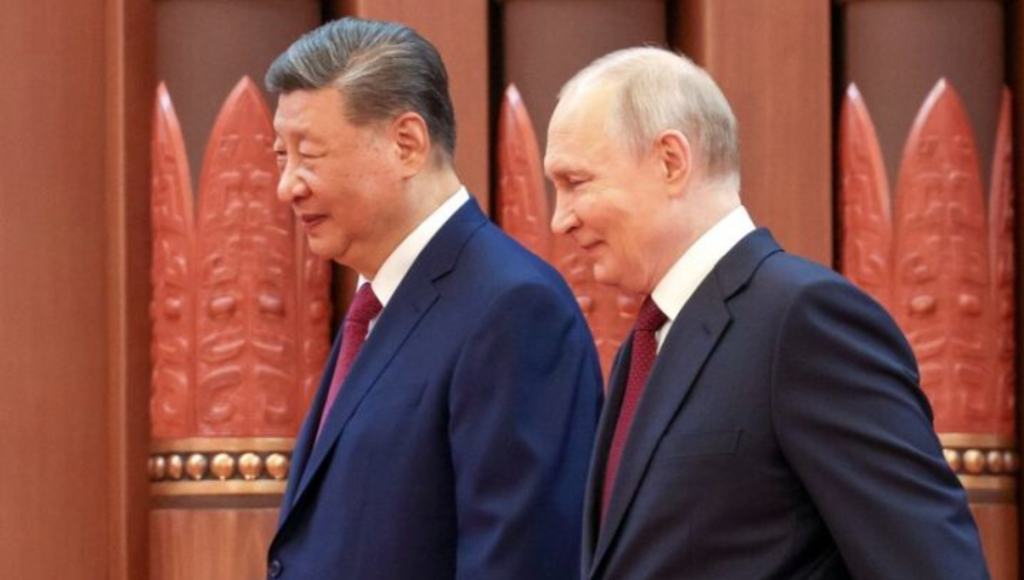
SHANGHAI – Here we are. The strategic partnership between Russia and China, leaders in the Eurasian integration process, leaders of the BRICS multipolar bodies and the SCO have formally endorsed and strengthened the drive towards multipolarity and a new system of international relations through a joint strategic statement signed, sealed and delivered during President Putin's visit to China this Wednesday.
This is an event that will go down in history – and not just in one sense. I had the privilege of following the activities in Beijing throughout the day at the Aurora College, one of the best private schools and universities in Shanghai, among a fabulous congregation of teachers and students.
We have therefore had a lot of time to discuss the implications of how the First Two Eurasian powers –and global powers– are setting the lines of a new geopolitical future for most of humanity. The exceptions will be exceptionalists, recalcitrants, and vassals addicted to serial political suicide.
We all remember President Xi's visit to Russia in 2023, when, leaving the Kremlin, side by side with Putin, he very concisely expressed what he had already been refining for some time: "Right now, we are seeing changes we haven't seen in 100 years." And then Xi and Putin agreed that now, "we are leading these changes together."
The concrete result is the Beijing joint declaration, with a decidedly incisive tone, drafted by unmistakable “civilizations with a thousand-year history".
Let's look at some of the highlights. The declaration does not mince words or concepts when it comes to offering a serious alternative to the current –declining – one-sided historical moment.
Polycentrism: "Attempts by some states to manage world affairs alone, impose their interests on the rest of the world, and limit the sovereign development of other countries in a spirit typical of the colonial era have failed." Russia-China will focus on establishing a "long-term state of polycentrism."
The "law of the jungle": "Universally recognized fundamental norms of international law and international relations are regularly violated [...] There is a risk of fragmentation within the international community and a return to the 'law of the jungle'."
A new security architecture: "Due attention must be paid to the rational security concerns of all countries, focus on security cooperation, reject confrontation between blocs and zero-sum strategies, oppose the expansion of military alliances, hybrid wars, and proxy wars, and promote the creation of an updated strategy, a balanced, effective, and sustainable global and regional security architecture [...] It is unacceptable to force sovereign states to abandon their neutrality."
This is exactly what Moscow proposed to Washington and NATO in December 2021: the indivisibility of security. The unanswered question sparked the SMO in Ukraine two months later, when it became clear to Moscow that NATO's plan was a blitzkrieg in Donbass.
Hegemony: "Hegemony in the world is unacceptable and should be prohibited. No state or group of states should control international affairs, determine the fate of other countries, or monopolize development opportunities."
Global governance: This is the concept President Xi is particularly fond of, fully illustrated at last year's Shanghai Cooperation Organization (SCO) summit in Tianjin: "In global governance, which is a fundamental tool for streamlining the system of international relations, it is necessary to adhere to the principles of sovereign equality, the international rule of law, multilateralism, a human-centered approach, and results-oriented thinking."
The United Nations: it is necessary “to strengthen the role of multilateralism as the main instrument for addressing global, complex and multifaceted challenges, and to prevent the weakening of the United Nations”. This should lead to "United Nations reform". Yet everyone knows that this will definitely not happen under the current administration in the White House.
Point 4 of the declaration: the diversity of civilizations and values at the global level. Perhaps this is precisely the crux of the matter, which inexorably buries any exceptionalist claim: "The spiritual and moral system of a civilization cannot be considered exceptional or superior to others. All countries should support a vision of civilizations based on equality, mutual exchange of experiences and dialogue, and should strengthen mutual respect, understanding, trust and exchanges among different nationalities and civilizations, promote understanding and mutual friendship among the peoples of all countries and protect the diversity of cultures and civilizations.'
The new "indispensable nation" enters the scene
The Russia-China declaration, as concisely as possible, offers what is the much-needed hope for humanity to delve into the matrix of a civilizational past as a means of forging a propitious and more egalitarian future.
It is undoubtedly a mini-humanist manifesto that goes far beyond the creation of a new security architecture and the introduction of fundamental changes in the current system of international relations. Its credibility is underpinned by the support of two Great Powers that are also States of civilization, fully sovereign and fully independent.
I called this process "The Eurasian Century" for quite some time. This is precisely what this fateful May 20, 2026, celebrated in Beijing, as part of an official visit by President Putin to China.
The scope and ambition of the joint statement clearly overshadow other aspects of Putin's journey in Beijing, even if they are already quite relevant in themselves.
Starting with the seal of the new "indispensable nation". The Exceptionalists leave the scene; China enters the scene. The old order is evicted – in real time. And yes, this is the most significant change in the structure of the Great Powers since the end of the Cold War – made complete by the Chaos Empire which condemned Russia to death aiming for its “isolation” and economic collapse, but which was inexorably outsmarted by the strategic partnership between Russia and China.
The 25-year Good Neighbor Treaty between Russia and China has been massively expanded – providing for strategic energy corridors (the Power of Siberia 2 pipeline), very close military coordination, and a shared civilizational/ideological framework.
Of course, there will be no substantial leaks about what Xi and Putin spoke during their informal two-hour tea session. The proxy war in Ukraine and the illegal war against Iran were supposed to be at the center of discussions, including whether Putin may have briefed Xi on Russia's possible next moves in an increasingly direct and toxic clash with NATO, and whether both are assessing the technicalities of Russian-Chinese support for Iran.
So, simply put, the New Silk Roads/BRI and its offshoots like the North Sea Route/Arctic Silk Road remain alive and well; and the de-dollarization of the global economy –a reflection of the trade balance between Russia and China, now advancing exclusively on yuan and rubles– is more than alive and well.
As for the BRICS, destabilized by the United States from within via India and the United Arab Emirates, they could eventually rise from its coma; this process will have to be led by Lavrov and Wang Yi. And the focus must change: BRICS countries must develop some sort of strategic coherence within the Global Majority for the transition to a multipolar order to truly work.
Then there is the bright future of Power of Siberia 2. Finally, China may even forget its obsession with the "escape from Malacca," in place since the early 2000s, and return to the spotlight with the fake American blockade of the Strait of Hormuz and Iranian ports.
The leadership in Beijing has always been fully aware that blocking the Strait of Malacca is essential to America's strategy of containing and suffocating China. The Power of Siberia 2 offers a solution completely outside the Thalassocratic Empire of Piracy, pumping gas directly into China from the Yamal Peninsula through the Altai Mountains and Mongolian steppes.
There was a delightful touch in the Great Hall of the People, amidst so much drama: a joint TASS-Xinhua exhibition, "The Indissoluble Friendship of the Great Nations, the Strategic Partnership of the Great Powers," featuring 26 photos documenting Putin-Xi friendship over the years, at various G20, BRICS, and OCS summits, at the One Belt forum, One Road, Victory Day in Moscow, and the Beijing Olympics.
Putin and Xi visited the expo with two rather special tour guides: TASS CEO Andrey Kondrashov and Xinhua CEO Fu Hua.
Combined with the tea ceremony, let's call it the deep, human, all-too-human bond, the person-to-person contact, essential for traveling the long and winding road to a geopolitical future of equanimity and mutual respect.