Pepe Escobar: In the AI era, where will the younger generation go in the future? A famous Brazilian journalist said this…
by Pepe Escobar [5-21-2026] Pepe Escobar(bio).

In the AI era, where will the younger generation go in the future? A famous Brazilian journalist said this...

Aurora Vocational College
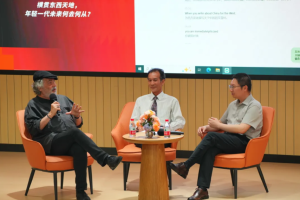
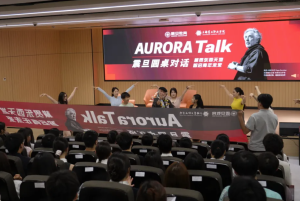
On May 20, Aurora Education Group specially invited Renowned Brazilian journalist and geopolitical scholar Mr. Pepe Escobar visited Focusing on “what is the future of the younger generation in the era of artificial intelligence?”, a cross-cultural and cross-context in-depth academic roundtable dialogue was held in the lecture hall of Yaoheng Hall 22 of Shanghai Aurora Vocational College. Zhang Shen, Chairman of Aurora Education Group, Huang Min, Deputy Secretary of the Party Committee of Shanghai Aurora Vocational College, and Zhong Jiejing, Vice President, attended the event.The event was co-chaired by Jin Chenzhong, Director of the International Exchange Department of Shanghai Aurora Vocational College, and Wang Bin, Director of the Ideological and Political Teaching and Research Center for Intercultural Courses.

A cross-cultural greeting where the body precedes the words

A Cross-Cultural Gesture: Body Before Words
At the beginning of the event, when Mr. Escobar entered the venue, the Shanghai Aurora Vocational College Student Art Troupe welcomed him with a passionate and unrestrained samba dance. The drums beat passionately, the skirts flew, and the entire venue was instantly pulled into an emotional resonance that transcended national borders.

Samba ——this Brazilian quintessence, which combines African, European and indigenous cultural genes, is itself a living sample “of intercultural mixing”.

Cognitive transformation and ideological awareness in the era of artificial intelligence
Cognitive Transformation and Intellectual Self-Awareness in the Age of AI
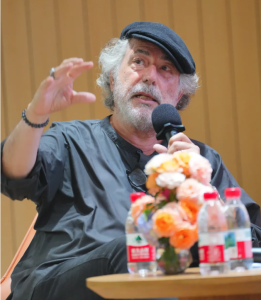
At the beginning of the conversation, Mr. Escobar started with the reshaping of the underlying logic of knowledge production by artificial intelligence. He pointed out that the current technological revolution is not a simple iteration of tools, but a profound epistemological transformation ——AI not only changes “how we acquire knowledge”, but also fundamentally changes “what is recognized as knowledge”.

When algorithms become the implicit arbiters of information screening and meaning construction, the authority, diversity and criticality of knowledge all face systematic challenges. Escobar warned:

“If the production of ideas is outsourced to algorithms, humans will lose not just a capability but a way of being. ”
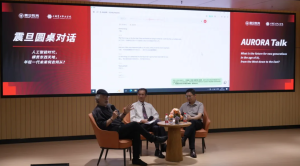
In response to the problem that AI may narrow cognition, he further analyzed: AI systems rely heavily on classification and binary judgment, subtly using simplified frameworks that users are accustomed to “yes/no ”“ right/wrong”, and losing the ability to dwell in ambiguous areas. He connects this phenomenon to “techno-feudalism”—— When a few technology giants monopolize information entry and discourse frameworks, individuals' cognitive autonomy faces structural erosion.

Ideological exchange during the Q&A session
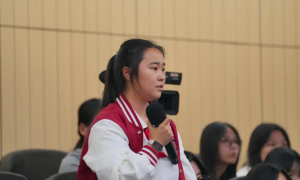
The Intellectual Clash of the Q&A Session
The interactive segment of the round-table dialogue will lead the discussions to more specific and tangible real concerns. The students and teachers present engaged in a heated all-English ideological exchange with Mr. Escobar on topics such as skills development, employment prospects, and technical ethics.

Among them, Chen Ping, vice dean of the School of Intelligent Engineering at Shanghai Aurora Vocational College, highly agreed with Mr. Escobar's insights and shared the profound insights she gained from the conversation. She admitted that she has a deeper understanding of global culture and the differences between the East and the West. She then pointed out in light of the educational practices of Aurora Vocational College:

“Currently, our School of Intelligent Engineering teachers are also teaching artificial intelligence courses. Our students are learning about IoT technology applications, digital media technologies, and more. In the future, they will work in smart manufacturing, automated operations, maintenance and smart device monitoring. In these areas, learning AI skills is crucial and invaluable.”
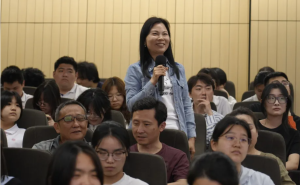
Vice President Chen Ping's speech precisely responded to Mr. Escobar's concerns about “change in the job market”. Aurora's answer was clear and firm: Rather than avoiding the AI wave, we should find irreplaceable anchors for students in the wave——transforming technological tools into extensions of human capabilities, rather than replacements.

Protecting cultural diversity in the AI era

Preserving Cultural Diversity in the Age of AI
After the lecture and question-and-answer session, Aurora also arranged a campus ethnic culture display session for Mr. Escobar. Students presented a rich map of China's multi-ethnic culture through ethnic costume performances, traditional handicraft workshops, and interactive experiences of intangible cultural heritage.

Mr. Escobar stopped at each booth under the guidance of students, and Teacher Fei Hongfeng of the International Exchange Office accompanied him on the tour.This is not a one-way cultural display, but a two-way understanding with depth. As a Western journalist who has lived in the East for more than 30 years, Mr. Escobar deeply resonates with Aurora's concept of integrating “cultural awareness” into AI literacy education. Aurora Education Group has always emphasized:

“We don't want students to lose their sense of their cultural roots while mastering technology. The practices presented to Mr. Escobar today are our efforts to explore ‘technology for good, culture for all’ educational models.”
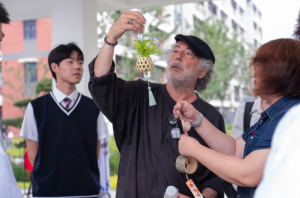
Together, they remind us that in an age where artificial intelligence attempts to encode all knowledge into homogeneous data, one of the most important missions of education is precisely to protect what cannot be encoded ——rhythm, emotion, physical memory, and the ‘willing’ openness between civilizations.”

Anchoring Idea Coordinates in Uncertainty
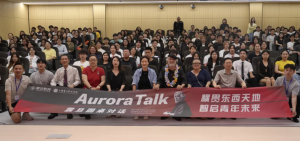
The entire roundtable dialogue and exchange ultimately converged into a common reminder: In an era where artificial intelligence is trying to encode all knowledge into homogeneous data, one of the most important missions of education is precisely to protect what cannot be encoded——Rhythm, emotion, physical memory, and that ‘willing to be moved’ openness between civilizations. Through this in-depth dialogue with Mr. Pepe Escobar, Aurora Education Group not only demonstrated its solid accumulation in the two major fields of AI vocational education and international cultural exchange, it also sends a clear signal to the world: Technology can be constantly iterated, but the very nature of education ——developing whole, rooted, thinking people—— will never be replaced by algorithms.In the future, Aurora Education will continue to build such a cross-cultural and interdisciplinary dialogue platform, preserving and opening up space for criticism and creation for young thinkers in an era of accelerated technological evolution.

Share to following:

Leave a Comment