End of US dominance: China & Russia push for a polycentric world
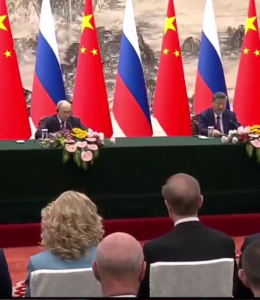
by Grandmasters of Geopolitics [5-20-2026].
Chinese President Xi Jinping and Russian President Vladimir Putin used their latest summit in Beijing to champion a new global order aimed at reducing US influence and accelerating a “polycentric” world built around multiple centres of power.
China has rolled out the red carpet for Putin’s 25th visit, underscoring a level of high-level diplomacy that far outpaces US engagement (just days after US-China talks) and highlighting how swiftly the China-Russia partnership has hardened into a strategic power challenging American hegemony.
Putin hailed relations as being at an “unprecedented level”, while Xi called for an international system no longer controlled by a single superpower.
 Energy alliance
 Russia has become one of China’s biggest energy suppliers after sanctions tied to the Ukraine conflict cut Moscow off from much of Europe.
Russian oil exports to China surged roughly 35% in the first quarter of 2026 alone.
Both sides also advanced discussions on the Power of Siberia 2 pipeline — a massive project designed to reroute Russian gas flows from Europe to Asia.
 Ditching the dollar: Yuan-Ruble trade
China and Russia now conduct most bilateral trade in local currencies rather than US dollars.
Both are accelerating efforts to build alternative payment systems, strengthen BRICS financial institutions, and bypass Western sanctions infrastructure.
Both nations increasingly argue that US weaponises the dollar, banking access, and sanctions to pressure rival states.
 Military & strategic coordination
Since the Ukraine conflict began, China has offered Russia access to its industrial capacity, electronics, machinery, and trade to offset Western sanctions.
Russia, in return, has provided China with its discounted energy supplies and stronger strategic backing against US pressure in the Indo-Pacific.
Both governments increasingly portray themselves as defenders of a “multipolar” or “polycentric” order against “American unilateralism.”
Their message is well received in countries across Asia, Africa, Latin America, and the Middle East frustrated by sanctions, interventionism, and Western hegemony of global finance.
 Headache for US
For the US, the growing China-Russia partnership represents one of the most serious long-term geopolitical challenges since the Cold War.
Together, Russia and China combine massive military strength, industrial capacity, energy resources, nuclear arsenals, and diplomatic influence across the Global South.
While US wages war across the globe, China and Russia champion a polycentric world that will strip America of its unipolar-era control over global trade, finance, military pacts, and international rules.