Larry Johnson: Three Men, One Photo Op and a Peace Declaration at APEC in Shenzhen China
 by Larry Johnson [11-19-2026] Larry C. Johnson(bio).
Three days ago I told you what to expect in Shenzhen. I said Trump would call the meeting historic, that the three men would agree to keep talking, that nobody would deliver a nuclear deal, and that the real deal would, as always, be scheduled for the next meeting. I titled the piece “Three Men and a Photo Op.”
On Thursday the three men met, and the photo came out beautifully. Then Trump climbed aboard Air Force One and gave the summit a “12 out of 10.” If that number sounds familiar, it should. It’s the same grade he gave his Busan truce with Xi last year. Donald Trump’s grading scale has the useful feature that every summit is the best summit, and the next one will be even better.
So let’s check the tape against my predictions. I’ll be honest about what I got wrong. There wasn’t much.
What actually happened
The day ran on a tight schedule. Putin and Trump met first for about 40 minutes, and the subject was Ukraine. Afterward, Kremlin aide Yuri Ushakov said neither side had made any particularly important statements and described the session as preparation for the three-way meeting. No result was announced.
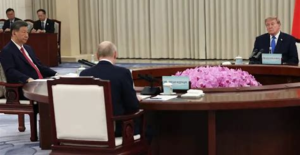
Then came the main event. Xi presided at Kylin Villa while Trump and Putin sat across the table. Trump opened by announcing that they were making history. Xi told them that when great powers are at peace the world is secure, and when they clash it falls into chaos. Putin said the three countries share interests in settling regional conflicts, “including obviously the conflict in Ukraine.” Xi, the host, did not mention Ukraine at all.
After an hour or so, the three released a short “peace declaration.” It commits them, as permanent members of the UN Security Council, to dialogue on reducing nuclear risks and preventing proliferation. It repeats that a nuclear war cannot be won and must never be fought. It reaffirms the importance of stable energy flows, without saying how. And it takes a swipe at the International Criminal Court, which is about the only thing all three governments genuinely agree on.
What the declaration leaves out is more telling. It says nothing about the war in Ukraine. It says nothing about the war with Iran. Two wars, three leaders, one declaration, and neither war made the cut.
The scorecard
| What I predicted on Nov. 16 | What happened on Nov. 19 | Verdict |
| Trump will call it historic | “We are really making history.” Then “12 out of 10,” a “very special relationship” with Xi, and Putin his “friend” | Hit |
| No nuclear deal; at most a pledge to keep talking | A pledge of dialogue on nuclear risk, no limits, no verification, and a “cannot be won” line recycled from 1985 | Hit |
| On Iran, words and no levers | The declaration ignored Iran. Trump says Xi agreed Hormuz must stay open, but neither Beijing nor Moscow has confirmed it | Hit |
| Russia and China nudge Trump back to the Islamabad memorandum | Nothing public yet in Shenzhen, though Xi pressed the same point in September | Too early to call |
| Ukraine “off the agenda” but discussed; no ceasefire | 40 minutes on Ukraine with Putin, Putin raised it at the table, no ceasefire, nothing in the text | Hit |
| The real money is at lunch: a truce extension | No extension. The truce still dies on Jan. 10 | Miss |
| Three readouts, three different meetings | Xi never mentioned Ukraine; Beijing’s readout stressed “strategic stability,” AI talks and a Taiwan warning | Hit |
| The next meeting will be announced | The G20 at Trump’s Doral resort, Dec. 14–15. Xi expected; Putin invited and undecided | Hit |
Six hits, one miss, and one still pending. I don’t say that to brag. I say it because predicting this outcome required no inside information whatsoever. It required only the willingness to look at four previous summits and assume the fifth would look the same.
My miss deserves a closer look, because it’s the most important part of the story. I assumed that, whatever else happened, Trump and Xi would at least roll the trade truce forward again. They didn’t. The two sides centered their talks on the new “Board of Trade” and its proposed 30-for-30 tariff swap, but Trump flew home without an extension. A senior US official complained that the rare earths still aren’t coming “at the pace and at the level that we would like.” Rush Doshi at the Council on Foreign Relations says Beijing has been throttling rare earth supplies in violation of the truce, and treats the whole détente as a pause to build leverage. I said Beijing would keep its rare earth leverage. I just didn’t expect it to keep the truce hostage too.
Iran: the war nobody mentioned
Iran was supposed to be the reason for this trip. Trump told reporters days earlier that he wanted Xi and Putin to help end the war. Then, a few hours before the summit, he told Fox News he doesn’t need their help. Iran’s navy and air force are defeated, he said, its missiles are down to about 12 or 13 percent of what they were, and Tehran wants a deal. If that’s true, it’s a mystery why diesel still costs what it does and why the Strait of Hormuz still isn’t open. I’ll leave it to the reader to decide which version of Trump to believe: the one who flew 8,000 miles to ask for help, or the one who said he didn’t need it.
Afterward, Trump said Xi agreed that Hormuz must stay open and that Iran can’t have a nuclear weapon. That’s Trump’s account. Neither Beijing nor Moscow has confirmed it, and the declaration all three men signed doesn’t mention Iran at all. ABC News pointed out the obvious awkwardness: Washington and the Europeans have accused both Russia and China of giving Iran satellite imagery and intelligence support. Both deny it. Neither one was going to put its name to a document that left its partner in Tehran out in the cold.
That’s the part of my prediction I’d stand on hardest. I said Russia and China would push Trump to return to the Islamabad memorandum and that the only question was whether they’d do it in public or in private. In September, Xi publicly told Washington to go back to the June memorandum. In Shenzhen, nothing on Iran made it into the public record at all. That tells me the pressure, if it was applied, was applied in private, which is exactly where serious pressure tends to happen. Iran will draw its own conclusion: its two most important partners sat down with the man who has been bombing it, and neither one signed a single word against it.
It appears Tehran drew that conclusion fast. On the very day of the summit, the IRGC-affiliated Sabereen News announced, in a post it labeled “unofficial,” that dozens of Iranian tankers were getting ready to sail for China in defiance of the US naval blockade. Sabereen said Tehran had warned governments across the region that it would go to war if the United States attacked Iranian tankers bound for China. At the same time, a ship-tracking service reported that a tanker was loading Iranian crude in the Gulf, which would be the first such export in four months. Other reports put more than 14 tankers waiting at Kharg Island, many with their transponders switched off.
Think about the timing. Trump spent the morning telling Fox News that the blockade was his most effective weapon and that he has “total control” of the Strait of Hormuz. By the end of the day, Iran was announcing that it intends to sail its oil straight through that blockade to the country whose president had just hosted him. Whether this is a real convoy or a calculated bluff, the message is aimed squarely at Washington: go ahead and stop a tanker headed for China, hours after you posed for pictures with Xi Jinping. If the US Navy boards one of those ships, it’s no longer just a war with Iran. It’s a confrontation with Iran’s biggest customer, which has just been named a partner in a “peace declaration.” I suspect Tehran reads the absence of Iran from that declaration the same way I do: as a green light, not a warning.
The chip war didn’t take the day off
One thread that I didn’t fully anticipate turned out to define the mood under all the smiles: artificial intelligence. A recent video making the rounds, under the less-than-subtle title “US Demands Just FAILED in China,” argues that Washington’s latest push to choke off Chinese access to advanced AI chips, including new rules on remote access and cloud rental of those chips, has run straight into a wall. Beijing has warned of retaliation, rejected calls for an AI “slowdown,” and framed the American rules as an attempt to lock in US dominance dressed up as safety. I’d treat the video’s packaging with some caution, since the summary I’ve seen was assembled from its title and surrounding coverage rather than a full transcript. But the core of it squares with the record.
In the run-up to Shenzhen, Washington moved to close the loopholes that let China reach advanced chips, including smuggling through Southeast Asia and renting computing power remotely. At the summit, Xi warned against “decoupling and supply chain disruptions,” a line plainly aimed at Washington, and urged the three countries to abandon a Cold War mentality. Beijing’s readout called for more communication on AI. Trump, for his part, came home touting AI talks. Translation: the Americans want China to stop, and the Chinese want the Americans to talk. Those are not the same thing.
Meanwhile, China has slapped its own new export controls on drones, AI and solar equipment, according to CFR’s Chris McGuire, while both sides claim to be honoring the Busan truce and quietly undermine it. Put that next to the missing truce extension and you get the real story of Shenzhen. Not a new Yalta, but two economic superpowers smiling for the cameras while each tries to cut the other’s supply lines.
The same video also points to the eye-watering gap, roughly $1.5 trillion by its count, between what America is pouring into data centers, chips and power plants and what AI is actually earning so far. I’m not an AI analyst, and I’ll leave the bubble arithmetic to others. But it does raise an awkward question for the chip war: Washington is betting the economy on staying ahead in a race it is also trying to win by tripping the other runner. If that bet goes bad, Washington won’t be able to blame Beijing for it.
The bottom line
Shenzhen produced exactly what the previous four summits produced: pageantry, superlatives and a promise to meet again. The difference this time is the picture itself. Xi presided. Putin sat at the table as an equal, a living rebuke to four years of Western talk about making Russia a pariah. And Trump, the man who came to them, got his photo and his “12 out of 10” and flew home without a ceasefire in Ukraine, a deal on Iran, a nuclear agreement with any teeth, or even a renewal of his own trade truce.
The winners are the ones I named on Monday. Xi got to be the indispensable host and gave up nothing. Putin got validation and 40 minutes on Ukraine with no European in the room. Trump got the photo. The Europeans held their own meeting in Berlin to prove they still mattered, which is the sort of thing you do when you’re worried that you don’t.
The next episode airs at Doral on December 14. Xi is expected. Putin is invited and keeping everyone guessing. And on January 10, the trade truce runs out. I’ll make one more prediction now so you can hold me to it: Trump will call Doral historic, too.