Larry Johnson: Striking Matches Near the Powder Keg of Europe
 by Larry Johnson [11-21-2026] Larry C. Johnson(bio).
There’s a certain kind of man who stands next to a powder keg tossing lit matches and then acts shocked when somebody yells at him. Europe has become that man.
In the space of a single week, Ukraine knocked down part of the Kerch Bridge with a lot of help from NATO’s eyes in the sky. Then, on Saturday, drones set a Russian military cargo ship ablaze in the Gulf of Finland, and by Saturday night air raid sirens were wailing over Kaliningrad and explosions were being reported near the headquarters of Russia’s Baltic Fleet. Every one of these strikes required something Ukraine can’t produce on its own: geography, airspace, or intelligence belonging to a NATO country.
The Europeans call it supporting Ukraine’s right to self-defense. Moscow is going to call it something else. And at some point, Moscow is going to act on its definition, not Brussels’.
A ship in the Gulf, sirens in Kaliningrad
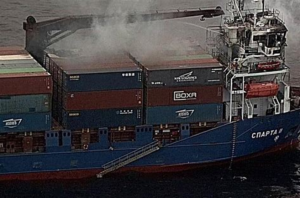
Start with the ship. On Saturday morning, the Sparta II, a 121-meter Russian-flagged cargo vessel, was hit by two drones in the eastern Gulf of Finland, west of Russia’s Gogland Island. Its owner is Oboronlogistika, the Russian Defense Ministry’s shipping arm, and the vessel is under US sanctions. It was headed from the St. Petersburg area to Kaliningrad. The bridge caught fire, the 16-man crew took to the lifeboats, and the burning hulk drifted into Finnish waters.
Finland’s armed forces said it was “likely” that Ukraine was behind the attack. Finnish Prime Minister Petteri Orpo said the war was spilling over into Finland’s neighborhood and, in the same breath, that Ukraine “has the right to fight against the aggressor.” Translation: we’d prefer you didn’t do this on our doorstep, but we’re not going to say no.
Then came the night. Sirens went off across Kaliningrad Oblast, and residents of Baltiysk, home port of the Baltic Fleet, reported explosions and drones while Russian air defenses opened up. Airport operations were restricted. If the reports hold, this was the first drone attack on Kaliningrad itself in the entire war. The Russian side has not confirmed a hit on the base, and the details remain murky. But one detail stands out: the regional authorities initially reported a suspicious object approaching from the direction of Lithuania.
Think about the map. Ukraine doesn’t border the Gulf of Finland, and it doesn’t border Kaliningrad. To get a drone to either one, you have three choices: fly it the long way across Russia and hope Russian air defenses miss it, launch it from a boat somebody lets you put in the Baltic, or fly it over a NATO country. Ukraine has done the first many times this year against the oil ports at Ust-Luga and Primorsk. The other two require a NATO country to look the other way. And a drone coming at Kaliningrad from the direction of Lithuania didn’t take the long way around Russia.
Estonia’s open skies
Which brings us to Estonia. On Saturday, the Estonian Defence Forces raised a drone alert for Lääne-Viru and Ida-Viru counties, the stretch of northern Estonia that faces the Gulf of Finland. NATO’s Baltic air policing F-16s were scrambled. And then, as far as anyone has reported, nothing happened. No drones shot down. No public complaint from Tallinn about foreign military drones transiting its airspace. Estonia’s Police and Border Guard put out a statement about explosions aboard the Sparta II and said it was “monitoring the situation.”
Monitoring. That’s a word you use when you watch something happen that you have the means to stop and decide not to. Estonia has shown it can shoot down a Ukrainian drone when it wants to; a NATO jet did exactly that over Estonian territory earlier this year, in the first case of its kind. European sources say the drones that hit the Sparta II came from Ukraine. At a minimum, they flew over or past Estonia to get there. If Tallinn didn’t stop them, it either couldn’t or wouldn’t. I’d like someone in the Estonian government to tell us which, because neither answer is reassuring.
Moscow, for the record, warned about precisely this back in March. Kremlin spokesman Dmitry Peskov said Russia would respond if other countries provided their airspace for hostile activity against Russia. Nobody in the Baltics seems to have taken that seriously. They should have.
The Kerch Bridge and the eyes in the sky
The Baltic strikes didn’t come out of nowhere. Earlier this week Ukraine went after the Kerch Bridge on November 16, 17 and 19 in a multi-stage operation that first picked apart the air defenses, radars and electronic warfare stations around the Kerch Strait and then saturated what was left with drones and missiles. Satellite imagery from November 19 shows damage to the rail line, and the attacks dropped a section of the road span. This was not a lucky shot by a sea drone. It was a planned campaign against one of the most heavily defended structures in Russia.
And it was planned with help. Flight trackers caught a US Air Force RC-135U Combat Sent, one of only two still flying, leaving RAF Mildenhall with a tanker escort and heading out over the western Black Sea hours before the decisive strike. The Combat Sent exists for one purpose: to locate and characterize enemy radars. A NATO airborne radar plane was up as well. According to a former intelligence officer, a naval reserve captain, quoted anonymously by Krym.Realii, American P-8A Poseidons and French Mirage 2000s were also detected over the Black Sea before the attacks.
The British were there too. My sources tell me that the RAF’s RC-135W, Britain’s version of the Rivet Joint, was in the air over the Black Sea supporting the targeting, and open-source watchers reported a British Rivet Joint circling there on November 16. That shouldn’t surprise anyone. The RAF flies those missions once or twice a month as a matter of routine. What’s different this time is the result: the targeting data those aircraft collect doesn’t vanish into a file in Cheltenham. It ends up in a Ukrainian strike plan.
Let me be blunt about my own assessment. I spent 30 years working intelligence and military affairs, and I’ve seen how these operations are put together. A strike package of this complexity, against a target this heavily defended, does not come together without the help of NATO countries. In my judgment there is no question that NATO countries were involved, the United States and Britain foremost among them. Whether it was an official NATO mission, flown under an alliance tasking order, is beside the point. Moscow isn’t going to parse the paperwork. As far as Russia is concerned, an American or British aircraft that helps find the target is NATO, and the distinction Brussels likes to draw between “the alliance” and “individual allies” is a lawyer’s fig leaf. Ukraine pulled the trigger. Aircraft from NATO countries told it where to aim. In my old trade, we had a word for the people who find the target, map the defenses and hand over the coordinates. We called them participants.
How Moscow could answer
The Europeans seem to think the only question is whether Russia will dare to hit back. That’s the wrong question. Russia has spent four years showing that it absorbs provocations, waits, and answers at a time and place of its own choosing. The right question is what form the answer takes. Here are the options I’d be war-gaming if I were still in the business:
- Go after the eyes. The ISR flights over the Black Sea are the most exposed piece of NATO’s involvement. Russia has been here before: in September 2022 a Russian Su-27 released a missile near an RAF Rivet Joint off Crimea, and in March 2023 a Russian fighter brought down an American MQ-9 Reaper over the Black Sea. Neither started World War III. Both sent a message. A more aggressive intercept posture, or a declared exclusion zone around Crimea, would put every one of those flights at risk.
- Escort the convoys. The Baltic Fleet can start escorting every ship that sails between St. Petersburg and Kaliningrad, with air defense ships and fighter cover. That turns the Gulf of Finland, one of the busiest and narrowest waterways in Europe, into a place where a Russian warship and a NATO jet may meet over a drone nobody wants to claim.
- Turn up the electronic warfare. Russia already jams GPS across much of the Baltic region. It can make that much worse for civil aviation and shipping in Estonia, Latvia, Lithuania and Finland, at almost no cost to itself.
- Hit the source. Moscow can intensify its strikes on Ukrainian drone production and launch sites, which it is already doing and which Ukraine cannot match in return.
- Make Estonia pay. This is the one that should keep NATO planners awake. If Moscow concludes that Estonian airspace is being used as a corridor, it doesn’t have to strike Estonia to punish it. Sabotage, cyber attacks and pressure on shipping into Tallinn are all on the menu. And every one of those options tests whether Article 5 means what Brussels thinks it means.
None of these require Russia to fire on a NATO country directly. All of them raise the odds that someone, somewhere, makes a mistake that does.
The bottom line
For four years, NATO and its member states have told themselves a comforting story: we just provide weapons and information, the Ukrainians do the fighting, and so we’re not a party to the war. That story was always thin. This week it wore through. Reconnaissance planes from NATO countries map the defenses around the Kerch Bridge, and the bridge comes down. A NATO member raises a drone alert, scrambles its jets, and then watches while drones go on to set a Russian military supply ship on fire. Sirens sound in Kaliningrad after something approaches from the direction of Lithuania. At some point, “we were only watching” stops being a defense and becomes a confession.
The timing is especially rich. Two days earlier, Trump was in Shenzhen signing a “peace declaration” with Putin and Xi pledging to lower nuclear risks. Whoever greenlit this week’s operations either didn’t read it or didn’t care.
Russia has a long memory and a patient streak, and it has made its red lines clear: it will respond to countries that lend their territory, their airspace or their intelligence to strikes on Russia. In my judgment, NATO countries have now lent all three, whether or not a single one of these operations carried an official NATO stamp. Russia won’t care about the stamp. The capitals involved had better hope that when the answer comes, it’s measured. Because the people who keep insisting Putin is bluffing have been wrong about almost everything else in this war.
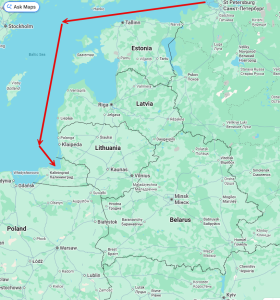
Possible route between St Petersburg & Kaliningrad