Pepe Escobar: Shenzhen – How an imperfect G3 buried the G1
 by Pepe Escobar [11-20-2026] Pepe Escobar(bio).
SHENZHEN – As graphic demonstrations go, the full force of the flow of History was on display this week in China’s tech capital. This is where the multinodal, multipolar future was playing out in more ways than one: economic growth, security, supply chains, non-stop movement all across the geopolitical chessboard.
The West – discombobulated, arrogantly posturing – wasn’t at the table in Shenzhen. And not even on the menu. Its sorry task didn’t even include collecting a few crumbs out of the historic Big Three banquet. Away from Shenzhen, the Empire of Piracy made sure that US weapons manufacturers remain the European suppliers of choice, and that Europe pays their bills. That’s it.
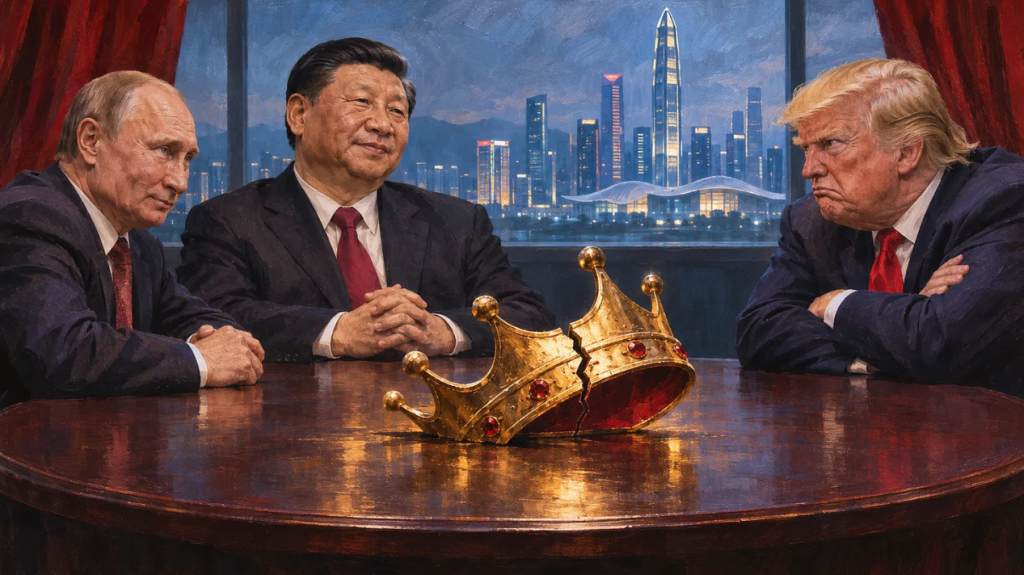
The image registered across the Global South – and most of the Global North. In a nutshell, POTUS was forced to sit face to face, hardly as an equal, with the leaders of a strategic partnership that the US has been relentlessly trying to isolate, sanction and subjugate.
The elaborate ritual had to take place in the supremely ritualistic Middle Kingdom, with the latest Celestial Emperor as host, in a former fishing village that China turned into a tech and industrial Valhalla in less than four decades while Exceptionalistan was busy waffling over the end of History.
Everything about how Shenzhen metastasized from an export processing hub into a global innovation powerhouse is staggering. In 45 years, the economy of this former Special Economic Zone (SEZ), half the size of Singapore, has grown more than 14,300-fold.
Shenzhen is now the world’s 31st-largest economy. The Shenzhen–Hong Kong–Guangzhou cluster remains the world’s No. 1 innovation hub. And more than 90% of innovation breakthroughs are homegrown, thanks to R&D institutions, researchers and spending concentrated in local strategic emerging industries.
Silicon Valley takes three months to build a prototype. Shenzhen does it in three days. And if you want, you can start mass-producing it right away.
How APEC and Shenzhen connect
Oh, those mountains so cherished by Chinese watercolors. Here’s President Xi – during the first key bilateral at APEC, even before the arrival of Trump: “Under the firm leadership of President Putin and myself, China-Russia relations have remained as steady as a mountain.” Also on Day One, Putin officially declared the abject failure of Western sanctions on Russia.
That was the fifth Xi–Putin meeting of 2026 alone. Their bilateral meeting set the stage for the trilateral.
Such irony that all that happened at APEC. The Asia-Pacific Economic Cooperation (APEC) forum, founded in Australia in 1989, is an American concoction. It brings together 21 economies: the United States, China, Russia, Japan, South Korea, Australia, New Zealand, Canada, Mexico, Chile, Peru, Indonesia, Malaysia, Singapore, Thailand, Vietnam, the Philippines, Brunei, Papua New Guinea, Hong Kong, and Taiwan under the name Chinese Taipei.
APEC’s task was to regiment Asia-Pacific trade (no “Indo-Pacific”: a nonsensical Pentagon concept that nobody uses) into the proverbial US-led “free” trade system (it’s only free when we say so).
My first exposure to APEC was in 1994, the year I moved to Asia: that was in Indonesia, under Clinton 1.0, who was received like a rock star. Those were the days: the East Asian Miracle, as defined by the World Bank, in full swing, three years before the Asian Financial Crisis.
So APEC was all about deregulation, privatization, and opening every possible market to US capital, corporations and technology. APEC defined supply chains and always promoted the American model as a fact of nature. Call it the Americanization of Asia.
APEC 2026 in Shenzhen turned it all upside down – for good. Shenzhen is home to Huawei, DJI, Tencent and BYD. APEC was invented to contain China. What gobsmacked foreigners saw this week in Shenzhen was Chinese splendor positioned at the center of the tech world.
And there was Russia, China’s strategic partner, as the sidekick – despite zillions of sanctions and expulsion from SWIFT, the G7 and the Western financial system. By nominal output, Russia is now the largest economy in Europe: that is beyond intolerable for the EUro-elites bent on political harakiri. As Putin remarked almost gleefully, it was the dollar system that walked away from Russia, not the other way around.
China is Russia’s largest trading partner. The strategic partnership all but phased out the US dollar and the euro in bilateral trade. Russian Deputy Prime Minister Alexey Overchuk confirmed that 95% of bilateral trade is now settled in rubles and yuan. The Chinese Cross-Border Interbank Payment System (CIPS) is the backbone of the system.
So China and Russia went into the meeting with Trump in sync: two separate civilization-states acting as partners.
APEC’s real power is the APEC Business Advisory Council – where corporations sit with political leaders and draw up proposals on digital trade, data flows, AI standards, supply chain resilience and critical minerals.
Yet APEC 2026 in Shenzhen was not only about trade deals, the specter of tariffs, supply chains, and the digital economy. The three-way talks were mostly about Ukraine, the war on Iran, the Strait of Hormuz, denuclearization and a possible new security architecture.
The “mountain” effect – and the war on Iran
The sight of the Big Three in the room reflected a shift in the global center of gravity back toward the Asia-Pacific, which accounts for over 60% of global GDP and does more than 68% of its trade within the region. The impaired Sociopath-in-Chief – who most of the time looked way out of his depth – certainly would not have been able to answer the key question: whether the Hegemon will accept that it no longer writes the rules.
Trilateral optics also made it crystal clear that absolutely no major global issue can be settled without Eurasia’s top two powers, in sync through their strategic partnership. That’s gotta be the new operational logic. Euro-suicidals – who do not produce or build much – have only their own incompetence to blame.
On a more pedestrian level, the case can be made that Trump might have considered the possibility, face to face with Xi and Putin, of trying to turn the inevitable imperial decline into a sort of gentle descent, without having to blow everything up.
So once again, this was no Yalta 2.0. Beijing in fact does not like the Yalta metaphor because China was excluded at the time, with the old world “order,” now defunct, shaped by three men from the West.
What we had in Shenzhen was two victors – linked as a partnership – facing a semi-loser. Nothing in the underwhelming final statement shows that they managed to find – at least in this initial get-together – a path to prevent a world war.
It may be too early to call this setup the Shenzhen order – where power rests not only on the geopolitical chessboard but on tech advances in top strategic industries from robotics to AI. If this is certainly the death knell for the G1, it’s not yet the birth of the G3. Because a G2 – the US and China – still supersedes the G3.
Top Chinese analysts did get the nuance: more than a G3, what Shenzhen demonstrated is that none of these questions – Ukraine, Iran, nuclear weapons, AI governance or supply chains – can be settled without the Russia-China strategic partnership.
The Global South also got the picture: the reverse-Nixon strategy failed miserably from the start. Never in a zillion years could Trump sell a “deal” to Russia to isolate China. Shenzhen, for all practical purposes, killed it.
That mountain, once again. Xi: China-Russia relations are “as steady as a mountain, unmoved by wind or rain.” Kissingerian tactics pale beside big powers exercising true sovereignty.
Trump had bragged before arriving in Shenzhen that he wanted to end the US-Iran war – which he started – and discuss denuclearization (without including the death cult’s nuclear weapons).
So in the end Trump got no “deal” on Iran because the strategic partnership backs Tehran all the way. Moreover, Xi met Putin first, likened their relationship to a mountain and only then went to receive Trump at the airport. The mainstream media in the US and the rest of the fragmented West cannot possibly admit that the trilateral, for all practical purposes, was Washington admitting that Unilateral Hegemony is over.
It’s quite significant that Trump the Vociferator left Shenzhen without a press conference. That means, among other things, that Russia and China told him, in no uncertain terms, that he should end, via diplomacy, the war of choice he launched on Iran.
There’s no evidence the message was understood. After a glimpse of hope emerging from tech heaven, the dogs of war may be back to barking as early as this weekend.