Scott Ritter: Reflections of a Hypocrite, Part One: Defining the Problem
 by Scott Ritter [9-10-2026] Scott Ritter(bio).
A gathering dedicated to promoting the concepts of “Living with Dignity” exposed the author’s own hypocrisy when it comes to waging war.
Four the past five years, there has been an intersection between myself, the first week of September, and the Swiss-based Mut zur Ethik (“Courage in Ethics”) conference held in Sirnach, near Zurich, Switzerland, which brings together speakers from Europe and around the world to discuss pressing ethical, political, and human rights issues. In 2022 I participated via teleconference. In 2023 I had the honor to participate in person. In 2024 I went back to teleconferencing as a result of my passport being confiscated by the US government. And in both 2025 and the present year (2026) I once again had the honor and privilege of participating in person.
During each presentation I made, I represented myself as a reformed warrior, a former Marine whose previous addiction to war had been overcome through a recognition of the futility of violence and the therapeutic effects of embracing the humanity that existed in those whom I had previously cast as being my enemy.
I was sincere in every sense of the word—I had walked away from a military career after deciding I was better off learning how to live in peace with the Russian people than I was training to kill them in battle. I had a similar existential revelation after going to war with Iraq, and participating in the deaths of hundreds of innocent Iraqi civilians. I had the opportunity of getting to know them during the course of seven years on the ground in Iraq implementing the disarmament resolutions of the United Nations Security Council. After being conditioned to dehumanize both the Russian and Iraqi people, I found after meeting them I no longer had a desire to take their lives.
This was a theme I continued to promote during my scheduled presentation at the conference, where I spoke about the Battle of Karbala, and how understanding one of the foundational events in the theology of Twelver Shi’ism (which dominates among the Islamic faithful in present day Iran) could have pointed the United States away from embracing as gospel the notion that by killing the Iranian Supreme Leader, Ali Khamenei, and making him a martyr, we would somehow facilitate the collapse of the Iranian government. I spoke about my invitation to participate in the Arba’in pilgrimage, which marks forty days after Ashura, the day that Husain, the grandson of the Prophet Muhammed, was martyred, alongside most of his relatives and his small retinue, in the Battle of Karbala by the army of the Umayyad Caliph, Yazid.
“We went to war with Iran,” I said, “on the misguided belief that by killing Ali Khamenei, the Supreme Leader of Iran, we could cause the Iranian people to lose faith with their government, not understanding how this very act of murder would achieve the exact opposite. But, even worse perhaps, we went to war because we disrespected the Iranian people so much that we didn’t even bother to learn about those we defined as our enemies.”
I then asked that each of the attendees reflect on their lives, and how their lives interact with the lives of others, “especially those who look different from us, speak a different language, dress differently, worship differently. And,” I added, “if for a moment any of the things about these people makes you uncomfortable, take pause and reflect. Because if you allow these differences to divide you, if you allow a wall to be built that separates you, then you are well on the way to repeat the same chain of ignorance-laced mistakes that put my country on a path towards war with Iran.”
I reached the culminating moment of my presentation: “We all must confront our own Battle of Karbala. Next year I will embark on a journey to learn more about the Battle of Karbala. I will walk the 80 kilometers of Arba’in. I ask that each of you find the equivalent of the Battle of Karbala in your own lives. And join me on this long walk of discovery. Wherever it leads you. I cannot predict the destinations that such journeys will take you. But I can say, with the strongest possible conviction, that you will arrive with dignity. And that’s the key to living a life with dignity.”
When I first conceived and wrote this presentation, I believed every word.
But at the time I delivered it, I was not as certain.
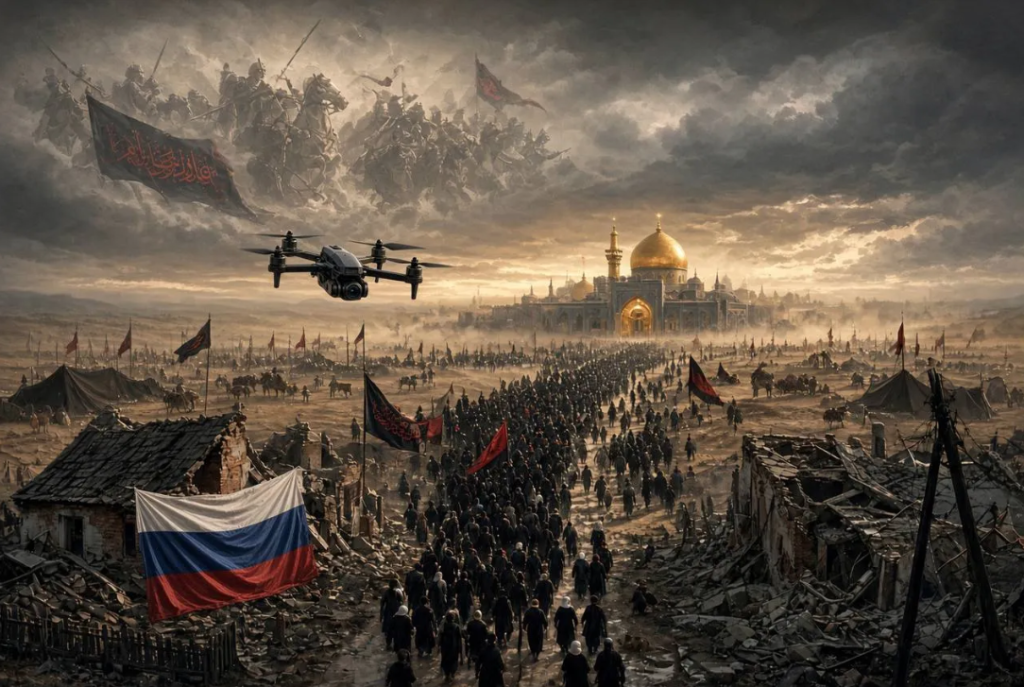
On the first night of the conference, I was asked to make a presentation about the visit I had made to the zone of the Special Military Operation in June of this year. I entitled the presentation “A Trail of Tears”, after a series of articles I had written about my experiences. The June experience had left me deeply troubled and overcome with emotion, especially when it came to the loss of life amongst the children of the regions impacted by the Special Military Operation.
“I left the Special Military Operation physically alive but morally crushed by what I had seen and experienced,” I told the assembled audience. “While people outside the Special Military Operation attend to the affairs of their blissful existence, the people who reside in the territories encompassing the Special Military Operation go to bed each night listening to the sounds of active air defense and live each day under the shadow of a looming drone attack.”
Then I got down to business. “People of conscious,” I continued, “cannot be allowed to live their respective lives in ignorance of this reality. And so, here I am, a witness to events that cannot be ignored if we are to retain anything that constitutes the essence of what it means to be human. I have looked into the eyes, shaken the hands and touched the souls of too many people to abandon them now that I am safely removed from the dangers that mark their daily existence. I have seen the graves and memorials of too many children to disgrace their collective memories by failing to tell their stories in as compelling fashion as possible.”
The “Trail of Tears” had been my Russian Arba’in, my pilgrimage of truth.
My “Battle of Karbala.”
And I cannot say that I finished it with the kind of dignity the organizers of Mut zur Ethik envisioned when they asked me to speak.
I did not emerge from the journey overcome with a desire for peace.
Instead, the “Trail of Tears” awakened my inner demons, emotions I had long sought to suppress, and which I had convinced my Swiss hosts that I had, in fact, had suppressed.
But I had not.
I finished the “Trail of Tears” wanting to kill every Ukrainian son of a bitch responsible for flying drones into the dormitories of sleeping college student, killing innocent mothers and their newborn children, murdering and terrorizing innocents for the simple crime of wanting to speak their native Russian language and practice their Orthodox faith.
And I was aware of this reality when I delivered my Battle of Karbala address.
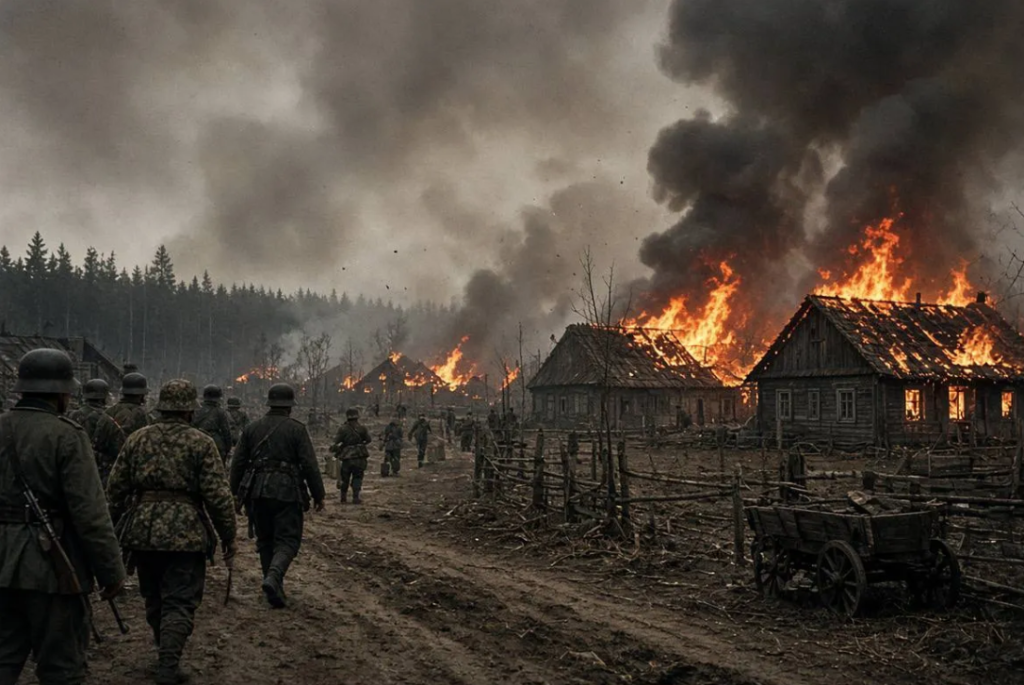
My internal crisis of confidence was furthered by two presentations made at the Mut zur Ethik conference, one by a senior Belarussian diplomat, Aleksandr Levanovich, and the other by a respected veteran German reporter, Dirk Pohlman. Both focused on the crimes committed by German forces during the Second World War against Belorussia.
These acts of mass murder were not incidental to a larger conflict, but directed acts of violence conducted in support of an official policy of extermination— Generalplan Ost (General Plan East.) This plan was the brainchild of Konrad Meyer-Hetling, a German professor-turned-Nazi who, in early 1940, while working for the Reich Security Main Office, produced the initial version of Generalplan Ost, which called for the “Germanization” of Eastern Europe. Meyer-Hetling’s plan called for the immediate removal of 80-85 percent of Poland’s population and 50 percent of the Czech Republic’s population, as well as the later deportation of 85 percent of Lithuania’s population, 75 percent of Belarus’ population, 65 percent of western Ukraine’s population and 50 percent of Latvia and Estonia’s populations. Meyer-Hetling created a racial hierarchy within Generalplan Ost which governed how exactly the targeted populations were to be “removed”: those of Slavic origin were “undesirable” and were to be moved into Siberia. Jews were to be “totally removed,” meaning killed. The rest of the people in Eastern Europe were to be enslaved, “Germanized” or killed.
Based upon their demographic composition, the people of Belarus were intended to be wiped off the face of the earth. Speaking at a meeting on March 30, 1941, Hitler declared, “We are obliged to exterminate the population—this is part of our mission to protect the German population. I have the right to remove millions of an inferior race that breeds like vermin.”
German soldiers charged with implementing Generalplan Ost were instructed, via the “Check-list of the German soldier” that “You have no heart or nerves; they are not needed in war. Destroy in yourself pity and compassion—kill every Russian, do not stop, if you it is an old man or woman, girl or boy, kill, you will save yourself from death, secure the future of your family and become forever glorified.”
One such soldier was Wehrmacht Sergeant Johannes Gerder. He was in a German infantry unit that had been placed in strategic reserve following the initial advance into the Soviet Union. But the German High Command found ways to keep Gerder and his fellow soldiers occupied. Here are two entries from the diary Gerder kept during this period:
“August 25. Throwed a grenade in the house. The house burns quickly. The fire moved to another house. It was a beautiful sight! People cried, and we laughed at tears. In this way, I have already burned 10 villages.”
“August 29. We grabbed dozens of people from a village and drove them into the cemetery. And they dug the grave wide and deep. The Slavs cannot show mercy or it cannot be. These cursed people are like an alien creature for us.”
During the German occupation of Belorussia, between 1941 and 1944, Nazi forces carried out more than 140 punitive expeditions against the Belorussian people, where they destroyed 5,454 villages, either partially or completely. The major cities of Belorussia suffered between 80-90% destruction.
Fully one-third of Belorussia’s prewar population of 9.2 million people perished during the Second World War.
I listened to Ambassador Levanovich recite the facts.
And I watched as Dirk Pohlman recounted how he, as a German citizen, investigated the German crimes committed against the Belorussian people.
The crimes were many.
Once of the crimes mentioned by Dirk was the use of children by German doctors as sources of blood for wounded German soldiers.
I had seen the movie “The North Star”, a Hollywood film made in 1943 about the German occupation of Ukraine, where such a scenario unfolded.
At first I thought it was just typical wartime propaganda, designed to generate hate against a designated enemy. But Dirk’s recitation of this same scenario as fact prompted me to dig a little deeper.
And I discovered the story of Krasny Bereg, in the Zhlobin district of the Gomel region of Belorussia. It was a fairly large village in which several agricultural enterprises operated.
It had its own school to educate the children of the workers.
On July 5, 1941, Krasny Bereg was occupied by the advancing units of the Wehrmacht. In one of the old landowners’ estates, the Nazis set up a military hospital, which grew into one of the largest transfer points for wounded German soldiers on the territory of Belorussia.
For the first year and a half of the war, Krasny Bereg received wounded German soldiers and officers. By 1943, however, the losses of the Wehrmacht outstripped the German military’s ability to provide blood for transfusions. The German doctors turned to a children’s concentration camp situated on the outskirts of Krasny Bereg, where children from the town and surrounding settlements had been forcibly located. The Germans culled out children between the ages of 8 and 14—it was at this age that the human body develops at the most rapid pace, and as such their blood has the strongest properties. Special attention was paid to girls, as they most often had the first group of blood possessing a positive Rh factor, which is universal.
After undergoing a medical exam to make sure the potential doner was disease free, the “clean” children were then used as sources of blood for wounded German soldiers up to the point of death, after which their bodies were disposed of through cremation.
Over 2,000 Belorussian children were murdered by the Germans in this fashion, some at the hospital in Krasny Bereg, others shipped out to Germany to be drained of their blood.
One of the children scheduled to be shipped out was Katya Sussana.
At the memorial that has been built in Krasny Bereg to honor the children who lost their lives during the German occupation there is a copy of a letter written by one of the girls selected to be transferred to Germany.
Dear Papa, I turned 15 today. If I had met me now, I would not have recognized him. My eyes sank, pigtails cut my head, hands dried, look like a rake. The number, like that of a criminal, is itself thin, like a skeleton, and salty tears in the eyes. I cough up blood.
Do you remember, Papa, when two years ago I turned 13, which were good times? You then told me: ‘Grow, daughter, we are very happy.’ I played a gramophone, my friends congratulated me on my birthday, and we sang our favorite pioneer song.
I will not go to this thrice-damned Germany. I decided that it was better to die in my own side than to be trodden in the damned German land. Bequeath, Papa, to avenge my mother and me. Goodbye, good Papa. I am leaving to die. Your daughter Katya Susanina.
The date of the latter was March 13, 1943.
I read this letter, and I thought of the children who are being murdered as we speak by the ideological progeny of these very Nazis who fight against Russia in Ukraine.
At the end of the Second World War, 18 Germans were put on trial in Minsk for crimes committed during the occupation of Belorussia by the Germans. On January 29, all 18 were found guilty; four were given long sentences, and the remaining 14 were hanged in the horse racing venue of Minsk before a crowd of more than 100,000.
The trials were carried out in accordance with an order of the Presidium of the USSR Supreme Soviet Decree No. 39, dated 19 April, 1943, entitled “On the penalties for the Nazi villains responsible for murdering and torturing Soviet civilians and captured Red Army personnel, for spies, traitors among Soviet citizens and their accomplices”
Every year on April 19, in all educational institutions of the Russian Federation, the “United Action Day” is held in memory of the genocide of the Soviet people during the Great Patriotic War. The purpose of holding the United Action Day is, according to the Russian government, “to preserve the historical truth about the crimes of the Nazis and their accomplices against peaceful Soviet citizens during the Great Patriotic War in the occupied territory.”
One can only hope that the Russian government prosecutes those in Ukraine responsible for the ongoing murder of the children of the Donbas, Zaporozhia, Kherson, Crimea, and all areas of the Russian Federation that have been victimized by Ukrainian terror, with the same dedication as they did the Nazi criminals that were hanged in Minsk and elsewhere.
You can’t hate these people enough.
My anger at those in Germany who had committed the crimes of mass murder against the people of Belorussia, and the criminals in Ukraine who continue to murder the innocent civilians who live in the territories encompassing the Special Military Operation, was still boiling over when the next speaker at the Mut zur Ethik conference took the stage.
Cara MariAnna is the wife and partner of Patrick Lawrence, the well respected independent journalist who previously worked as a correspondent and columnist overseas for nearly thirty years, chiefly for the Far Eastern Economic Review, the International Herald Tribune, and The New Yorker. Cara is is herself an accomplished writer who pens “essays and reports from and about the West Bank based on travels and encounters with Palestinians.”
Her presentation was entitled “Peace between the Sword and the Neck”, taken from an exchange between Ghassan Kanafani, the famous Palestinian author who, in 1967, became the spokesperson for the Popular Front for the Liberation of Palestine (PFLP), and Richard Carleton, a reporter with the Australian Broadcast Company.
“Why won’t your organization engage in peace talks with the Israelis?” Carleton asked.
“You don’t mean exactly ‘peace talks’, Kanafani replied. “You mean capitulation. Surrendering.”
“Why not just talk?” Carleton retorted.
“Talk to whom?” Kanafani asked.
“Talk to the Israeli leaders,” Carleton responded.
“That’s kind of conversation,” Kanafani observed, “between the sword and the neck you mean?”
Kanafani asked what the PFLP could talk about with the Israeli leadership.
“Talk about the possibility of not fighting,” Carleton replied.
Kanafani was taken aback. “Not fighting for what?”
“No fighting at all,” Carleton replied. “No matter what for.”
“Yaʿnī,” Kanafani answered. “People usually fight for something and they stop fighting for something. So you cannot tell me even why should we speak about what—or talk about stop fighting, why?”
“Talk to stop fighting,” Carleton said, “to stop the death and the misery, the destruction and the pain.”
“The misery and the destruction the pain and the death of whom?” Kanafani queried.
“Of Palestinians,” Carleton said. “Of Israelis. Of Arabs.”
“Of the Palestinian people who are uprooted, thrown in the camps, living in starvation, killed for twenty years and forbidden to use even the name ‘Palestinians’?” Kanafani asked.
“Better that way than dead though,” Carleton replied.
“Maybe to you,” Kanafani stated. “But to us, it’s not. To us, to liberate our country, to have dignity, to have respect, to have our mere human rights is something as essential as life itself.”
Kanafani’s obituary noted that “He was a commando who never fired a gun, whose weapon was a ball-point pen, and his arena the newspaper pages.”
Ghassan Kanafani was assassinated by the Israelis in 1972.
As Cara pointed out in her presentation, nothing has changed in the more than 50 years that has transpired since Kanafani’s death. While I don’t have a copy of her presentation available to quote from, I have familiarized myself with Cara’s writing on the issue of Palestinian rights. “The ethnic cleansing of the West Bank continues at an increased pace and the world remains silent,” Cara wrote in February 2026, “as it remains silent as the genocide in Gaza continues unabated. Israel’s project to steal all Palestinian lands in the West Bank proceeds. Settler attacks on Palestinians remain a daily occurrence. Palestinians are arrested and disappear into Israel’s sprawling network of torture facilities…The story everywhere is the same throughout the West Bank. Israel continues to tighten the noose around villages to force Palestinians to flee or relocate into urban enclaves which are encircled by settlements and controlled by roadblocks. The apartheid state controls every inch of every Palestinian’s movements.”
Cara’s recent travels, conducted shortly before her appearance at the Mut zur Ethik conference, put her in contact with the citizens of the farming village of al–Mughayyir, northeast of Ramallah in the central West Bank. Cara had made it a point to do more than simply observe what was happening to the Palestinian people. She became immersed in their lives.
“I received word just yesterday,” Cara wrote recently, “from a friend who reported by email that settlers had destroyed a small school in the South Hebron Hills—a school he and many others had helped to build in 2018. The photos he sent were devastating. This is someone I spent days with while in al–Khalil, driving with him out into the field, observing his work and the many projects he supports. His personal motto: ‘They destroy, we rebuild.’ Supporting communities in this way is an act of resistance and survival.”
It was as I listened to my village guide, a hardworking olive grower and community leader, making arrangements for a therapist to visit al–Mughayyir so that the children I had just met might have a minimal amount of psychosocial care, that I determined to raise money so the kindergartners could have a playground. These kids, who routinely experience levels of violence no human being should ever be exposed to, need and deserve to have moments in their lives when they can laugh and play.
It is equally important that the people of Palestine know that they are seen and not forgotten. Enabling the villagers of al–Mughayyir to provide a playground for their youngest schoolchildren sends a powerful message of support and solidarity—and love. Already the community is deeply grateful for the work my translator and I have been doing to get this project off of the ground.
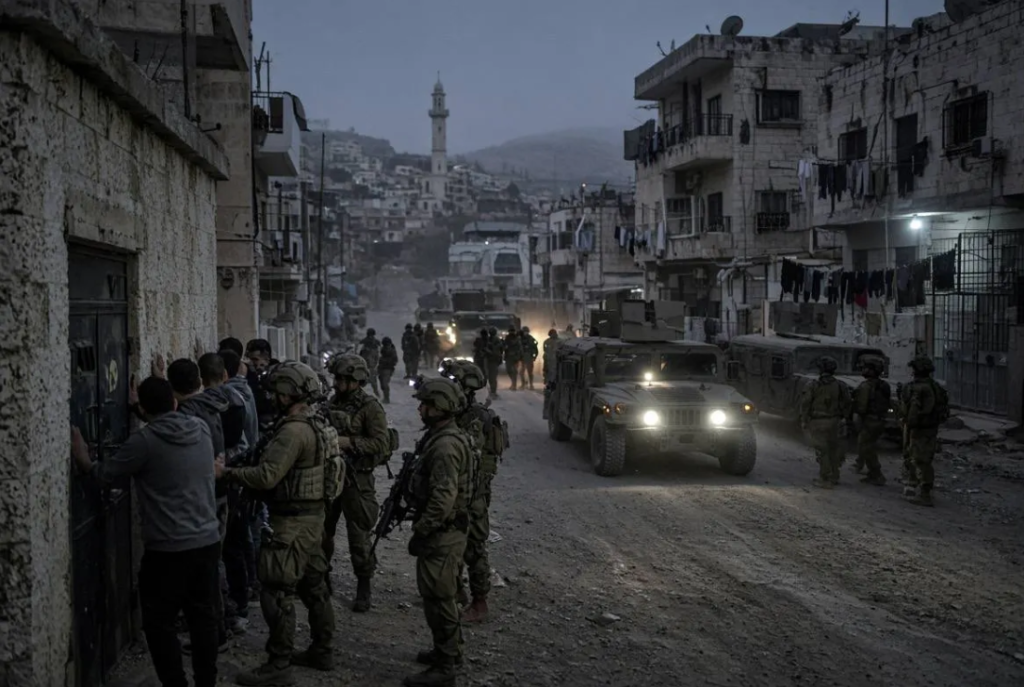
Just before Cara arrived in Switzerland, she received word that Omar Mohammad Naji al-Nassan, 19, and Khalil Rasem Khalil Shahada, 16, were shot dead by the Israeli army in the village of al-Mughayyir.
Israeli settlers had tried to steal sheep from residents of al-Mughayyir, and were confronted by the village’s residents. The Israeli Army surrounded the village before sending in a raiding team. Snipers had set themselves up inside buildings in the village. When the villagers protested against the incursion of the Israeli forces into their neighborhoods and homes, the snipers opened fire, killing Omar and Khalil.
Cara closed her presentation by showing photographs of the two boys, and announcing their deaths.
As she left the podium to return to her seat, Cara was visibly trembling. The impact the loss of these two boys had on her was crushing to witness.
You cannot hate the Israelis responsible for the deaths of Omar and Khalil, and all the Palestinian victims of Israeli genocidal behavior, enough.
The last night of the Mut zur Ethik conference found many of the speakers gathered together with the organizers around a dinner table discussing what the main take aways were from the conference for each participant. I arrived late, having been out for a few beers with a Swiss officer and his Belorussian wife I had befriended during my previous travels to Switzerland. I continued to be troubled by the extent of my hypocrisy, posturing as a man of peace before this distinguished body of peace-loving people, while secretly harboring a desire to inflict deadly violence on those persons capable of committing the crimes I witnessed in the Donbas, the crimes committed by the Germans in Krasny Bereg and the thousands of other villages and hamlets destroyed under the Nazi boot, and the dead boys from al-Mughayyir.
I had decided not to speak out about my inner turmoil, not wanting to spoil the mood of those who had put so much effort into this conference and all the others I had participated in, and who had put so much faith into the credibility of my presentations and the belief system they thought underpinned my words. But the direction the conversation was taking prompted me to break my vow to myself.
I confessed my sins.
As much as I wanted to be a man of peace, I noted, I was programed for war.
When confronted with acts of violence against innocents, my default mode was to close with and destroy.
But I also recognized the reality that all war accomplishes is to create opportunities for more death and destruction. War never brought true peace, only a brief lull between renewed fighting. My own experience in Iraq proved this—we defeated the Iraqi Army in 1991, only to invade Iraq in 2003, and remained trapped their for the next two-plus decades.
War was not the solution, I observed. But it was the only solution I knew.
I was pleasantly surprised that the organizers of Mut zur Ethik took my confession of hypocrisy in stride.
I was taken aback, however, with the level of pushback I received from some of my fellow attendees.
I was asked if I thought that the world was better because of the outcome of 1939-1945 (basically the Second World War.) I was asked if I believed in the notion of a “Just War.” And I was asked if I thought perhaps we all loved peace too much.
I relied that the events of 1939-1945 did not take place in a historical vacuum, and that whatever benefits we imagined were derived from that conflict were soon dissipated by what came after, and disproved by the events of the present day, where Nazis ran wild in Ukraine and Israelis committed genocide in Gaza.
I noted that I had fought in a so-called “Just War” (the Gulf War of 1991, sanctioned by a Security Council resolution and a Congressional vote authorizing the use of force, and triggered by an act of aggression perpetrated by Iraq. And I concluded that to the tens of thousands of Iraqi civilians who lost their lives in this so-called “Just War”, the justification for their deaths was irrelevant—they were dead, and their homes destroyed.
War, I said, was simply war. It was about humans killing humans, nothing more.
And I concluded that the problem wasn’t that we loved peace too much.
It was that we loved war too much, and peace too little.
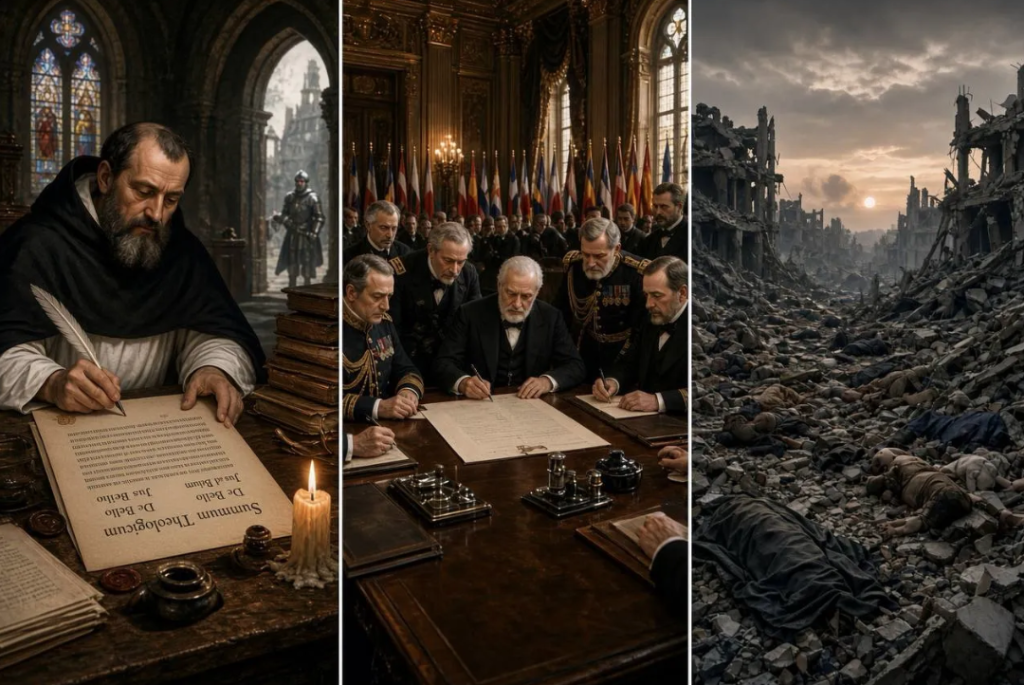
My replies generated real anger and even derision on the part of my questioner. How dare I call the Gulf War of 1991 a “Just War”. Was I not familiar with Saint Thomas Aquinas? And what about the right of resistance? Was that not a just cause for inflicting violence?
I was schooled in the practical application of the Law of War—the Geneva Conventions, so to speak, which had at their roots the very principles of “Just War” Aquinas espoused. The just war tradition speaks to the morality of the use of force in two parts: one, when it is right to resort to armed force (jus ad bellum), and two, what is acceptable in using such force (jus in bello).
I applied the principles of Just War to everything I did when I was at war with Iraq.
Truly I did.
And yet, at the end of the day, my actions contributed to the deaths of some 408 innocent women and children in the bombing of the Amiriyah bomb shelter, and potentially scores more in the bombing of sites believed to be housing Saddam Hussein.
Dead is dead, whether or not one could articulate jus ad bellum and/or jus in bello.
In this light, I noted that the end result of resistance against overwhelming odds was simply dead people and destroyed homes—Gaza proved that.
Let it suffice that my words were not well received.
Afterwards I had pause to reflect on the argument made in defense of “Just War.” The concept itself is derived, at least in its modern manifestation, in the Summa Theologica of Saint Thomas Aquinas. Here Aquinas asserted that three requirements must be met for any conflict to be considered just. First, the war must be waged upon the command of a rightful sovereign. Second, the war needs to be waged for just cause. And third, the intent of those waging a just conflict must be to do good and avoid evil.
Aquinas’ work later served as the moral foundation for the Geneva Conventions that underpin the Law of Armed Warfare as is currently practiced today.
Just-war theorists espouse to believe in the moral abhorrence of war, and yet are ready to embrace the notion that there are times when war is necessary. They then engage in mental gymnastics to distinguish between what it justified and unjustified when it comes to the conduct of organized warfare, and further this moral psychological Pilates by conceiving limits to the use of force, including the most absurd notion of how to make the act of organized death that is war more humane. And then, in the most Orwelian of twists, they seek to justify this embrace of death by pretending that it is all done in the interests of establishing a lasting peace and justice.
This may impress in the halls of academia, or the backrooms of diplomacy where such matters are discussed by men with failing eyesight and bent backs. But it is meaningless in the actual conduct of war.
War is organized mass murder. My job in the Marines was, literally, to kill as many bad guys as possible. If they raised their hands in surrender, I stopped killing. If not, they all died.
And that mentality enabled me and others like me to direct our respective death-dealing capabilities toward military problems that had an intersection with civilian life. The end result were the so=called “collateral deaths” that war inevitably brings with it.
All excused away as “military necessity.”
One of the main problems with Just War theory is that it makes certain assumptions that simply don’t exist in reality—that mankind is driven by moral concerns which help distinguish between right and wrong, just and unjustified.
But the reality is that since time immemorial, man has been programed to kill.
And when man organizes himself into nation states, the collective is programmed to kill on a scale commensurate to the number of resources gathered for that purpose.
Peace is not the natural state of mankind.
War is.
Any honest examination of history will prove this point. We may come into this world innocent, but we leave it soaked in the sins committed by the collective to improve our lot in life.
This has been true since the time of Able and Cain.
Some speak to the eponymous Peace of Westphalia (1648) that allegedly broke out at the end of the 30-years War (or 80-years War, depending on whom was killing whom) as an example of man’s ultimate desire for peace.
What an absurdity.
The Westphalian Peace simply took Europe’s main empires and their greedy war-inducing schemes out of Europe temporarily, and sent them across the oceans to engage in business of building their respective colonial empires, where they slaughtered their fellow humans with abandon.
And, less than 100 years later, Europe was back at war with itself, and has been ever since.
All wars could have been avoided—that is the lesson of the Westphalian Peace. We simply don’t realize this inevitable conclusion until after we have punched each other silly. And once we have rested and regrouped, we forget the lessons we previously learned and once again resort to violence as a means of resolving disputes.
Because we are programed from birth by our respective societies to kill.
This is the hard truth I put before the organizers and attendees of the Mut zur Ethik conference that evening.
And that, in the face of evil such as exists in Ukraine and Palestine, killing would seem to be the only acceptable solution.
Except for one thing: it solves nothing.
War begets war.
Death begets death.
Killing begets killing.
The cycle will never end.
I was a hypocrite to believe peace to be possible, knowing that deep inside I was programed by my country to revert to violence when confronted with issues my society defined as being existential in nature.
But the real problem wasn’t that I was programed to kill.
I was good at it.
It excited me.
War made me whole.
That was the problem.
I was addicted to war, and the concepts of peace were not strong enough to break this addiction.
Like most addicts, I knew what I was doing, and what I embraced, was wrong.
Even evil.
But war was the default solution to the problems that manifested themselves daily, like bottles of alcohol hidden away in the corners of a home, waiting to be “discovered” by the alcoholic looking for solutions to the problems that haunted his life.
I may have been a hypocrite.
But at least I was honest enough to admit it.