Scott Ritter: Russia Should Seek to Activate “The Sanctions Shield”

Russian President Vladimir Putin (left) shakes hands with US President Donald Trump (right)
by Scott Ritter [1-5-2026] Scott Ritter(bio).
(RAD: This is a very well thought out analysis of the dynamics between the US & Russia. It is also based upon Scott's rethinking of what the US is up to. Namely, the US desires ousting Putin and the collapse of Russia and is attempting to use financial greed to accomplish this & is being turbocharged by Trump. This has been a long term objective going back to the end of WW2 & reinforced after the collapse of the Soviet Union in 1991. Pay close attention to how the US has used this strategy against other nations. Based upon what I've learned over recent years, Scott is right. — RAD)
Keeping sanction in place may be Russia's best chance at survival.
Forces within the US and Russia today openly advocate for the lifting of economic sanctions targeting Russia. But these sanctions are not designed to be lifted for the benefit of Russia, but to exist as a tool designed to bring about the collapse of Russia. The hope of improved economic relations brought on by the end of sanctions is used as a means of leveraging greed and corruption inside Russia in order to bring down the government of President Vladimir Putin. Russia’s best option is to stop advocating for the lifting of sanctions and instead use the existing sanctions as a shield to protect Russia from the inherently corrupting influence of western economies.
I used to hold that sanctions as policy was in fact a statement that there was no real policy in place for the given problem, and that sanctions were simply a mechanism for buying time to consider the options. But the longer I have had to observe US sanctions policy unfold over time, the more I realize that there is, in fact, a method to the madness. Whether this newly discovered intent was in existence when the wide-spread sanctioning of nation states was first employed as a major pillar of US foreign and national security policy, or evolved over time, isn’t the point. The reality is that today sanctions underpin policies of targeted regime change and serve as the primary facilitating agent of such policies.
The primary indicator for this realization is that while sanctions portend to target behavior or policies the United States wishes to see altered, the sanctions are almost invariably tied to a person or persons in power. This linkage almost inevitably means that the desired behavioral modifications sought through sanctions cannot be achieved so long as the targeted persons remain in power.
But such linkage in and of itself does not a policy make. To be effective, a policy must be implementable. And here sanctions bring with them an inherently implementable weapon—human greed. The conventional thinking was that sanctions were designed to compel change from within the targeted nation—punish the people, the people will put pressure on their leadership to effect the necessary changes. But this approach did not achieve the desired results—the case of Iraq stands out, where the regime of Saddam Hussein withstood more than a decade of stringent economic sanctions before being removed by military force.
But lately sanctions have taken on a different character—a commodity, so to speak, part of a transactional approach to policy making which has come to maturity during the second iteration of the Trump administration. Trump has been a master when it comes to employing this new commodity-based approach to sanctioning, slapping sanctions onto a targeted nation, and then holding out the possibility of these sanctions being lifted if certain behavioral benchmarks are met. “We can do business together” has become the mantra of Trump 2.0, a promise of mutually beneficial economic relationships predicated on one side—the sanctioned side—yielding to the demands of the other.
The transactional relationship, however, is never allowed to reach fruition. The promise of economic largesse is instead held hostage to behavioral alterations that cannot be attained because they are linked to the personal and/or political credibility of the targeted personalities named in the sanctions. But the transactions were not designed to enrich the targeted individuals, but rather the class of political and economic elites for whom the targeted individual(s) relied upon for their continued viability as the leader of the targeted nation.
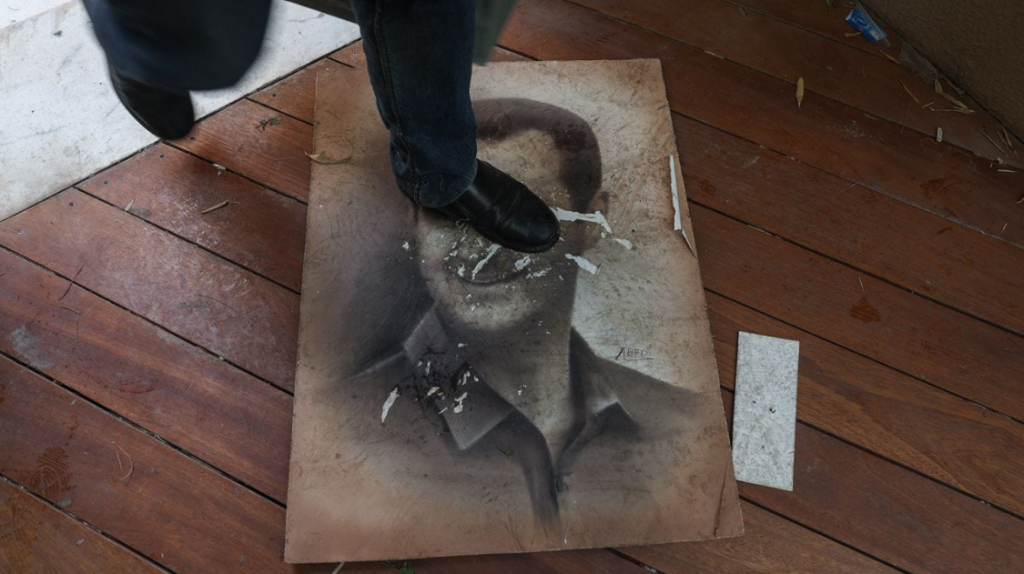
Syrians step on the portrait of former President Bashar al-Assad
The goal of these new regime-change sanctions is to create leverage inside these elites that can be manipulated by the promise of personal fortune if the impediment to this utopia were only removed from power. There is reason to believe that the promise of economic assistance from the Arab League combined with the lifting of stringent US sanctions created the opportunity for Syrian elites to be bought off, abandoning the former President of Syria, Bashar al-Assad, to the wolves when Islamic forces attacked in November 2024.
The recent abduction of Venezuelan President Nicolas Maduro by US forces likewise suggests that there was a significant amount of betrayal by Venezuelan political and economic elites brought on by the promise of the lifting of sanctions against Venezuela once Maduro was removed from power.
Likewise, in Iran President Pezeshkian’s stated objective of wanting better relations with the West, inclusive of economic interaction keyed to the lifting of sanctions, created a certain level of societal expectation which was weaponized by the West, linking the inability to lift sanctions until the Iranian government changed fundamental policies, such as those related to their nuclear program. These Iranian elites, having already begun to spend their new-found wealth in their imaginations, were easy pickings for foreign intelligence services looking for vectors of societal unrest linked to the removal of the Iranian Supreme Leader, Ayatollah Khameini, from power.
But the biggest regime change target of them all is Russian President Vladimir Putin. Donald Trump has made the lifting of sanctions and the renewal of US-Russian economic projects one of his highest priorities—after the ending of the Russian-Ukraine conflict on terms acceptable to Donald Trump. Trump has allowed a dual-track of negotiations to proceed simultaneously, the first involving setting the terms of conflict resolution, and the second focused on the economic benefits that would accrue once the war with Ukraine ended.
The problem is that Trump has no intention of agreeing to terms that would be acceptable to Russia, and every intention of continuing to impose targeted sanctions designed to impact various political and economic elites surrounding Russian President Vladimir Putin. Trump has made it clear that he is personally unhappy with President Putin, implying outright that any continuation of existing sanctions and/or issuing of ne sanctions is the fault of the Russian President and no one else.
The hope attached to this methodology is that by dangling the possibility of lifting sanctions in front of these elites, they can be persuaded/influenced to exert pressure on the Russian leadership to change policy goals and objectives or, failing that, to change leadership.
Given everything I have analyzed over the course of the past several days, I am convinced now more than ever that the Trump policy toward Russia is not normalization, but regime change, and that economic sanctions are not viewed as something that is transitory, but rather something that serves as a permanent fixture of policy designed to create the potential for regime change. There are zero advocates for the genuine normalization of relations on Trumps’ innermost circle of advisors. Steve Witkoff, the former New York real estate broker turned special envoy, does not make policy, but rather furthers the possibility of better economic relations once sanctions are lifted—which, of course, they never will.
Marco Rubio, the dual-hatted Secretary of State and National Security Advisor, is staunchly anti-Putin. Scott Bessant, the Secretary of Treasury, believes that Russia can be brought to its knees using sanctions. And John Radcliffe, the Director of the CIA, oversees an agency that has sought the demise of Vladimir Putin and Russia since the fall of Boris Yeltsin.
There are zero advocates for a truly mutually beneficial relationship between the US and Russia in the Trump cabinet today. A relationship built on transparency and mutual trust is impossible so long as one party is actively seeking the strategic defeat of the other.
The strategic defeat of Russia continues to be the policy of the United States.
And economic sanctions are the primary tool being used to achieve this result.
Gone are the days of calling Russia out as the principal opponent of the United States. That action only solidified the United States as an enemy in the minds of those Russians the United States seeks to bring over to our side.
Instead, the United States, by publishing a National Security Strategy document that lists Russia as a force of strategic stability, creates the notion that the path has already been cleared for a revitalized relationship born on the principle of mutual benefit.

Artist’s conception of the Russia-US tunnel promoted by Kirill Dmitriev
But the US-Siberian tunnel that Kirill Dmitriev is fond of promoting isn’t designed to bring American wealth to Russian shores, but rather to extract Russian resources on terms unilaterally beneficial to the United States. Yes, the United States desires a time when sanctions can be lifted, and US businesses can return to Russia. But only on terms acceptable to the United States, and these terms cannot exist in an environment where Russia operates as the geopolitical equal of the United States. Vladimir Putin has spent 25 years leading Russia out of the ruins of the decade of the 1990’s. It is the goal and objective of the United States to return Russia to that period, where Russian nationalism has been subordinated to Western commercialism, where Russian culture and traditions are seen as an expression of inferiority in the face of all that the West can offer.
A new Trump Tower, not the towers of Moscow Center, would be the landmark of Moscow if Donald Trump had his way, with all that entails.
But in the case of Russia sanctions are a double-edged sword. The combined impact of the US-European sanctions is the near total isolation of Russia from the western economy. If Russia continues to play the game of pretending there will be better times ahead once these sanctions are lifted, it is just a matter of time before human greed and CIA money find common cause, and Russia finds itself wracked by internal political disputes designed to weaken it and its leadership.
Sanctions, simply put, are not a path toward prosperity, but a highway to hell.
Russia can isolate itself from the negative consequences of the Trump sanction game simply by refusing to engage on any discussion that doesn’t have the immediate, unconditional lifting of economic sanctions as the core objective. There can be no quid pro quo, no phased easing out—nothing. Anything that creates conditions for the lifting of sanctions provides the US the leverage it needs to start corrupting segments of Russian society, to turn them against the Russian government.

Philosopher Professor Alexander Dugin
None other than the esteemed Russian philosopher, Alexander Dugin, agrees that Russia faces such a threat today. “Look,” he recently wrote, “friendly regimes and forces are collapsing one after another. Of course, we’re reacting and trying to take advantage of the general crisis of globalism, but we’re missing a lot.
It’s perfectly clear, and this has been confirmed by events in Syria, Iran, Lebanon, and now Venezuela, that over the past decades, the West has created spy networks within the highest leadership of all countries. I think even China is no exception. And at the right moment, they activate to betray the supreme power. Such a network simply cannot fail to exist in Russia. It would be logical for it to be the source of systemic sabotage and the slowdown of all those processes that must be conducted at a completely different speed to effectively defend and strengthen our sovereignty. And these agents can be found anywhere, including in circles and departments where we least expect them.”
Dugan is right—these networks exist in Russia today. The point of vulnerability which is exploited most effectively by the West is the greed that comes with the unfulfilled desires of those who have bought into the notion of the West serving as the source of Russia’s economic wellbeing.
The sanctions against Russia were specifically crafted to isolate Russia from the West and, in doing so, create the impression that Russia’s economic woes could be resolved simply by creating the conditions under which these sanctions could be lifted.
But at what cost?
The West does not seek to live side by side with a rejuvenated Russia. Europe has made it clear that a Russia that stands on its own two feet is deemed a threat, and much be brought down.
The West wants Russia to be brought to its knees, to crawl toward its master, begging for relief.
This is not the Russia I experienced in my past travels.
This is not the Russia I fell in love with.
And this is not a Russia I would want to be friends with.
And so Russia should seek to activate the “sanctions shield”, to do everything possible to encourage the economic isolation from the West, to weaken the leverage those in Russia who would sell their magnificent civilization for a handful of silver will never get the chance.
Sergei Karaganov is right—Russia’s future lies to the East, its ruination to the West.
It is to the East and the collective South that Russia must now turn for its economic future.
Make sanctions moot by making it impossible for sanctions to be lifted.
Stop the Dmitriev-Witkoff experiment in its tracks.
One day—maybe soon, probably not—the conditions will exist where Russia can once again do business with the West.
But first the European Union must be broken up.
NATO disbanded.
And the United States compelled through the reality of its own limitations to accept Russia on terms wholly acceptable to Russia, for the benefit of Russia, and not the other way around.
Never forget—Russia has never sought the strategic defeat of the United States.
The United States today is actively seeking the strategic defeat of Russia.
Sanctions are the chosen vector for this policy to reach fruition.
Therefore Russia has no choice, if it desires to avoid being caught up in the regime change policy construct of the United States, than to do everything possible to keep the sanctions imposed against it by the collective West in place in order to shield itself from the destructive forces of corruption and greed that are an inherent part of any “economic engagement” with the West—especially with the United States under the rule of the most transactionally-minded President in US history, Donald Trump.
Related
Philosopher Alexander Dugin: The End of International Law and the Return of World War [1-8-2026]
Jiang Xueqin, Glenn Diesen: Predictions for 2026 – Empire, Rivalry & Collapse [1-5-2026]
Analytical Report: Global Ramifications of US Invasion and Occupation of Venezuela (2026) [1-6-2026]
Peter Hanseler: Trump the Robber Baron [1-4-2026]
Fyodor Lukyanov: The West gambled on Russia’s defeat, and trapped itself instead [1-2-2026]