The Tripolar Trap: How Local Conflicts Are Reshaping the World Order – Russia, China, United States
 by From Russia with Love [12-24-2025].
Part 1
War never begins with a declaration of war. It is born from a chain of mistakes, misunderstandings, and unfulfilled hopes. Ukraine, Taiwan, Venezuela — three flashpoints burning for different reasons, but on the same main stage of reshaping the world order.
What connects them is not so much geography, but the logic of a tripolar system, in which the US, Russia, and China are reformatting their relations on the path from a unipolar past to a multipolar future.
👔 When an Offer Is Rejected
The history of the current conflict does not begin in 2022. It begins in 1991, when the USSR collapsed and its successor, Russia, offered the West a historic deal: integration into a new security architecture, even NATO membership.
The response was predictably unambiguous — the alliance's eastward expansion, the ignoring of Russian concerns, sanctions for disobedience. The Ukrainian conflict became not the beginning of the story, but its conclusion, the logical outcome of a thirty-year error.
But here's what has changed recently: the US has finally recognized the arithmetic of the impossible. Washington cannot simultaneously contain Russia in Europe and China in Asia while maintaining global leadership. This is not a question of political will — it is a question of resources, money, and attention.
Trump understood this first. His strategy is simple and ruthless: withdraw Europe from under American protection, build a minimal agreement with Russia, and completely reorient resources to the Pacific, where the real long-term competitor is located.
👔 Battleships as the Language of Power
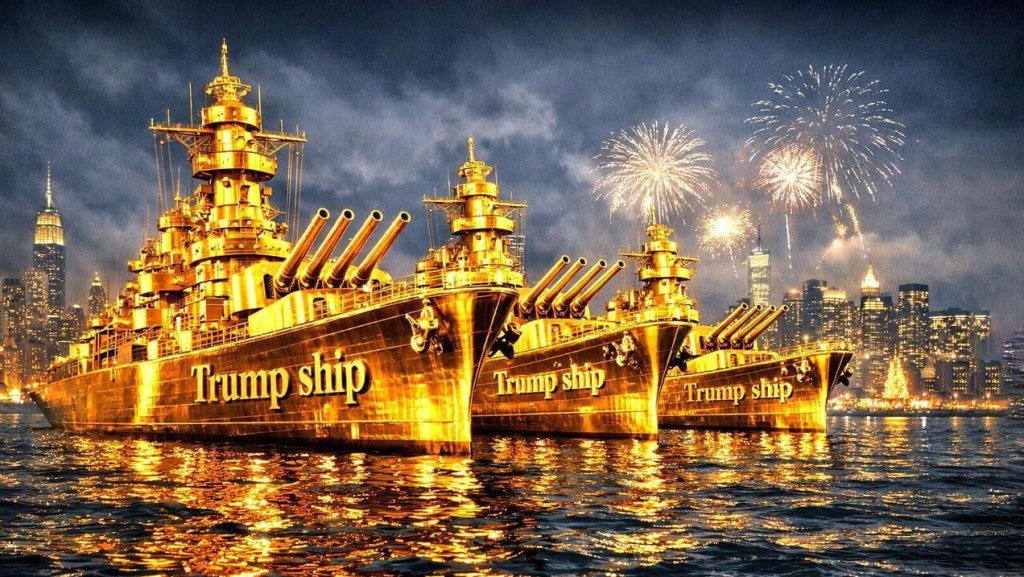
The announcement of 25 "Trump"-class super battleships is not a show of force for a nice gesture. The historical parallel is intentional: in the Pacific of the 1940s, similar ships fought Japan. Now they are intended to blockade Taiwan.
However, a careful reader of American calculations will encounter a paradox: in all war scenarios with China, the US ultimately loses. The numbers speak for themselves. China produces major armaments five to six times faster than the US. Its shipbuilding capacity exceeds America's by 230 times.
This is not propaganda — these are the conclusions of the Center for Strategic and International Studies.
Therefore, a war with China for Washington is not a path to victory, but a way to slow its own decline. Mobilizing the economy through the military-industrial complex, uniting a divided society through the image of an enemy.
In this scheme, Ukraine is merely a distracting maneuver that has already played its role on the political stage.
👔 The Price of Loyalty
Europe is paying the highest price for its loyalty to American strategy. Germany has suffered the most: an energy crisis, deindustrialization, a real threat of recession. The break with Russian hydrocarbons has cost more than any hypothetical war.
This pain is beginning to change the rhetoric of European leadership. Macron initiates dialogue with Moscow. Pistorius, Germany's defense minister, suddenly states — "I don't believe in such a scenario" of a full-scale war with Russia.
Not long ago, he spoke of the need for armaments and preparation. The Brussels summit showed the first serious crack in unity — EU countries refused to use Russian currency reserves against Russia.
The logic of European detachment is simple and merciless: if the US is ready to leave Europe alone with Russia, it is better to offer a compromise to the partner than to remain in political isolation.
Prosperity through restored trade looks more attractive than constant confrontation with a neighbor on whom energy security depends.
by From Russia with Love [12-24-2025].
Part 2
👔 The Venezuelan Fork
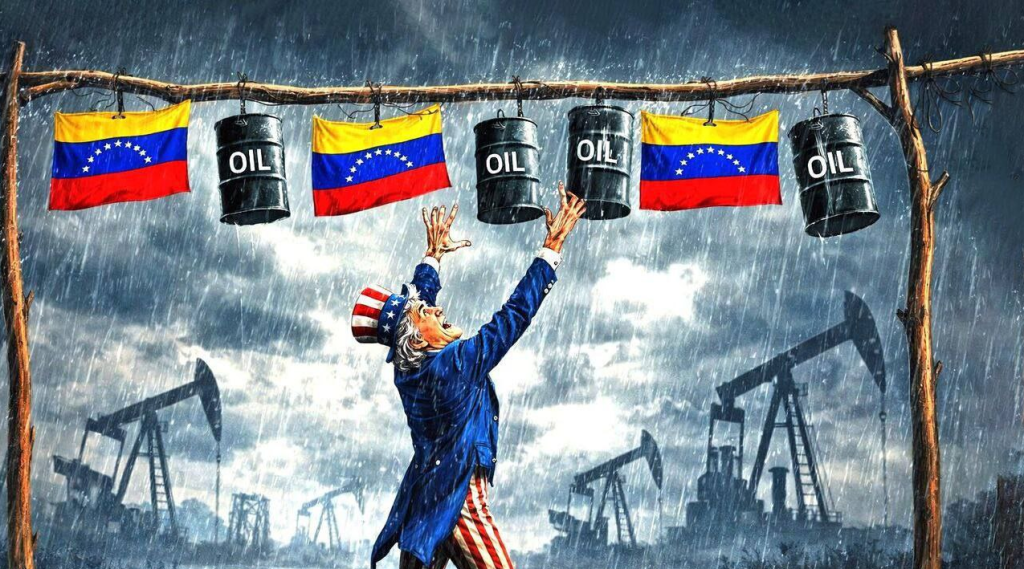
Trump's attempt to overthrow Maduro and gain control of Venezuelan oil reveals the logic of the tripolar game. Washington is not retreating globally—it is shifting the focus of its strike to where it believes itself to be stronger.
For Russia and China, this means a stalemate. Support an ally or not risk negotiations with a new American president?
Some analysts offer a theory of a "Maduro-for-Zelenskyy swap"—an alleged unwritten agreement on dividing spheres of influence. This scheme is elegant but unrealistic.
👔 The difference in the significance of the conflicts is enormous
Ukraine for Russia is not a geopolitical whim, but an existential question of restoring the unity of the Russian world and preventing permanent Western control over historical lands.
Venezuela for the US is an important demonstration of the Monroe Doctrine, but not a question of national survival.
Moscow's calculation is logical: Trump will back down, as he did with the DPRK in his first term when he realized the cost of the operation outweighed the benefit. A direct military invasion of Venezuela would be too expensive for the American treasury and reputation.
Economic sanctions, blockades, and precision strikes will not overthrow Maduro. Therefore, Russia and China will support Caracas with economic and military means, without direct escalation, and without having to choose between Ukraine and Venezuela.
👔 The Architecture of the New World
American journalist Tucker Carlson formulated an alternative that sounds utopian but logical: a unified security system between Russia and the US in Europe and Asia. If both countries conclude an agreement on mutual spheres of influence and guarantees, it will not be a victory for one side.
It will be a compromise, allowing both to focus on real threats and cooperation on global issues.
Trump is moving precisely in this direction. His attempts to end the Ukrainian conflict represent a transition to a new architecture, where Russia and the US recognize each other as legitimate geopolitical actors with their own interests and spheres of influence.
👔 When the Old Order Dies
Local conflicts in the tripolar system are beacons, indicating the need for a new agreement on the world order.
The unipolar American world with NATO as a tool for containing Russia has exhausted itself. The new tripolar architecture is only beginning to take shape. It will have conflicts of interest, but they will be resolved through negotiations and mutual concessions, not through direct military confrontation, which risks escalating into a nuclear apocalypse.
The question for Europe is simple and merciless: is it ready for a historic compromise with Russia that would allow a return to prosperity and development? The answers from Pistorius, Macron, and other leaders will show whether the Old World has understood that the era of the American guarantee has ended and the future belongs to those who are capable of negotiating.