Alastair Crooke, Glenn Diesen: Insurrection & Regime Change Coming to Saudi Arabia – A New Middle East Emerging
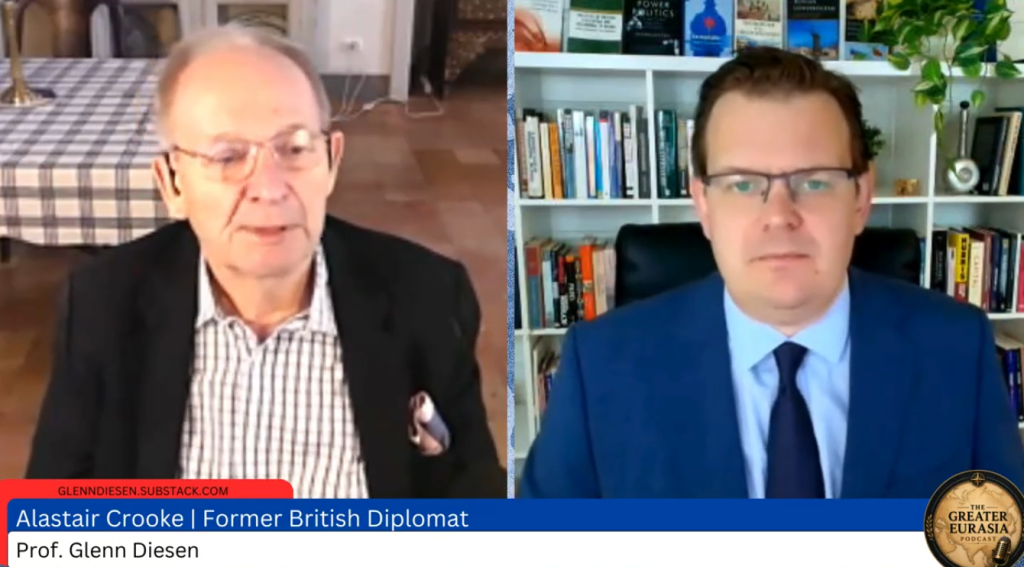 by Alastair Crooke, Glenn Diesen [10-14-2026] Alastair Crooke(bio).
Alastair Crooke, a former British diplomat and negotiator, argues that Saudi Arabia is facing a profound crisis of political legitimacy that could threaten the position of Crown Prince Mohammed bin Salman (MBS) and fundamentally reshape the Middle East. The greatest danger to MBS comes not from external enemies but from within Saudi Arabia itself, particularly from tribal structures whose support has historically underpinned the ruling family.
MBS has concentrated power in his own hands while weakening the traditional pillars of Saudi legitimacy. The historic alliance between the House of Saud and the Wahhabi religious establishment provided the monarchy with theological and moral authority. By marginalizing the religious leadership, promoting social liberalization through Vision 2030, and concentrating the country’s wealth within the royal family, MBS has undermined this arrangement and generated deep resentment.
Tribal communities have also suffered from land expropriations, unequal access to oil revenues and the humiliation of members of the royal family during the Ritz-Carlton detentions. These grievances have created conditions for internal opposition, with discussions reportedly taking place among tribal leaders about a different political settlement.
War, Oil and Economic Vulnerability
Saudi Arabia’s military campaign against Yemen’s Ansar Allah movement has exposed additional vulnerabilities. Crooke argues that attacks on Saudi oil fields, refineries and other infrastructure threaten the foundations of the kingdom’s economic model. Damage to oil production cannot necessarily be repaired quickly, challenging assumptions that the region’s energy industry will simply return to normal.
The financial consequences could be equally severe. Saudi Arabia depends heavily on oil exports to finance imports and sustain its economic system. If export revenues collapse while import requirements remain, the kingdom would face a choice between sharply devaluing its currency, risking substantial inflation, and selling foreign exchange reserves. Large-scale reserve sales could also destabilise Western financial markets.
Military intervention offers no easy solution. Yemen’s mountainous terrain, fortified positions and deeply rooted warrior traditions make it exceptionally difficult to defeat Ansar Allah through bombing. Crooke argues that Saudi Arabia’s military structures are primarily designed to protect the monarchy against internal threats rather than fight a prolonged war against Yemen.
The End of the Colonial Order
Crooke sees these developments as part of a wider crisis affecting the political foundations of the Middle East. Several regional states depend on external financial support, inherited political arrangements and concentrated oil wealth. Meanwhile, much of the population remains economically marginalized.
The distribution of oil revenues among royal courts and narrow elites has failed to provide broadly shared prosperity. Economic hardship, subsidy reductions and growing inequality are intensifying popular dissatisfaction across the region.
For Crooke, the current upheaval may represent the beginning of the end of the long colonial project in the Middle East. The political arrangements established under external influence are increasingly vulnerable because they lack deep popular legitimacy and fail to distribute wealth and political rights fairly.
Iran and a New Regional Settlement
Crooke argues that Iran will play a central role in the emerging regional order, not necessarily through Shia dominance, but through a broader transformation of political and economic relationships. He emphasizes that movements such as Ansar Allah have their own historical traditions and have cooperated across religious divisions. The Sunni-Shia divide, therefore, does not adequately explain the region’s changing alignments.
Iran’s wider objective, in Crooke’s assessment, is to reduce American political, cultural and financial dominance in the Gulf. This would create opportunities for an economic model that serves wider populations rather than concentrating wealth among oligarchs and ruling elites.
A new settlement would require negotiations among regional actors, potentially including tribal leaders, Iran and Yemen. The central questions concern the redistribution of oil wealth, political representation and the restoration of rights that communities believe have been taken from them.
Israel Must Adapt to the Emerging Reality
Crooke argues that Israel faces a strategic crisis because its regional ambitions conflict with the emerging balance of power. He sees serious strains within the Israeli military, including problems with manpower, morale and logistics, while the country’s political climate is moving further towards the right.
Rather than accommodating its neighbors, Israel may retreat into an increasingly fortified posture. Yet Crooke maintains that a durable regional settlement will ultimately require engagement with Iran, which he considers uniquely positioned to facilitate a wider agreement.
The Middle East is therefore approaching a fundamental reorganization. For Crooke, the decisive issue is whether established powers can adapt to changing realities or whether their weakened political foundations will give way to a new regional order.
[10-12-2026]