Scott Ritter – The US and Iran: Between Stalemate and Checkmate
 by Scott Ritter [4-28-2026] Scott Ritter(bio).
The US and its allies started a war with Iran that they did not win. For nearly 40 days, from the start of the war on Feb. 28 to the Apr. 7 ceasefire, the US and Israel carried out an incessant strategic bombing campaign against Iran. The goals and objectives of this campaign were variously to bring about a change of regime in Iran, to degrade Iran’s conventional military capabilities — particularly its missile and drone stockpiles, manufacturing capacity and launchers — and to deny Iran the ability to develop a nuclear weapon. None of these objectives has been fully met, and the US was instead compelled to seek a ceasefire that arguably leaves Iran in a strategically advantageous position.
The US and Israel, between them, struck tens of thousands of targets inside Iran. Several senior Iranian leaders, including the supreme leader, Ali Khamenei, were killed, and a large part of Iran’s identifiable military infrastructure was destroyed, including most of Iran’s major naval vessels and many helicopters and aircraft. But Iran’s prewar preparations for this very sort of conflict, which had been under way for more than two decades, effectively blunted the effectiveness of the US-led strategic air campaign. Not only did Iran’s government withstand the assault, but the state’s core institutions appear to have remained intact.
Iran had divided its expansive territory into 31 autonomous military districts, each designed to operate independently of central direction and support, making decapitation all but impossible. Analysts assess that much of Iran’s offensive strike and critical strategic military industrial capacity, including both missile and drone production, had been moved underground, helping to protect it from US and Israeli bombs. And Iran retained effective control over the strategic Strait of Hormuz, enabling it to choke off the transit of oil and gas resources critical to both regional and global economies.
While failing to achieve their main stated political and military objectives, the US and Israel depleted much of their on-hand stocks of precision-guided munitions and ballistic missile interception capabilities. For the US, this means that a significant share of certain precision-strike systems were used in the campaign, as were large portions of missile defense interceptor inventories. While these munitions have been replenished, this was only done by drawing down on stocks earmarked for other strategic contingencies in Europe and the Pacific, raising concerns about US readiness across other theaters. Moreover, the effectiveness of these weapons has been put into question, meaning any resumption of military operations against Iran would not guarantee improved results.
Unrealistic Expectations
The ceasefire brokered by Pakistan helped enable negotiations between the US and Iran aimed at bringing an end to the conflict. From the start, Iran approached these negotiations with seriousness, arriving in Islamabad, Pakistan, with a sizeable team that included not only national-level decision makers, but also teams of technical experts.
For its part, the US dispatched a team led by Vice President JD Vance, which was reported to be constrained in its negotiating flexibility. Moreover, the US negotiation posture was guided by demands — such as Iran giving up uranium enrichment, terminating its missile programs, surrendering control of the Strait of Hormuz and ending its support for Hezbollah in Lebanon and the Houthis in Yemen — that could only have been deemed viable in the event of a more decisive military outcome in favor of the US.
These negotiations ended in failure. Resuming them has been difficult, in part because the US struggles to reconcile that it will not be able to accomplish at the negotiating table what it failed to achieve on the battlefield. The collapse of the peace talks led to widespread speculation that the conflict would resume. But Trump instead opted to indefinitely extend the ceasefire, seemingly indicating that the US is not willing or sufficiently prepared to restart what could be a prolonged active conflict.
Indeed, if anything, the strategic balance of power has further shifted in Iran’s favor. The US’ inability to quickly put an end to Iran’s influence over the Strait of Hormuz is evident, with Washington opting for what could prove to be a slow-burning blockade of Iranian ports in order to pile pressure on Tehran. But there is no near-term military solution to this problem. Moreover, Iran has indicated that any resumption of attacks on its soil will automatically result in attacks designed to destroy identified critical energy production facilities in Kuwait, Saudi Arabia, Qatar and the United Arab Emirates. The restocking of missile defense weapons that Iran’s missile and drone attacks permeated does not fully resolve concerns about regional vulnerability. The resumption of attacks on Iran using the same weapons that delivered mixed results in the first stretch of the war offers no guarantee that future attacks would achieve a different outcome.
Stalemate to Attrition
Iran, despite the US and Israel’s combined show of force, targeted elements of US and allied radar and early-warning infrastructure across the region, some of which remain degraded. The return of Iranian fighter aircraft and attack helicopters to the skies underscores the incomplete impact of the US and Israeli attacks. Iran’s nuclear ambitions, meanwhile, remain at the heart of the US and Iran’s standoff. And while Iran’s official position continues to be a rejection of any ambition to acquire a nuclear weapon, the US and Israel’s decision to launch a war against it while nuclear negotiations were under way has led many to speculate that Iran’s red lines regarding nuclear weapons may have become blurred. Iran’s navy, which the Trump administration claimed to have “obliterated,” has also reconstituted elements of its operational presence and continues to operate in and around the Strait of Hormuz.
Simply put, the US does not hold the cards it claims to in the current crisis and cannot guarantee success in any renewed conflict. Instead, the US has embarked on an alternative strategy grounded in a declared naval blockade of Iran. The goal of this blockade is to deny Iran the ability to generate income derived from the sale of its oil, thereby triggering a larger economic collapse that could in turn result in social upheaval, a climbdown by Tehran, or both. A secondary objective appears to be to put Iranian oil production capacity as the country’s oil storage capacity overspills, forcing Iran to either back down or risk damaging oil fields that will be compelled to be shut down. But these shifting goals are a response to the US’ Plan A unraveling.
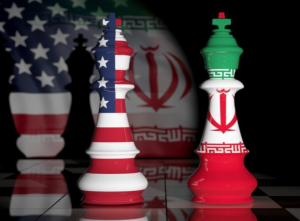
The current stalemate in the Mideast Gulf is seen in some quarters as an Iranian checkmate on the US and its allies, as both sides settle in for an attritional battle of pain points, with each side betting that the other will be compelled to retreat before it does.