Larry Johnson: While Waiting for Armageddon, Watch Pepe Escobar’s New “Golden Corridor” Documentary on Iran
 by Larry Johnson [2-25-2026] Larry C. Johnson(bio).
(RAD: The "Golden Corridor" video at the end is an absolute must to see that was produced by Pepe Escobar in cooperation with people from Iran. This is the only video in English that explains the importance of Iran in the norht/south & east/west trade corridors. Don't pass it up. ― RAD)
By noon eastern time on Thursday we will likely know whether or not Donald Trump will sign off on an order to attack Iran. Why noon? That is 6pm in Geneva, Switzerland, where Steve Witkoff and Jared Kushner will hold indirect talks with representatives of the Islamic Republic of Iran. If the two sides emerge from the meeting speaking in positive terms about a tentative agreement, then it is unlikely that Trump will risk starting a war that is likely to escalate into a regional conflagration. Alternatively, if the US side announces — either directly or through selected leaks to the corporate media — that Iran is intransigent and is refusing to compromise, the stage is set for the US and/or Israel launching the long awaited attack.
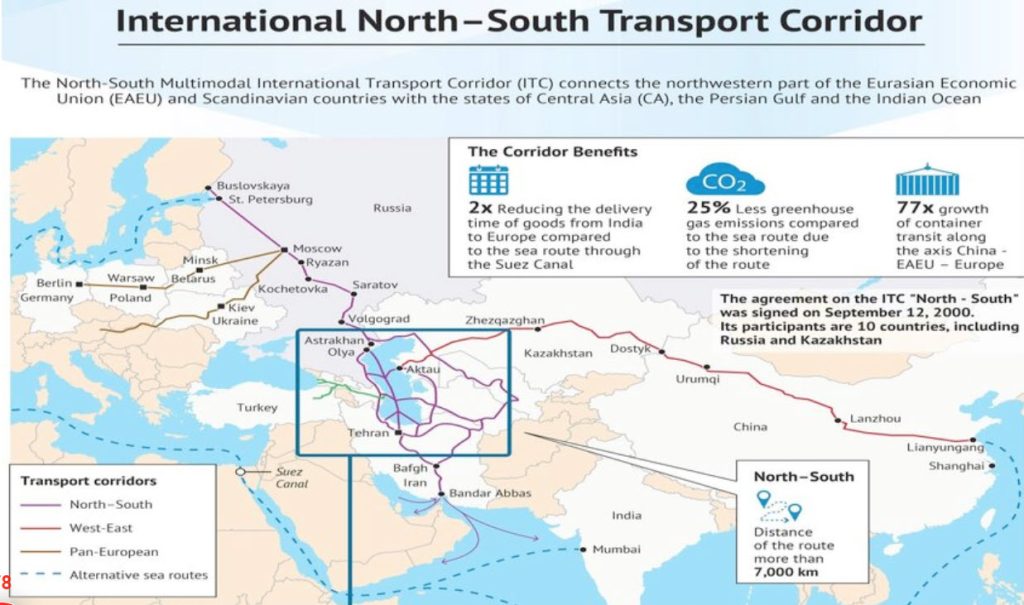
While we wait, I encourage you to watch the video-linked below. It is a new documentary by my dear friend, Pepe Escobar, that is a result of his journey last year to Iran to study the International North-South Transportation Corridor (INSTC). The INSTC is designed not only to boost Iran-Russia trade, but to unlock unique economic opportunities for many other countries. It is the first English-language documentary ever made on the INSTC.
Pepe presents Tehran not just as Iran’s capital, but as a potential capital of a new Eurasian project — positioned somewhere between Shanghai and St. Petersburg. Pepe frames Iran not as a destination, but as a vital connector reshaping global trade and geopolitics.
The documentary traces Iran’s role as a trade corridor back through history — from the Achaemenid Empire’s Royal Road stretching 2,500 kilometers from Susa to Sardis, through the Silk Road era when caravans of silk, spices and precious goods passed through the heart of Iran, to the Islamic empires that expanded both land and sea routes, making the ports of the Persian Gulf and Sea of Oman Iran’s gateways to the world.
Iran today sits at a strategic crossroads between the Caspian Sea, the Persian Gulf, and the overland routes of the Caucasus and Central Asia, striving to transform its north-south and east-west corridors into powerful interconnected arteries carrying not only commerce but the shifting weight of regional and global geopolitics.
Pepe begins his journey in the north, tracing the rail line from Bandar Abbas to Rasht as part of the INSTC. Ports like Anzali and Amirabad on the Caspian Sea are described as Iran’s twin arms, with a combined capacity of over 10 million tons annually — serving as a lifeline for landlocked countries including Kazakhstan, Russia, and Turkmenistan.
The documentary argues that if the transfer of power from West to East continues through the 21st century, countries like Iran, China, Russia, and India will occupy a central pivotal position — and the North-South Corridor connecting India, Iran, and Russia could become the shortest and most economical route for moving goods between those regions.
Pepe’s documentary casts a new light on Iran’s importance to both Russia and China in creating a new international economic order that is free of US coercion and bullying. This helps explain why Russia and China have been working feverishly over the past 7 months to bolster Iran’s ability to defend itself against new attacks from the US and/or Israel. If Pepe is right (and I think he is), Iran is poised to play a critical role in the global economy during the remainder of the 21st Century.
Pepe Escobar: The Golden Corridor, BRICS and Iran's New World Order
By New World Order [2-25-2026] Pepe Escobar(bio).
Pepe Escobar: The Golden Corridor, BRICS and Iran's New World Order reveals how the Golden Corridor and the North South Transport Corridor are reshaping BRICS, Iran, and the emerging multipolar world. In this in-depth Think BRICS conversation, Pepe Escobar breaks down the geopolitical significance of the Russia Iran India corridor and how Eurasia integration is accelerating through the Caspian Sea trade route, Chabahar port, and the New Silk Road.
Filmed following Escobar’s documentary on the Golden Corridor, this discussion explores how the North South Transport Corridor connects St. Petersburg to Mumbai, integrating Russia, Iran, and India into a powerful geoeconomic axis. The conversation highlights how BRICS is advancing dedollarization, building alternative payment systems, and strengthening the multipolar world across the Global South.
Pepe Escobar analyzes the strategic importance of Iran’s ports, including Chabahar port, the Caspian Sea trade route, and their link to the Belt and Road Initiative. He explains how Eurasian geopolitics is shifting amid sanctions, maritime tensions, and growing BRICS cooperation. The Armenia Azerbaijan corridor and the so-called Trump corridor are examined within the broader struggle over Eurasia integration and geopolitics 2026.
The discussion also addresses India’s balancing act between BRICS and Western alliances, the future of the Iran New World Order, and how the Russia Iran India corridor fits into the evolving New Silk Road framework. Throughout, Think BRICS provides sharp analysis of dedollarization, Global South strategy, and the future architecture of global power.
This episode does not provide classified intelligence, military operational details, or real-time battlefield updates. It does not offer financial or investment advice related to BRICS, Iran, or the North South Transport Corridor. While it discusses the Armenia Azerbaijan corridor and Trump corridor in geopolitical terms, it does not present official government positions or diplomatic negotiations. The focus remains analytical, centered on Pepe Escobar’s interpretation of the Golden Corridor, Eurasia integration, dedollarization, and the multipolar world shaping geopolitics 2026.
0:00 - Pepe Escobar on Iran’s “Golden Corridor” Documentary & the Future of BRICS
0:31 - Inside Iran: What the West Gets Wrong About Sanctions, Ports & the North–South Corridor
1:40 - From the Caspian to the Persian Gulf: How Iran’s Trade Routes Defy Sanctions
3:24 - The Russia–Iran–India Corridor Explained: BRICS’ North–South Transport Revolution
4:36 - Multimodal Eurasia: Rail, Sea & Highways Linking Russia, Iran, India & Central Asia
6:22 - New Silk Road 2.0: China’s Belt & Road Meets the North–South Transport Corridor
7:32 - Dedollarization & BRICS Payments: Trading in National Currencies Across Eurasia
8:31 - The “Trump Corridor” in the Caucasus: US Strategy in Armenia–Azerbaijan Explained
10:23 - Divide & Rule? How the US Move in the South Caucasus Targets Russia & Iran
11:58 - US Fleet vs Iran in the Persian Gulf: Rising Tensions in the Sea of Oman
13:09 - Chabahar Port Crisis: Did Washington Block India’s Access to Iran?
14:43 - India at a Crossroads: BRICS Leadership, Quad Ties & the Multipolar World
16:04 - Can India Stop Hedging? Modi, BRICS 2026 & the Global South Power Shift
19:17 - “Rules-Based Order” or Global Chaos? How the Global South Sees US Power
21:12 - Trump 2.0 & the End of International Law? Empire, Sanctions & Geopolitics 2026
22:39 - Can BRICS Defend Iran & Cuba? The Struggle for a New World Order
23:40 - Institutionalizing BRICS: Is the Global South Ready to Counter US Recolonization?