Larry Johnson: Relax, It’s Only an Exxon Valdez on Steroids
 by Larry Johnson [10-24-2026] Larry C. Johnson(bio).
Good news from the Persian Gulf: the war is going so well that the sea itself has joined the fight. While Washington’s experts debate missile counts and the price of oil (around $115 for Brent on Friday, in case anyone in the White House is still checking), Karl Miller, who is actually on the ground in the Gulf, sent me a note this week that nobody in the briefing rooms seems to have read. Don’t underestimate the damage to the world’s crude tanker fleet, he wrote, and don’t underestimate the pollution now spreading through the Gulf and down the coast of Oman. “It’s an Exxon Valdez on steroids,” he told me. “This is a catastrophe in its own right.”
But I’m sure it’s fine. Let’s look at the numbers, just for fun.
Shooting the delivery trucks
The UK Maritime Trade Operations center has now counted 119 vessels reporting damage this year, and 77 sailors killed or injured. October is shaping up to be a banner month: Bloomberg counted at least 23 attacks on ships in or near the Strait of Hormuz in just the first two weeks, at least five of them in engine rooms, which is the maritime equivalent of being shot in the knees. Two ships sank last week. Two more tankers, the Kylo and the Riesco, went down in September. Nothing says “freedom of navigation” quite like a navigable ocean floor.
On October 9, somebody put a hole in the Gem No. 2, a 302,783-ton Very Large Crude Carrier, off the UAE coast near Umm Al Quwain. On October 22, Iran claimed four more hits on ships doing ship-to-ship transfers. Tehran’s new “Persian Gulf Strait Authority,” which sounds like a harbor commission and acts like a firing squad, says it has 122 “non-compliant” vessels on its list. One oil broker told Bloomberg that “every VLCC hit is material.” You don’t say.
Eight Valdezes to a ship !!!
A little arithmetic for the folks at the Pentagon. The Exxon Valdez spilled about 257,000 barrels of oil into Prince William Sound in 1989, and Americans are still talking about it. A single VLCC carries about two million barrels. So every supertanker sitting in the Gulf is roughly eight Exxon Valdezes waiting for a drone. And the Gulf is a shallow, nearly enclosed bathtub with lousy circulation. Whatever goes in, stays in. Steroids, indeed.
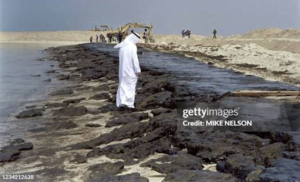
We’re already enjoying the preview. This week the UAE closed the beaches of Umm Al Quwain after a slick more than 22 miles long and more than 60 square miles in area washed ashore on the Khor Al Beidah peninsula. The UAE said, with admirable understatement, that the oil was “likely coming from a VLCC struck earlier in the month.” Fishermen have been advised to stay away from the fish.
Down the coast, Oman is hosting the Caroline Bezengi, a tanker carrying about 800,000 barrels that suffered a mysterious explosion on June 8, was abandoned by its crew and then drifted aground in, of all places, a marine nature reserve near Qibliyah Island, home to humpback whales and Socotra cormorants. It started leaking at the end of June. By August the slick covered hundreds of square miles. The whales were not consulted. Across the water, Iran is mopping up its own crude spill off Qeshm Island. Everyone gets a souvenir.
But who needs drinking water?
Here’s the fun part that the war planners seem to have skipped. The Arab Gulf states don’t just pump oil out of the sea. They drink the sea. Desalination supplies about 99 percent of Qatar’s drinking water, more than 90 percent of Bahrain’s, about 90 percent of Kuwait’s, 86 percent of Oman’s, 70 percent of Saudi Arabia’s and 42 percent of the UAE’s, according to figures compiled by CSIS and the Atlantic Council. The six Gulf states run about 3,400 desalination plants, a third of the world’s capacity, and more than 90 percent of the Gulf’s desalinated water comes from just 56 of them. What could possibly go wrong?
Desalination plants have a small design quirk: they need clean seawater. When an oil slick reaches an intake, the plant has to shut down or risk wrecking its membranes and filters. We’ve run this experiment before. In 1991, Saddam Hussein dumped oil into the northern Gulf and trashed Kuwait’s desalination capacity, and Kuwaitis got running water four days a week, with the rest delivered by truck. Even a humble algal bloom in 2008 and 2009 shut plants in Oman and the UAE for up to two months. Imagine what eight Exxon Valdezes could do.
And the backup plan? The UAE’s own water-security planning envisions about two days of stored supply under normal demand. Two days. Bahrain, Kuwait and Qatar, the countries that depend most on desalination, have what analysts politely call “insufficient storage.” Plants have already been hit directly: a strike in Bahrain in March cut water to as many as 30 villages, and Kuwait and the UAE have reported damage too. So the strategy appears to be: keep shooting at tankers in a shallow sea full of desalination intakes, and hope the wind cooperates. In the Gulf summer, a city without water is not an economic inconvenience. It is an evacuation.
Supertankers: now priced like space travel
Meanwhile, the world has discovered that you can’t actually move oil without ships. Who knew? In early January, chartering a VLCC on the benchmark Middle East to Far East route cost about $30,000 a day. By early October, according to Poten, it cost $1.3 million a day, a modest 43-fold increase. On October 8 it hit a record $1.4 million a day. For a few days this month, Bloomberg noted, renting a supertanker cost more than launching a rocket into space. Freight alone now adds about $33 to the delivered price of a barrel. In January it added $1.73.
Why? Partly because ships keep getting sunk, burned and sent to the repair yard from a fleet that had zero spare capacity to begin with. Partly because, with Hormuz restricted, tankers are stuck shuttling and pumping oil from ship to ship in the Gulf of Oman, a process the head of Vitol called “very inefficient” before observing that “there is really not quite enough shipping to go around.” And partly because shipowners have developed an irrational reluctance to sail a $100 million ship full of two million barrels of crude into waters where Iran keeps a target list. Cowards, all of them.
And the winner is…
Now for the punch line, courtesy of Miller. When the smoke clears, the country sitting prettiest on the water will be Russia. For years, while Washington and Brussels were busy sanctioning Russian oil, Moscow and its friends were quietly buying up tankers, mostly older midsize ships, to build the so-called shadow fleet. Ukraine’s government counted 1,337 of them as of February. Western capitals called it a sanctions-evasion network. In a world that suddenly can’t find enough tankers, it is called a fleet.
And the West has already come crawling. In March, the U.S. Treasury temporarily lifted restrictions on selling Russian oil sitting on detained tankers, for the sake of “stability in global energy markets.” This month, the President of the United States personally negotiated a deal to buy Russian diesel. Four years of sanctions, followed by asking Putin for fuel. Bravo.
To be fair, the shadow fleet has its own charms. The tanker leaking all over Oman’s nature reserve, the Caroline Bezengi, is believed to be one of Russia’s: old, opaquely owned and, by most accounts, insured by somebody’s cousin. So the shadow fleet is both Russia’s trump card and a floating environmental time bomb that nobody is accountable for. Naturally, the bill for that lands on the beaches of Oman and the UAE, not in Moscow.
So let’s review. We have shot up the world’s supertanker fleet. We have turned the Gulf and the coast of Oman into an oil-slicked bathtub. We have put the drinking water of tens of millions of people at the mercy of the wind and a few seawater intakes. And we have handed the biggest stock of spare tankers to the one country Washington spent four years trying to sanction into oblivion. Miller summed up the outcome for the rest of the world in a word I can’t print in a family publication. I’ll paraphrase: when this settles, Russia comes out on top, and the rest of us are in very deep kimche. Mission accomplished.