How BRICS Is Linking Payment Systems Without a Common Currency
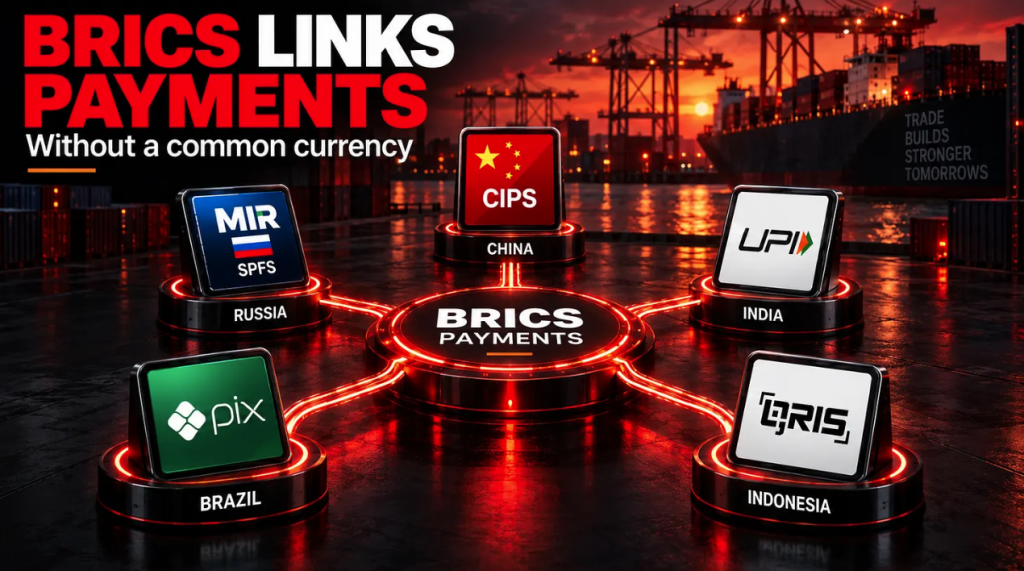 by Geopolitics Prime [9-17-2026].
The New Delhi summit kept the focus on local-currency settlement and payment-system interoperability. The harder task is making domestic payment rails, foreign-exchange markets, and bank settlement work together across borders.
In medieval Europe, a merchant trading between Genoa, Florence, Bruges, or Lyon did not always need to move a chest of silver across the continent. A bill of exchange could carry the claim instead. Bankers in different cities kept accounts with one another, offset mutual obligations, and settled the remaining balance later.
The arrangements were slow, personal, and risky by modern standards. They nevertheless solved a problem that sounds strikingly familiar today: commerce had to move value across borders where currencies, institutions, and rules differed.
BRICS now faces a modern version of that problem. Russia has the Faster Payments System, Mir cards, and SPFS. India has UPI. Brazil has Pix. Indonesia has QRIS, while China has extensive renminbi clearing and settlement infrastructure. These systems can be extremely fast at home. Crossing the border is where the plumbing becomes complicated.
New Delhi Made the Direction Clearer
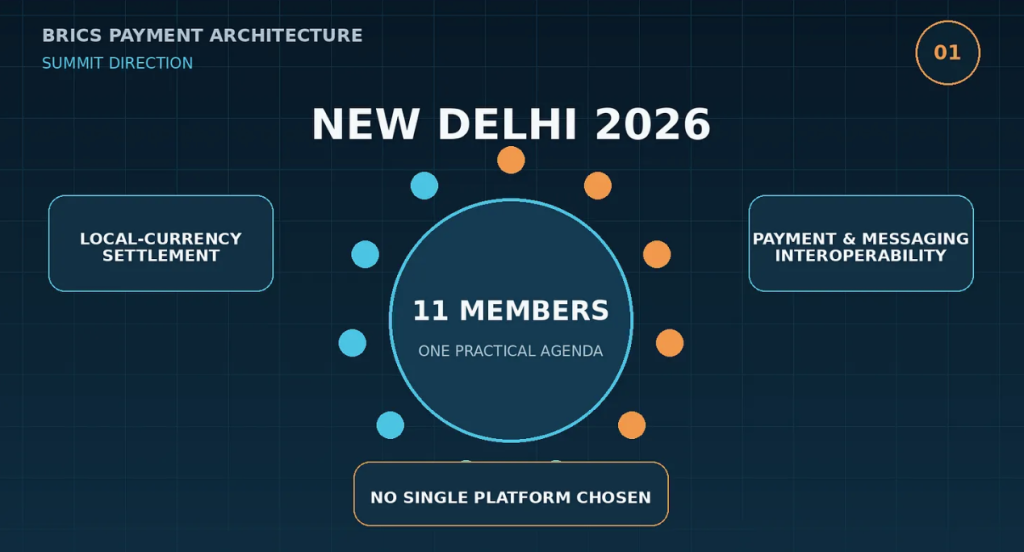
The 2026 summit kept the payment agenda focused on interoperability and local-currency settlement.
The BRICS summit in New Delhi on September 12–13, 2026, did not produce a common currency or unveil a single payment platform. Its final declaration instead gave the BRICS Payment Task Force a practical brief: continue work on efficient cross-border payment mechanisms, study interoperability between payment and messaging channels, and advance trade settlements and investments using BRICS local currencies.
The wording matters. Leaders explicitly recognized national priorities and said there is “no one-size-fits-all approach.” They asked the task force to keep developing solutions that are fast, low-cost, accessible, efficient, transparent, and safe.
That leaves considerable room for different architectures. India entered the summit pushing a more specific idea: Reuters reported on September 10 that New Delhi wanted BRICS members to explore linking central-bank digital currencies. The final declaration did not mention CBDCs. The broader commitment to interoperability survived; the summit stopped short of choosing a single technological route.
This continues a line of work already visible in the 2024 Kazan documents and the 2025 Rio declaration. Rio tasked officials with exploring greater interoperability and welcomed a technical report on cross-border payments. New Delhi moved the discussion forward without pretending that eleven very different monetary and regulatory systems can be folded into one design overnight.
The Common-Currency Debate Misses Part of the Problem
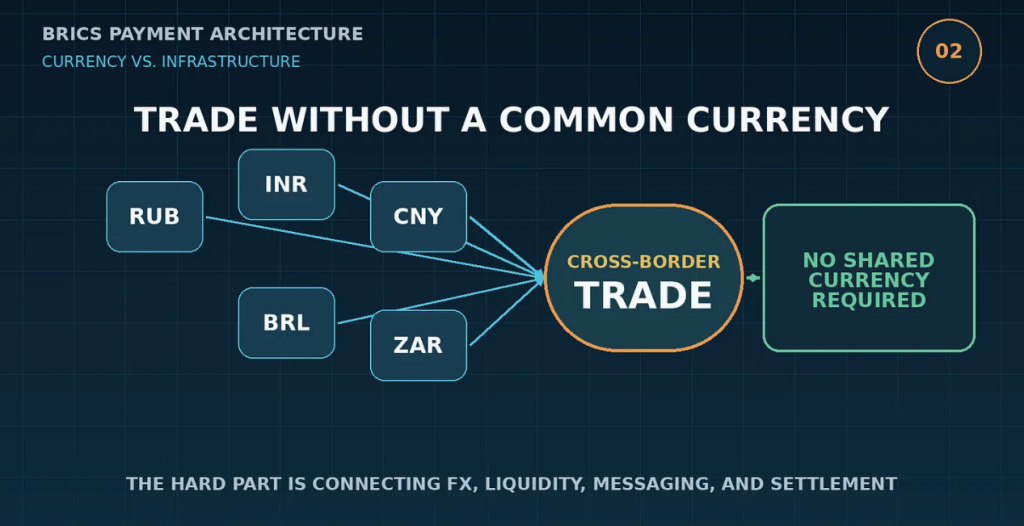
BRICS members can expand trade in national currencies without creating a common currency.
A new BRICS currency has attracted far more attention than payment infrastructure. Brazil’s BRICS sherpa Mauricio Lyrio said in 2025 that such a currency was not under discussion and that the practical agenda centered on lowering the cost of trade and financial transactions, including through greater use of national currencies.
The 2026 declaration reinforces that emphasis. A Russian company can pay an Indian supplier in rubles and rupees without either country surrendering its currency. The difficult questions begin after the choice of currency: who provides the exchange rate, where liquidity sits, how payment instructions travel, which banks hold the necessary accounts, and how final settlement is completed.
A Unit of Account Belongs to Another Layer
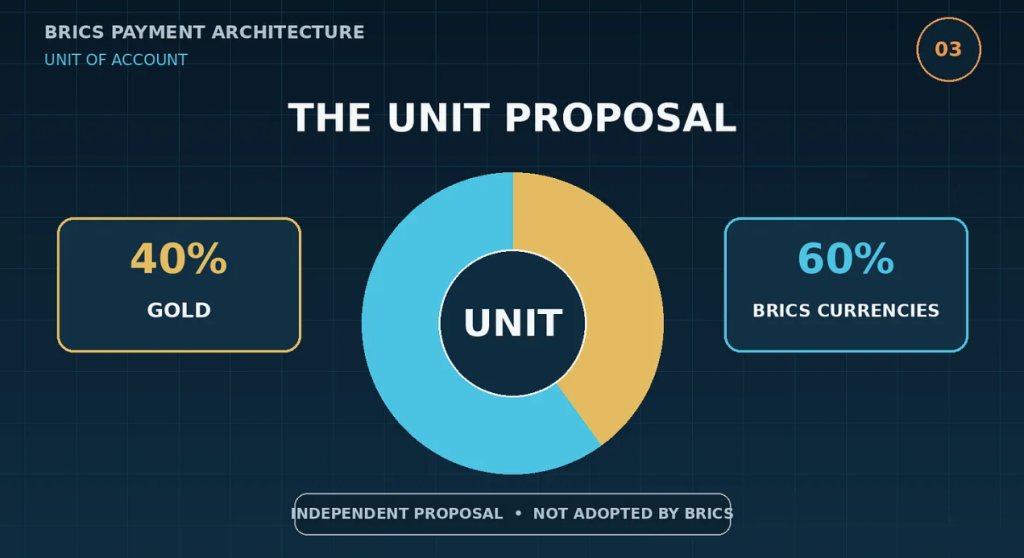
The independent Unit proposal combines a 40% gold component with a 60% currency basket.
There is still a separate question about how BRICS members might measure and net out obligations in trade. Proposals such as the Unit attempt to answer it. The Unit’s designers have proposed a reserve basket made up of 40% gold and 60% currencies of the original five BRICS members, and moved the idea into experimental testing in 2025.
The Unit has not been adopted by BRICS central banks or by the New Development Bank. It remains an independent proposal. Its purpose also differs from that of payment-system interoperability. A unit of account would provide a common measure for pricing or netting obligations; payment infrastructure determines how funds actually travel from one banking system to another. The two layers could eventually interact, but they do not solve the same problem.
What Happens Behind the “Send” Button
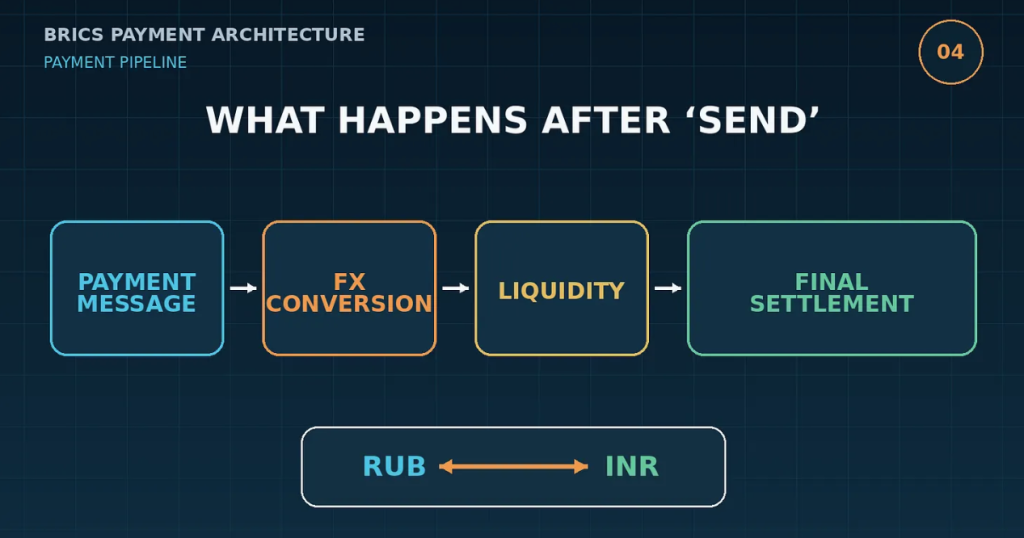
A cross-border payment still requires messaging, foreign exchange, liquidity, and final settlement.
Suppose a Russian importer pays an Indian supplier. The customer may see a simple transfer instruction, yet several operations sit behind it. The banks need to exchange payment messages. Rubles must be converted into rupees, directly or through another currency. The institutions on both sides then have to settle what they owe one another.
Speed at the customer interface therefore tells only part of the story. A transfer can look instantaneous while funding, foreign exchange, and interbank settlement still depend on separate institutions and accounts.
This is where infrastructure becomes decisive. A useful cross-border route needs enough liquidity in both currencies, reliable exchange-rate quotations, common technical standards, clear compliance rules, and a mechanism for final settlement. Connecting two payment systems solves one part of the chain; the rest still has to work.
One Connection Can Replace Many Bilateral Links
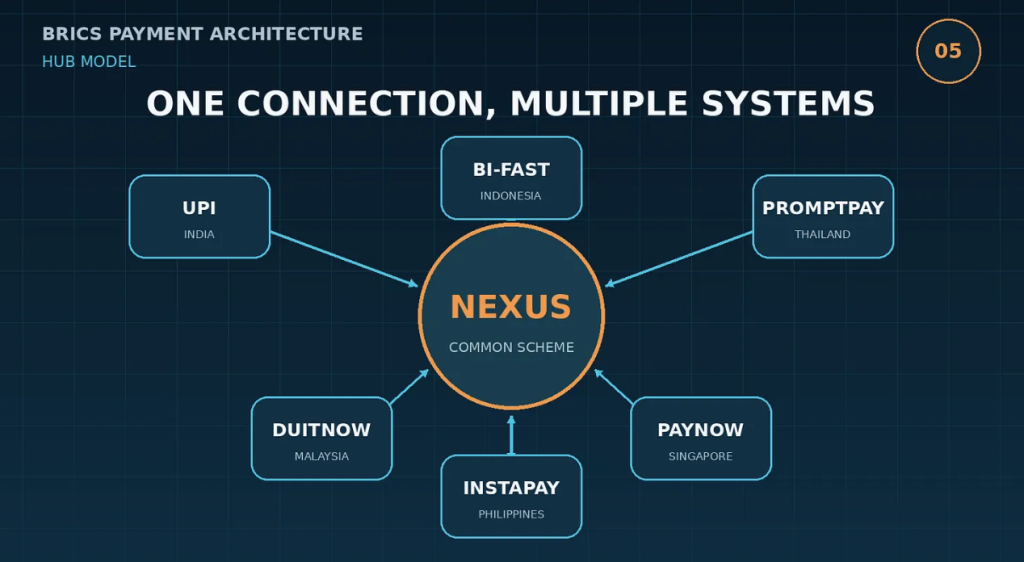
Nexus connects domestic instant-payment systems through a common scheme.
The simplest model is bilateral. Russia and Iran have been linking the Mir and Shetab card systems in stages. Indonesia already operates cross-border QR payment links with several partners. A corridor can start working as soon as the two sides are ready, without waiting for every BRICS member to agree on the same timetable.
The number of bilateral connections, however, grows quickly as more countries join. Project Nexus is an example of a hub model designed to reduce that complexity. A domestic instant-payment system connects to the common scheme once and can then reach other participating systems through the same framework.
Nexus Global Payments was established in 2025 by the central banks of India, Malaysia, the Philippines, Singapore, and Thailand. Indonesia initially participated as a special observer. In February 2026, it became the sixth full participant and began preparing BI-FAST for connection to the network.
Nexus standardizes the route, but foreign exchange and settlement remain necessary functions handled by participating institutions. Its design includes FX providers and settlement-access providers that maintain funds in the relevant domestic systems. The hub simplifies connectivity; it does not create a single pool of BRICS money.
mBridge Tackles the Settlement Layer Differently
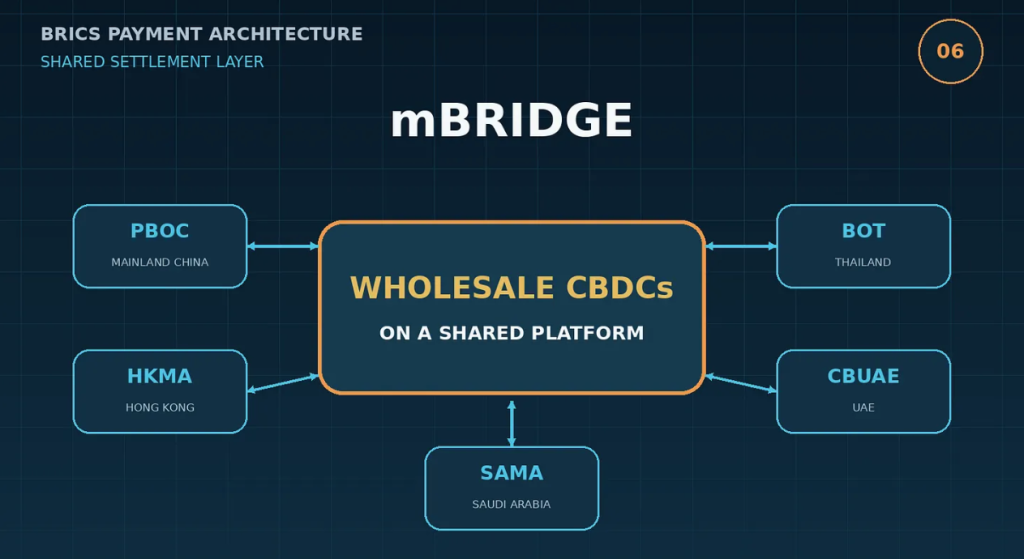
mBridge uses wholesale CBDCs on a shared settlement platform.
Project mBridge illustrates a more radical architecture. It uses central-bank digital currencies on a shared platform so participating commercial banks can transfer and settle central-bank money across borders without reproducing the full traditional correspondent-banking chain.
The platform’s transaction volume has grown sharply. Reuters reported in January 2026, citing Atlantic Council data, that mBridge had processed more than 4,000 cross-border transactions with a cumulative value of $55.5 billion since the project’s early stages. The digital yuan accounted for roughly 95% of that volume.
In November 2025, the UAE Ministry of Finance and the Dubai Department of Finance carried out the first government transaction using the wholesale digital dirham on mBridge. That transaction was a separate milestone and did not represent the platform’s $55.5 billion cumulative total.
mBridge is also separate from the BRICS payment initiative. Its participants include the central banks and monetary authorities of mainland China, Hong Kong, Thailand, the UAE, and Saudi Arabia. It is useful here as an example of what a shared settlement layer can look like, not as evidence that BRICS has already chosen one.
Currency Choice and Payment Speed Can Move Separately
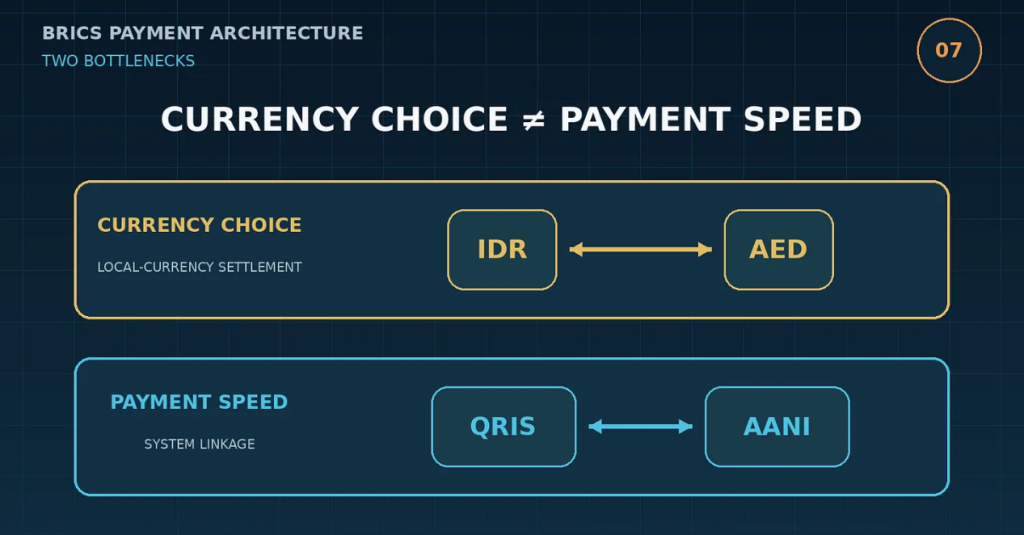
Local-currency settlement and payment-system linkage address different bottlenecks.
Indonesia and the UAE show why these layers need to be distinguished. Their central banks have built a framework for transactions in rupiah and dirhams, using designated banks and foreign-exchange arrangements to support bilateral trade and investment. In parallel, the two central banks have also signed agreements aimed at linking their payment systems for faster cross-border transactions.
Those projects address different bottlenecks. Local-currency settlement reduces reliance on a third currency in a particular trade corridor. Payment-system linkage reduces friction in transmitting and processing the transfer. Neither automatically removes the need for liquidity, compliance checks, or final settlement arrangements.
The same distinction helps explain the language chosen in New Delhi. The declaration refers separately to payment and messaging interoperability and to trade settlements and investments in local currencies. BRICS is treating these as connected pieces of infrastructure rather than a single monetary switch.
Russia and India Already Have a Working Corridor
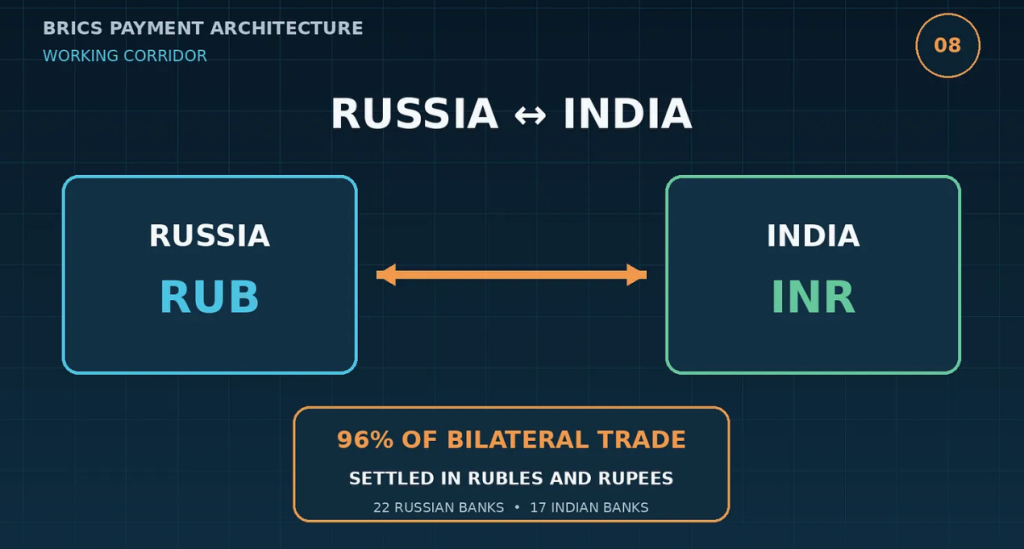
Russia and India already settle most bilateral trade in rubles and rupees.
For Russia, the discussion is already practical. On September 2, 2026, Ivan Nosov, head of Sberbank in India, told Reuters that rubles and rupees were being used in about 96% of bilateral trade. Twenty-two Russian banks and 17 Indian banks were servicing the corridor. According to Nosov, 90% of transactions were processed within ten minutes and more than half within one minute.
That system is bilateral, built from national currencies and existing banking institutions. Its importance lies precisely in the absence of a grand new monetary structure: a workable route can emerge by connecting banks, liquidity, and settlement arrangements around a specific trade relationship.
The Mir–Shetab connection follows the same broad logic at another layer. As more routes become operational, BRICS can pursue interoperability while allowing bilateral solutions to continue where they already work.
An Old Problem, New Tools
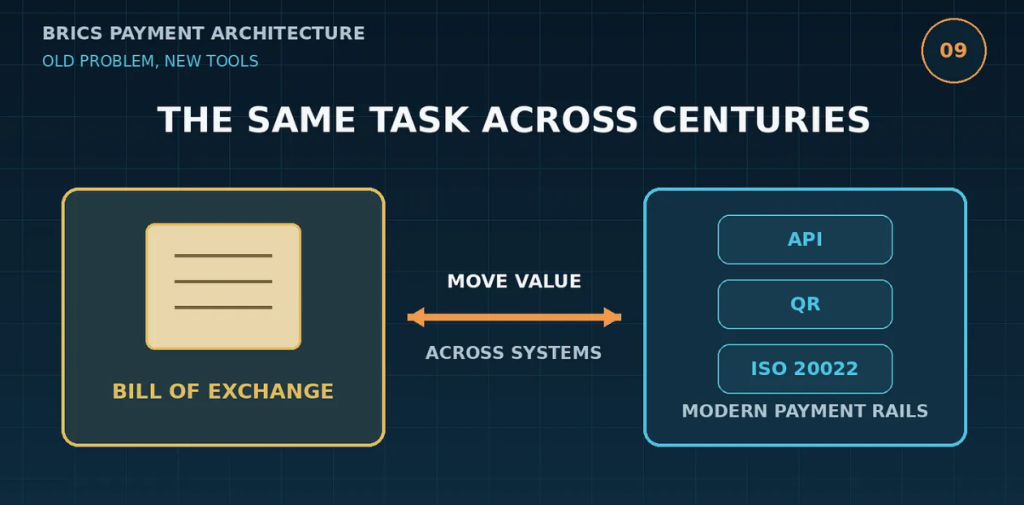
Modern payment rails solve the same basic problem once handled by bills of exchange.
Bills of exchange once reduced the need to move coins physically between cities. Trade fairs allowed merchants to net large numbers of obligations and settle only the balance. Correspondent banking later connected institutions across borders, and clearing houses reduced the number of separate settlements they had to make.
Today the instruments are instant-payment systems, APIs, ISO 20022 messages, QR codes, digital currencies, and automated compliance tools. The underlying task is familiar: move value between separate monetary systems while cutting unnecessary steps.
The New Delhi declaration suggests that BRICS is settling on a practical agenda. National currencies remain in place. Domestic payment systems remain in place. The work now is to make those pieces communicate, convert, and settle across borders with fewer points of delay or failure.
If that effort succeeds, the visible result may be surprisingly ordinary. A company sends money in its own currency, its partner receives another, and the transaction crosses a network of interoperable systems without either side needing to know how many technical layers sit underneath.