Larry Johnson: Day One in New Delhi – BRICS Steps Off the Dollar, With Iran Pressing Hardest
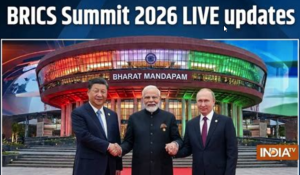 by Larry Johnson [9-12-2026] Larry C. Johnson(bio).
NEW DELHI — The 18th BRICS summit opened on September 12 with the bloc taking its most concrete step yet toward loosening the grip of the US dollar, adopting a 45-page New Delhi Declaration on the first day and endorsing a payments architecture built to route cross-border trade around the Western financial system. For most members the move was incremental. For Iran — under sweeping US sanctions, a naval blockade, and roughly six months into a war with the United States and Israel — it was closer to a lifeline.
The declaration and the payment rails
Leaders gathered at the Bharat Mandapam convention center adopted the New Delhi Declaration 2026 unanimously on the opening day, with Prime Minister Narendra Modi emerging from a closed session to report that no member had objected to the text. The economic centerpiece was a commitment to expand trade and investment settled in members’ own national currencies, and to link their domestic payment and messaging systems so that transactions can move without passing through the dollar-denominated SWIFT network. According to the declaration, the bloc’s payment task force had studied cross-border interoperability of those channels and examined using local currencies for trade settlement and investment.
The mechanism drawing the most attention was BRICS Pay, a decentralized payment-messaging framework that stitches together India’s UPI, China’s CIPS, and Russia’s SPFS into a shared interoperability layer — a way to clear payments among members outside SWIFT. The declaration also referenced a pilot for a gold-backed “Unit” token.
Just as telling was what the bloc again declined to do. There was no endorsement of a single common BRICS currency; India in particular has resisted that leap, favoring interoperable national-currency settlement over the political and monetary complexity of a shared unit. The result, as several observers characterized it, is incremental financial de-dollarization rather than a monetary union — plumbing, not a new reserve currency.
Washington’s answer
The response from Washington was immediate. President Trump threatened tariffs of up to 100% on the bloc, extending a pressure campaign he has waged all year against what he calls BRICS’s “anti-American” trajectory. The threat carries genuine weight for export-dependent members that rely on the US market — but its deterrent power erodes with each transaction the bloc succeeds in routing through non-dollar channels. That is the paradox Washington now faces: the tariffs are meant to punish de-dollarization, yet de-dollarization is precisely what blunts the tariffs.
Iran at the front of the line
No member arrived with more at stake than Iran. President Masoud Pezeshkian pressed the case for national-currency trade, telling reporters that expanding the use of members’ own currencies in intra-bloc commerce was among the most important steps the group could take. Tehran has pushed throughout the summit for mechanisms to insulate members from Western financial pressure — a priority sharpened by the sanctions and blockade it now faces.
Crucially, the summit institutionalizes at the multilateral level what Iran has already been building bilaterally. On January 29, 2026, Tehran signed a trilateral strategic pact with China and Russia, an agreement whose economic core is the construction of alternative financial mechanisms that sidestep SWIFT and reduce exposure to the dollar-centered system. That pact rests on foundations already in place: an Iran–Russia monetary agreement, operational since early 2025, that settles trade directly in rials and rubles and links Russia’s Mir card network to Iran’s Shetab system; a 25-year Iran–China cooperation framework; and the plain fact that China now buys the overwhelming majority of Iran’s oil, much of it settled in yuan.
The implication cuts against the common assumption that Iran is scrambling for a dollar workaround. It already has one. For Tehran, BRICS Pay is not a novel escape hatch but a larger, sanctions-resistant network onto which it can graft trade it is already conducting outside Western channels — and a multilateral blessing for the parallel financial architecture it has spent two years assembling with Moscow and Beijing.
Where BRICS drew the line — and where it didn’t
The declaration’s language on the region’s wars was the most fought-over in the text, and the outcome was uneven: sharp in places, deliberately vague in others. Reaching consensus reportedly required negotiations that ran until 4 a.m., driven mainly by a rift between Iran and the United Arab Emirates.
On the US–Israeli war against Iran, the bloc expressed deep concern and called for maximum restraint, dialogue and diplomacy — but it named neither the United States nor Israel, and condemned no country outright. That hedge was the price of unanimity. Iranian Foreign Minister Abbas Araghchi had pressed BRICS to condemn what he called unlawful US and Israeli aggression; the UAE pushed back hard, accusing Tehran of using the summit to justify its own missile and drone barrages against Gulf states. India, in the chair, acknowledged “differing views among some members” and steered the text toward common ground. The language was firmer in tone than a bland appeal for peace, but well short of the unequivocal condemnation of the strikes on Iran that Tehran had won from the Rio summit a year earlier — a notable step back on that specific question, not forward.
Yet Iran signed the text anyway, and that was the summit’s quieter diplomatic story. Tehran — which has spent the war firing missiles and drones at the UAE, most recently at the Al Minhad Air Base in late August — put its name to language its Gulf adversary could also accept, while Pezeshkian met the Abu Dhabi crown prince on the sidelines in the two sides’ highest-level contact since the fighting began. Iran’s willingness to sit inside the consensus rather than force a rupture signaled that it read the declaration’s direction — deep concern over the escalation and a call to protect civilians — as acceptable enough, even without the naming it had sought. But the same words served Abu Dhabi: the call to respect the sovereignty and territorial integrity of states pointed as much at Iran’s strikes on the Gulf as at the US–Israeli assault on Iran. The consensus held because the text could be read both ways.
On Lebanon, the bloc was sharper, and it named Israel directly. The leaders condemned the continued violations of Lebanon’s sovereignty and territorial integrity, called on Israel to withdraw its occupying forces from all Lebanese territory, demanded full implementation of UN Security Council Resolution 1701, and condemned all attacks against the UNIFIL peacekeeping force — extending condolences for peacekeepers killed in the south, among them four Indonesians, and demanding accountability. It amounts to some of the most direct criticism of Israel in any BRICS declaration to date, even though Israel is named only three times in the entire 45-page document. The declaration separately took note of the International Court of Justice proceedings brought by South Africa against Israel over Gaza, and rejected any unilateral moves to alter the status of occupied Jerusalem.
For India, the shift is best measured against where Modi stood barely six months earlier. On February 25–26 he made a landmark visit to Israel — the first Indian premier to address the Knesset, honored with its Speaker’s Medal as the first foreign leader to receive it, presiding over the elevation of ties to a “special strategic partnership” and a defense co-production track. When the US and Israel opened their war on Iran forty-eight hours after he left, killing Iran’s supreme leader in an airstrike, New Delhi stayed conspicuously silent — no condemnation of the strikes, no condolence for the killing — and let its own Iran links, from Chabahar port funding to bilateral trade, wither under US pressure. That silence held for months.
It broke at Bishkek. On September 1, at the Shanghai Cooperation Organisation summit, Modi signed a declaration condemning the military strikes on Iranian territory as violations of international law, offering condolences for the slain Iranian leader, and backing Iran’s sovereignty and its rights under the Non-Proliferation Treaty — the first time India had endorsed language condemning the US–Israeli assault. From the leader who had embraced Netanyahu in February, that was a genuine reversal, not a calibration. The New Delhi Declaration eleven days later was actually softer on Iran than Bishkek, and the reason is instructive: the SCO has no Gulf Arab members, but BRICS has the UAE, which pushed back hard and forced the unnamed “deep concern” formula — even as the bloc kept firm, named criticism of Israel over Lebanon. India’s arc across 2026, from the Knesset medal to the Bishkek condemnation, is the real measure of the move; the hedged Iran passage in the New Delhi text reflects the BRICS bargaining table, not a retreat from it.
What is real, and what is symbolic
Sober assessment is warranted. BRICS Pay is a messaging and interoperability layer, not a replacement for the dollar as the world’s reserve asset, and nothing in the New Delhi Declaration displaces the dollar’s dominance in global reserves, commodity pricing, or third-country trade. The bloc’s unity also has limits the declaration papered over rather than resolved: the consensus on the Middle East held only because the text avoided naming the aggressors Iran wanted named, and the Iran–UAE rift that nearly sank the negotiations has not gone away. Grand pronouncements about a post-dollar order have a long history of outrunning the mechanics.
But the asymmetry inside the bloc is the point. What reads as incremental to India or Brazil — countries with full access to Western markets and finance — is closer to existential for Iran and Russia. For a state locked out of SWIFT and dollar clearing, a payment rail that functions precisely because it does not touch the dollar is worth far more than any debate over reserve-currency theory. The New Delhi Declaration will not dethrone the dollar. What it does is hand the bloc’s sanctioned members a collective, expanding, and now formally endorsed alternative to the system Washington has used to isolate them.
The backdrop
All of this unfolds under the shadow of simultaneous wars — in Ukraine and across the Middle East — and an Iran conflict, triggered by US–Israeli strikes in late February, that has pushed oil above $100 a barrel, disrupted the Strait of Hormuz, and now bleeds into the escalation between Saudi Arabia and Yemen’s Houthis. It is an environment that gives the de-dollarization agenda its urgency: the more Washington wields financial and military pressure, the greater the incentive for the targeted states to build channels beyond its reach. Day two of the summit turns to supply chains, energy security, and the bloc’s Economic Strategy 2030.