Glenn Diesen: The Future of Transatlantic Security in a Multipolar World
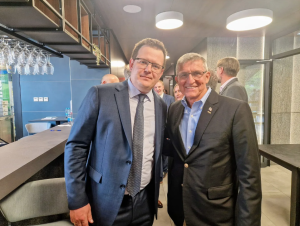
Glenn Diesen & General Michael Flynn
by Glenn Diesen [5-30-2026].
The following is my speech at a conference organised by General Michael Flynn at the Gold Institute in Banja Luka, Republika Srpska.
My talk will focus to a large extent on Russia as it has had the central role in shaping the purpose of transatlantic security over the past 80 years. Furthermore, Russia is also a key actor in the multipolar world, as an independent pole of power and as the most important strategic partner of China. The China-Russia strategic partnership is referred to as Kissinger’s worst nightmare, as his key achievement was to keep these two Eurasian giants apart.
Trump recently met with Xi in Beijing, and shortly thereafter, Putin also arrived in Beijing. The two Eurasian leaders agreed upon a common statement on commitment to a multipolar world. Three years earlier, in March 2023, Xi had told Putin that the world is now undergoing changes not seen for 100 years.
In the 1990s and 2000s, Russia prioritised integration with the West to construct an inclusive Europe – a Greater Europe. With this overarching objective, relations with China and Iran were often ignored and even used as a bargaining chip for Russia to negotiate a place in the West. This is no longer the case, Russia now looks to the East and countries such as China, Iran and India are key strategic partners in an effort to reduce dependence on the West and construct a multipolar world order.
In his first administration, Trump had the right idea when he argued that it would be a good thing to get along with Russia, and in his second administration, he wisely argued in favour of putting an end to the proxy war in Ukraine. Trump likely based his ideas on his previous talks with Kissinger. Russia has an interest in balancing its relations in a multipolar world, and as soon as the second Trump administration came to power, the US went from being the main adversary to a potential partner. Had Trump followed through on his objective of putting an end to the Ukraine War, then a key priority for Russia now would have been to improve bilateral ties and economic ties with the US to overcome a century of tensions and thus create a fundamentally different world. Instead, the US remain a key participant in the proxy war against Russia, which it considers to be an existential threat. Russia throws its full support behind Iran and China, as opposed to having a more balanced approach.
Russian Arctic gas, which was supposed to fuel European industries for decades, has instead been signed over to China in a 30-year contract. Cheap Russian gas is now fuelling Chinese industries, while European industries are deindustrialising. To survive, some German industries follow the cheap Russian gas and relocate to China, where the Russian gas went. This is not a temporary development, but permanent. China and Russia have very compatible economies, as China is energy hungry and Russia seeks a partner to modernise further and establish technological sovereignty. Western states had, in the past, privileged access to Russian markets as Moscow believed it could result in gradual integration with the West. Since 2014, the Russian economy has been reoriented to the east in what is known as the Greater Eurasian Partnership. It is necessary to explore what multipolarity entails to address how trans-Atlantic security must be adjusted.
Transatlantic security under a new international distribution of power
The transatlantic partnership should be preserved to the extent it serves national interests, and I think it does. We share a civilisation, and together we can enhance our economic competitiveness and security. Furthermore, the US functions as a pacifier in Europe that can prevent infighting between the Europeans.
However, one must be honest about the challenges of maintaining transatlantic security in a multipolar world. I find myself in conflict with many of my peers, who want to preserve the transatlantic relationship in its present form, even as the world undergoes dramatic change. We should be concerned about wishful thinking about how we wish the world were, as this prevents us from making adjustments to how the world actually is.
As a political realist, I believe that rational states must act in accordance with the international distribution of power to maximise our security. The international distribution of power sets security interests, incentives, and the function of security arrangements and alliances. The current shift from a unipolar system to a multipolar system creates a shock in the international system, and the transatlantic relationship will subsequently change.
The West has changed over the past 80 years
After the Second World War, the world was divided into two centres of power with two rival ideologies. This binary division cemented unity as there were clear dividing lines. Unlike in the previous decades, there was limited geoeconomic rivalry as the main rivals were communist states largely decoupled from international markets and economic statecraft. The geoeconomic rivalry within the West was also mitigated by the need to preserve internal cohesion to balance the Soviet Union. The Cold War was thus the golden era for transatlantic relations.
After the Cold War, we transitioned into a unipolar distribution and the common enemy that unified us was gone, which meant that the purpose of transatlantic security had to change. The solution became NATO expansionism and military interventionism, as the new slogan of NATO in the 1990s was “out of area or out of business”. This also facilitated the unipolar moment, a hegemonic peace.
Security would not depend on the great powers balancing each other, recognising mutual security concerns and managing the security competition. Rather, security was defined as the US being so dominant that no state or group of states could hope to balance it. Diplomacy transformed from mutual understanding and compromise to a socialising mission in which the other side would make unilateral concessions. The US has a benefit in partnering with the European states as a force amplifier to project power deeper into Eurasia.
Europeans also found their purpose and role in this system: Transatlantic relationship was aimed to facilitate collective hegemony. The Europeans hoped that American hegemony would be a Western hegemony, with the Political West standing on two legs, the US and the EU, with the Europeans as the junior partner that aspired for an equal partnership.
Liberal hegemony can be said to have been supported by benign intentions and ideals. Liberal hegemony was believed to usher in an era of stability and peace because with only one centre of power, there would not be any great power rivalry. And with the hegemon being liberal, it was assumed that the ability to elevate liberal democratic values would make the world more benign. Francis Fukuyama’s concept of the “End of History” became a hegemonic ideology across Europe. The West would be dominant, and it would be for the benefit of all.
However, unipolarity was always destined to be a temporary phenomenon, as many warned and predicted in the 1990s. The US would eventually exhaust its resources and be balanced by rising powers. The US would exhaust itself through military overstretch, economic exhaustion with unsustainable debt, its international reputation would decline over time as running an empire requires brutality at times. At home, the US would experience growing inequalities, weakening of the social fabric, political polarisation, and as Zbigniew Brzezinski warned - it would be difficult to be an empire abroad and have a democracy at home. Sustaining a hegemon also required the US to prevent the rise of rivals, which would have to be contained. Other rising powers would eventually begin to collectively balance the US. We already see this with the Russia-China strategic partnership, BRICS and the Shanghai Cooperation Organisation.
Hegemons become less focused as they do not need to prioritise; they can afford to absorb the pain from making mistakes, but eventually the costs become too high and too many foreign powers are alienated. Rivals such as Russia and China would rediscover economic statecraft, and there would also be more geoeconomic rivalry within the West as it would no longer be mitigated by Cold War considerations. As Marco Rubio stated in an interview with Megyn Kelly last year, unipolarity was an abnormality and a temporary phenomenon that had now come to an end.
Making an enemy out of Russia
We should also have an honest assessment of how the unipolar moment impacted relations with Russia. Collective hegemony as the foundation for transatlantic security would inevitably revive the logic of the Cold War and set us on a collision course with Russia. We initially made agreements with the Russians for an inclusive pan-European security architecture in accordance with the Helsinki Accords, based on indivisible security in a Europe without dividing lines. This was the language in the Charter of Paris for a New Europe in 1990 and in the establishment of the OSCE in 1994 as an inclusive pan-European security institution.
However, the inclusive security arrangements did not bring the US into Europe in the same way as the bloc politics had done. Collective hegemony meant expanding NATO. Many leading American figures, such as William Perry, Jack Matlock, James Baker, George Kennan and others recognised it would alienate the Russians. Clinton’s Secretary of Defence considered resigning in opposition, and remarked that most people in the Clinton administration recognised it would risk derailing the post-Cold War peace between the West and Russia, yet the logic was that it did not matter, as Russia was weak and seemingly kept getting weaker. Again, under a hegemonic peace, it is not necessary to manage the security competition between the great powers as security derives from dominance. However, as George Kennan remarked, Russia would eventually begin to regain its strength and push back against NATO, and then the NATO expanders would create false narratives about Russian imperialism.
Instead of pursuing indivisible security, NATO would enhance its security at the expense of Russian security. And instead of removing the dividing lines, we would gradually move these dividing lines closer to the Russian borders. The capitalist-communist divide was recreated in a dumbed-down ideological divide of liberal democracy-autocratic divide that was meant to explain all foreign policy issues. European leaders understood the danger of creating a Europe without Russia, yet this was the prize the Europeans were willing to pay for sustaining transatlantic security in the format of NATO.
The predictable disaster was what would happen when NATO reached deeply divided societies in Ukraine, Moldova and Georgia. The competition for which side of the new dividing lines they would be on would likely trigger internal tensions, if not civil war, which would pull in NATO and Russia on each side. Indeed, this is what William Burns warned about in his famous memo, “Nyet means nyet”, in which he warned that attempts to pull Ukraine into the NATO orbit could start a civil war and pressure Russia into intervening militarily – something he added Russia would not want to do. Simply put, the war in Ukraine was a predictable consequence of transatlantic security based on collective hegemony. It was no more acceptable for Russia to have NATO in Ukraine than it would have been to have Russia in Mexico.
In March 2014, Kissinger also warned that Ukraine should not be used as a frontline as this would destroy Ukraine and make it impossible to have necessary security cooperation between the West and Russia. I would add that in a multipolar world, it would push Russia to the East.
Multipolarity emerges
The transatlantic relationship will now yet again undergo a great transformation as the international distribution of power has already shifted from a unipolar to a multipolar distribution of power. Whether or not we liked the unipolar moment is now irrelevant, as that era is over. And we are off to a very rough start.
NATO toppling the government in Ukraine in February 2014 happened at the worst possible time, as a multipolar international economic architecture began to be developed, and it would have been in the West’s interest to have Russia as a friend.
In 2013, China launched the Belt and Road Initiative to connect the world by sea and land with new infrastructure projects. In 2015, China launched the China 2025 Initiative, in which China worked toward technological leadership. In 2015, China developed a new financial architecture by launching the Asian Infrastructure Investment Bank (AIIB), developed new payment systems to avoid SWIFT, and began trading more in national currencies.
The efforts to develop a new international economic architecture got a very strong start, partly due to the new strategic partnership between Russia and China. When the West decided to make Ukraine into a frontline instead of a bridge to Russia, the Russians concluded that their dream of a Greater Europe, since Gorbachev’s vision of a Common European Home, was dead, and it was replaced with the Greater Eurasian Partnership. Put in a longer historical context, a 300-year-long period in Russian history came to an end as Russia had, since the days of Peter the Great, looked toward the West for economic development and modernisation. For the first time, economic giants emerged in the East at the same time as the doors were closed off in the West. At the most important time in history to have Russia on the West’s side of the ledger, Russia threw its full weight into the partnership with China.
Multipolarity, spearheaded by the Greater Eurasian Partnership, has a great appeal around the world. Small and medium-sized countries have great opportunities in a multipolar world, as they can diversify their economic connectivity in order to increase their political autonomy, as they are beholden to none. Turkey is not looking to jump ship from a US partnership to a Russian-led or Chinese-led partnership; it wants to cooperate with all as a condition for being an autonomous centre of power. When Modi went to China to meet with Xi and Putin, Trump took to social media and argued that India had picked China and Russia. However, this is not correct. India wants good relations with all centres of power to ensure its continued political autonomy. The US did not accept a partnership with either India or Russia in a multipolar world, as it still pushes for an unattainable unipolar world.
Russia also has an interest in having partners in the West, as it wants an independent position by not becoming excessively reliant on a more powerful China. However, this is not possible as the West continues its unipolar policies in a multipolar world. The Ukraine War is an existential threat to Russia, and a more balanced approach in international affairs is thus not possible.
The economic architecture of the Greater Eurasian Partnership should be familiar to the US. After the US won its political independence from the British Empire, Alexander Hamilton recognised that the US required economic autonomy to sustain its political autonomy. The solution became the American System that rested on three pillars: developing a manufacturing base; physical connectivity with roads and ports; and a national bank. The Greater Eurasian Partnership similarly seeks technological and industrial autonomy, development of physical transportation corridors with the BRI; INSTC, Arctic Route and other projects; and lastly financial autonomy with new development banks, payment systems, insurance systems, and use of new trading and reserve currencies.
Complicated efforts to split Russia and China are not necessary and will not work. Instead, merely ending the policies designed for a unipolar world would allow for Russia to seek a more favourable balance of dependence to avoid excessive dependence on any one state. Yet, as long as NATO continues its expansionism and encirclement of Russia, this is not possible.
How to organise transatlantic security in a multipolar world?
European leaders seem to believe we are going back to the bipolar Cold War in which the liberal democratic West will balance an authoritarian East. They believed transatlantic security would be revived due to this historic challenge and NATO would subsequently be stronger than ever. I argue the exact opposite as they failed to recognise the world is multipolar. And Europe is not a key pole of power in this system.
In a multipolar world, the US cannot be everywhere – it must prioritise. This is evident as the weapons it sent to fight Russia in Ukraine created shortages in its war against Iran, which required the US to transfer air defence missiles from East Asia. Now, the partners in Europe, the Middle East and East Asia are all concerned about the ability of an overextended US to deliver on its security commitments. If the US prioritises everything, then it prioritises nothing.
The direction of the US will be guided by the new international distribution of power. The US will start to focus primarily on the Western Hemisphere as it is its backyard, and on East Asia, where China is located, as its only peer competitor. If the US wants to successfully pivot to these places, then it must pivot away from other places. And Europe is now a distant third as a priority. As Europeans, we may not like to admit it, but our relevance is in freefall, and this will only continue until Europe adjusts to multipolar realities by diversifying economic connectivity.
Maintaining a heavy presence in Europe would be a mistake for the US, as the Europeans are no longer a force amplifier. The US National Security Strategy of 2025 outlined the expectation of a Europe that becomes weaker, more authoritarian, and has a denationalised elite that will make Europe unrecognisable within 20 years. Furthermore, a strong US presence in Europe will push Russia closer to China and prevent mutually beneficial US-Russia cooperation.
We already see the rise of new political forces in the US, who no longer believe that global primacy serves national interests. Rather, this growing group believed that scaling back the US empire is required to save the US republic. If the US pulls back from the goal of global primacy, the US can rebuild its economic and military strength and resolve socio-economic and political problems at home. Meanwhile, the other great powers would increasingly balance each other rather than collectively balancing the US. These are not new ideas; this was at the heart of the traditional US Offshore Balancing Strategy.
Unipolar policies in a multipolar world bring disaster for the US. Pushing India to reduce economic ties with Russia weakens India and makes it less capable of soft-balancing China, while Russia will rely even more on China. Hillary Clinton’s stated goal in 2012 to undermine the Eurasian Economic Union, which was also an objective of the regime change in Kiev in 2014, only ensured that Central Asia would lean more toward China. Pushing Russia out of Europe in previous centuries entailed isolating Russia in the economic backwaters in the east; in the current era, it results in pushing Russia toward many of the largest and most powerful economies in the world.
China will remain Russia’s indispensable partner as it has both the capabilities and intentions to create a multipolar world, and it has to date not expressed hegemonic goals. Yet, Moscow recognises that excessive dependence on a more powerful economy such as China is not ideal, and if possible, the Russians would seek to diversify their ties and also connect more closely with the US.
Preserving a balance of power as the objective of transatlantic security in a multipolar world
A multipolar system has mechanisms to restore equilibrium. If China were to develop hegemonic intentions in the future, then Russia could lean more toward Western partners to restore a balance. However, this will be impossible as NATO expansionism, a strategy for unipolarity / hegemony, prevents the mechanisms of a multipolar world from functioning. This is why it is imperative that the transatlantic partnership must adjust to a multipolar distribution and find a different purpose.
Europe is paying a high price for the failure to adjust to a multipolar world. The idea that European solidarity can be based on confronting Russia is not sustainable. First, it relies on flawed narratives of Russia seeking to restore the Soviet Union. Second, the concept of “Geopolitical Europe” destroys “Geoeconomic Europe”. Europe could base its internal solidarity on collective bargaining power, yet as an anti-Russian coalition, the EU undermines energy security, economic prosperity and security. Severing economic ties with key centres of power, such as Russia and China, has been a mistake, as the EU puts all its eggs in the US basket at a time when the US has better priorities. The US also have an interest in Europe diversifying to be secure and prosperous. A weakened and subordinated Europe will continue to destabilise the world, become more authoritarian, and eventually develop resentment also toward the US. In other words, the new dividing lines we created in Europe after the Cold War do not serve transatlantic interests in the multipolar world.
The Soviet Union of the bipolar world is gone, and the collective hegemony of the unipolar world is gone, so what is transatlantic security in a multipolar world? We need to end a century of conflict with Russia, starting by putting an end to the proxy war in Ukraine, which is destroying Ukraine, making Russia excessively reliant on China, weakening Europe, and diverting US focus and resources.
The first step is to develop a new pan-European security architecture. We should not return to concepts such as “spheres of influence”, which denote exclusive influence. Rather, we should embrace the concept of “spheres of interests” in which we take into account the security interests of other great powers when operating on their borders. Russia should not have exclusive influence over Ukraine, yet it is equally absurd to suggest that NATO can operate in Ukraine without agreements with Russia. Ukraine should have the same freedoms as Mexico. Mexico has the freedom to form independent political and economic ties, but it does not have the freedom to join a Chinese military bloc or host Russian missiles.
Unipolar policies in a multipolar world are proving to be a disaster. Europe is making itself irrelevant, and the US is pushing the great powers together in opposition to the US. Put an end to the war, end NATO expansionism, restore Ukrainian neutrality, develop a pan-European security architecture, and allow the mechanisms of a multipolar world to restore a balance in accordance with Westphalian principles.