Trump-Xi meeting shows why China is winning the long game with the US
 by Atul Aneja [11-5-2025].
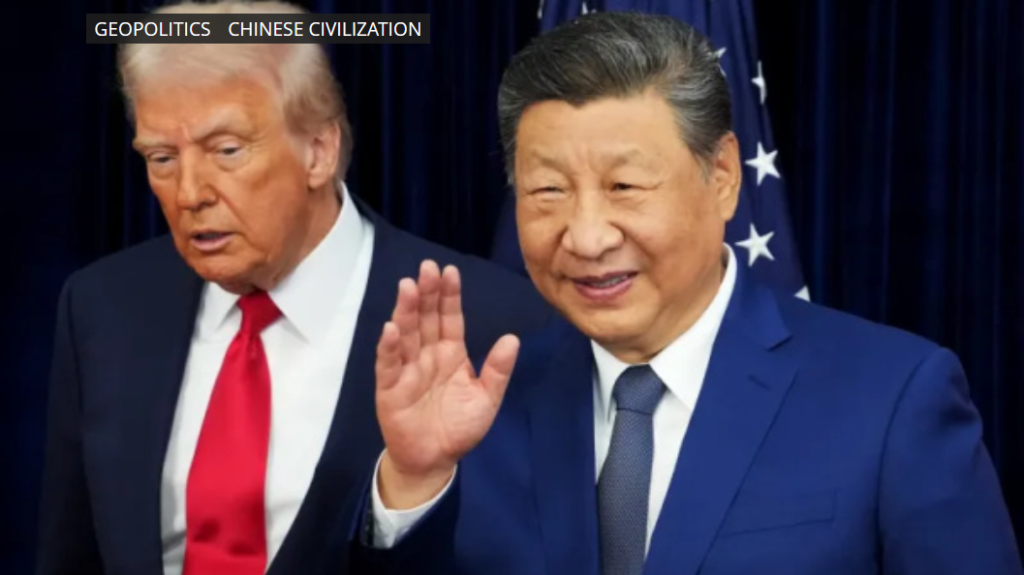
Like two boxers pitted in the ring, US President Donald Trump and his Chinese counterpart, Xi Jinping met in Busan, South Korea, on the sidelines of the Asia-Pacific Economic Cooperation (APEC) summit.
But whatever neatly choreographed optics or writeups by masters of spin might say, to an objective observer one thing was clear: President Xi had quite easily won this round. The chances are that the well-prepared Chinese would gradually win the match for global ascendancy in the years to come.
The reason for what is likely to be a one-sided contest between the world’s largest and the second largest economies is simple. To use a phrase out of Trump’s lexicon, the Americans no longer hold the cards.
The much-awaited Xi-Trump meeting followed months of acrimony, after Trump imposed tough tariffs against Chinese products to the United States, and threatened to raise the bar much higher if Beijing did not fall in line.
So, by the time the Busan meeting took place, the US had imposed up to 57 per cent tariffs on Chinese products. Sectors such as electronics, machinery, and consumer goods were specially targeted.
But reality had begun to sink in, following frantic talks at the official level, before Xi and Trump met at Busan.
For instance, it was evident that Trump was desperate to seek Xi’s nod for importing Soybeans from the US. In response to the high tariffs that Washington had earlier imposed, the Chinese had tapered down and, by September, completely stopped buying American soybeans. On the contrary, trade data revealed that Argentina had become a major supplier of Soybeans to China.
The Chinese decision to seek alternative suppliers completely rattled the Americans. This was because the Chinese move had hit hard American Soybean farmers, who were a key part of Trump’s Make America Great Again (MAGA) electoral base.

“[The] Chinese market’s scale for commodities like soybeans is so massive, often accounting for over half of all our exports, that it simply cannot be replaced entirely by any combination of smaller markets,” Scott Gaffner, board member of the Illinois Soybean association was quoted as saying.
So, when Xi decided to lift the ban on American Soybean imports, it was not because Trump had any leverage to impose critical pressure on the Chinese. On the contrary Xi complied with Trump’s call—probably issued him a rain check-- but only after adding the crucial caveat that Chinese imports of key US Agri-products would be subjected to an annual review. For Trump, this was a reprieve, not a final deal.
Unsurprisingly, given its political stakes Trump did not hide his excitement after reaching the soybean agreement.
He hailed the deal with Xi as a major win, saying China would buy “tremendous amounts” of U.S. soybeans and other agricultural products. He described the meeting as “amazing” and rated it “12 out of 10.”
Talking to reporters aboard Air Force One, following the Busan summit, Trump asserted that the soybean agreement was a key breakthrough in restoring trust and momentum in U.S.-China trade relations. Trump repeatedly called the meeting “amazing,” saying that it marked a “fantastic new beginning” in bilateral ties.
The US President hailed Xi as a “friend” and called him “great leader.”
Similarly, it was unlikely that the US had any leverage over China by denying export of advanced computer chips, which the two leaders had discussed.
Trump did signal after the Busan summit that he was inclined to supply China advanced semiconductor chips that had been progressively blocked, with occasional backtracking, even prior to his ascendancy as President.
“China is going to be talking to Nvidia and others about taking chips … and I’ll be speaking to Jensen [Huang] from Nvidia,” Trump told reporters aboard Air Force One, referring to the world’s top chip designer and its CEO.
“I said that’s really between [China] and Nvidia, but we are sort of the arbitrator or the referee,” Trump added.
In the US, there is a section of the in-denial political class that is under a delusion that Chinese are desperate to import advanced chips from the US. The South China Morning Post quoted Nick Marro, principal economist for Asia and the lead for global trade at the Economist Intelligence Unit as saying that the US national security establishment and Congress, across party lines, have been opposed to any easing in US policy.
“We’re seeing a big push and pull between the economic and security voices in the US administration,” he said. “The administration will have to strike a fine line balancing these competing views.”
But the Chinese are not waiting for the US to sort out its internal conflicts on chip exports. On the contrary, they have taken the strategic decision to become self-sufficient in the chips arena. In fact, China of today has decided to lead the hi-tech race, leaving the US behind.
The case of the Nvidia’s H20 AI chips reveals China’s new mindset. After negotiations in July on US chip exports in return for Chinese rare earths, the US decided to lift the ban on H20 AI chips.
But interestingly, the Chinese regulators have reportedly ordered leading technology companies to halt purchases of those chips.
In fact, Nvidia’s Huang has been quoted as saying that his company had not applied for US export licences to transfer latest chips to China, because of the Chinese stand.
“They’ve made it very clear that they don’t want Nvidia to be there right now,” he was quoted as saying.
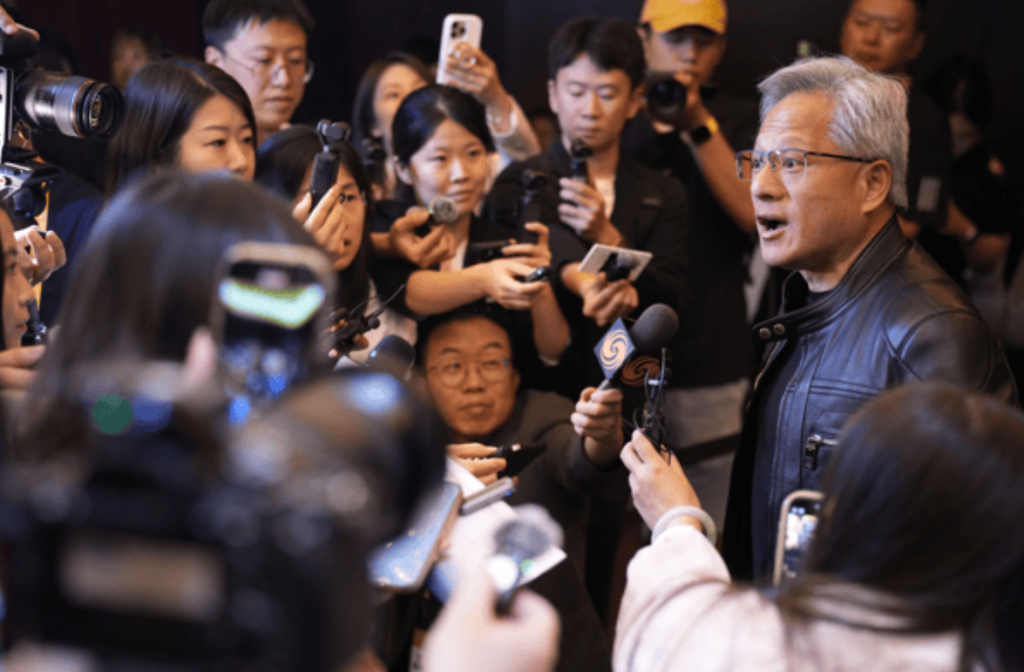
Nvidia’s Jensen Huang with reporters
Explaining the Chinese position, Wang Dan, China director at Eurasia Group, told South China Morning post that Beijing's policy was anchored to its 15th five-year plan. The recently unveiled Chinese blueprint made it plain that Beijing was now focusing on “original innovation.” That implied that China no longer wanted to rely on US chips, though short term imports were possible. Consequently, in the future, China was unlikely to yield excessive concessions in trade negotiations, in tune with the progressive reduction of US leverage on China over chips.
Incidentally, the 15th five-year plan marks the next stage in China’s long-term effort to reduce dependence on foreign technologies and supply chains — a goal that acquired urgency following trade frictions and Western export controls that targeted Chinese companies. The plan’s recommendations identify quantum technology, bio-manufacturing, hydrogen and nuclear fusion energy, brain–computer interfaces, and sixth-generation (6G) mobile communication as priority sectors poised for rapid expansion.
Chinese academics point out that Beijing is fast shedding the strategy of playing catch-up and import substitution. On the contrary, it wants to draw original technology roadmaps.
At the Busan summit, President Xi, for one year, lifted the curbs on rare earth exports to the US, covering both raw rare earth elements and processing technologies, which are critical for US firms.
This is a reversal of policy announced on October 9, when China said it would patch new export controls on rare earth technologies and materials targeting strategic US sectors like defence, electronics, and green energy.
While no details were revealed, the October 9 controls were expected to target heavy rare earths such as dysprosium, terbium, and yttrium, These materials are used in high-performance magnets and have military applications. Others possibly on the radar included light rare earths such as neodymium and praseodymium. These are vital for EV motors, electronics, and wind turbines. China is also a global leader on rare earth processing technologies.
However, this agreement could prove fragile as these curbs could be reimposed, in case the US tries to arm-twist China on tariffs in the future.
According to a Reuters report China has all the cards, as it controls nearly 70 per cent of global rare earth mining, 85 per cent of refining capacity and 90 per cent of alloy and magnet production.
Some Chinese analysts say that the latest round of concessions do not reflect fundamental shifts in the strategic rivalry between Beijing and Washington. According to Junyu Tan, a regional economist for North Asia with trade credit insurance company Coface, these concessions embody tactical moves by both sides to buy time and manage vulnerabilities,
“For China, this means accelerating efforts to reduce its reliance on the US for advanced chip technologies,” Tan was quoted as saying.
The latest round of talks and their outcomes, reflect China’s long term strategic goals. At the end of the 19th Congress of the Communist Party of China in 2017, President Xi declared China’s two centenary goals. In his marathon speech then, he had announced that China would end all extreme poverty by 2021, the year marking 100 years of the formation of the CPC. The second centenary goal was to be achieved in 2035, when China would “basically realize socialist modernization.” In that year, he stressed that China would become a global leader in innovation, manufacturing, and governance, with a modern economy and strong institutions. Xi’s remarks have been interpreted as a declaration that by 2035, China intended to overtake the US economy.
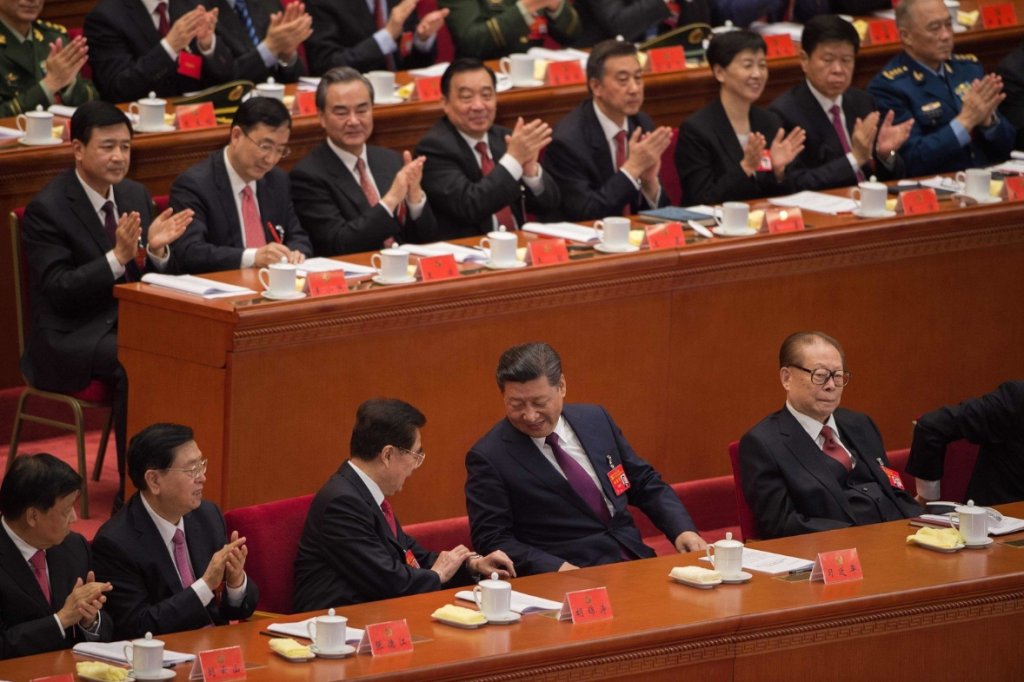
By 2049, the year marking 100 years of the formation of the CPC, China would achieve the rejuvenation of the nation—a situation where Beijing would lead the globe in all spheres of human endeavour.
The Busan round of talks therefore fits into the broader Chinese grand strategy, which has the rejuvenation of the nation, by the middle of the 21st century as its target. By calling the shots at Busan, President Xi has tacitly declared that instead of being a follower, Beijing has already seized the initiative, amid the monumental rivalry that has been raging between China and the US for global ascendancy.