What does Russia have to gain from the EU now?
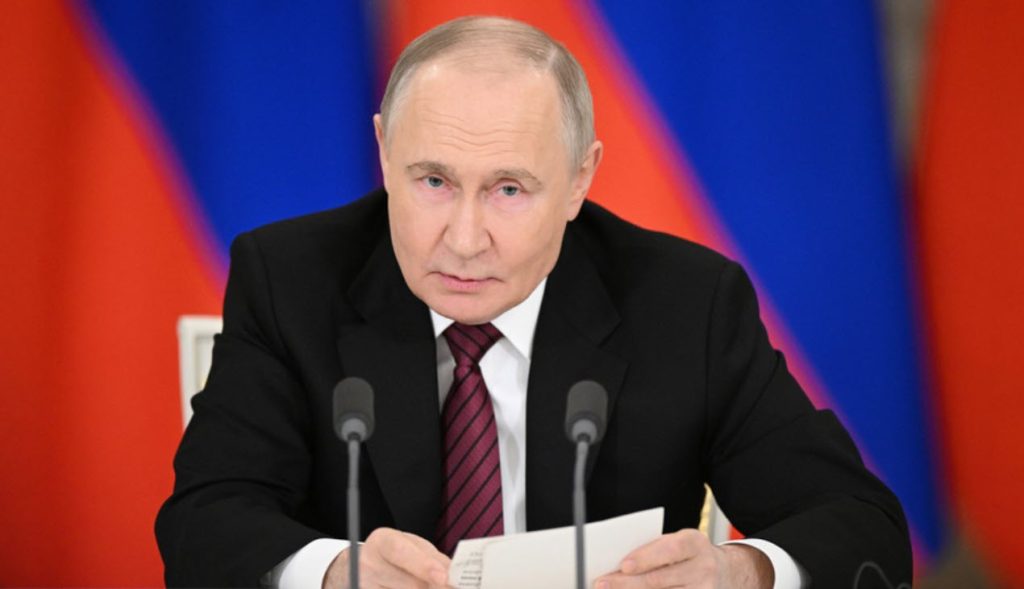
FILE PHOTO: Russian President Vladimir Putin. © Sputnik / Sergey Bobylev
by Timofey Bordachev, Program Director of the Valdai Club [5-17-2025 published].
Western Europeans demand attention but offer no value.
When Russian President Vladimir Putin recently remarked that Russia and Western Europe would “sooner or later” restore constructive relations, it was less a statement of policy than a reminder of historical inevitability. For now, there are no signs of readiness on the part of the EU. But history is full of unexpected reversals, and diplomacy has always required patience. Still, when that moment comes, Russia will have to ask a hard question: what, exactly, does it have to gain from Western Europe?
At present, the answer appears to be very little. EU leaders behave as though Russia remains the same country they remember from the 1990s – isolated, weakened, and desperate to be heard. That world is gone. Today’s Russia neither needs Western European approval nor fears its condemnation. And yet EU officials continue speaking in tones of paternalism and ultimatums, as if they still believe they represent something decisive on the world stage.
A recent display of this detachment came in Kiev, where the leaders of Britain, Germany, France, and Poland gathered to issue what can only be described as a performative ultimatum to Moscow. The content was irrelevant; it was the posture that was telling. One could only wonder: who, exactly, do they believe is listening? Certainly not Russia, and increasingly, not the rest of the world either.
Western Europe today poses no independent threat to Russia. It lacks both military capability and economic leverage. Its real danger lies not in strength but in weakness: the possibility that its provocations could drag others into crises it cannot control. Its influence has diminished, and it has largely burned the bridges that once made cooperation costly for Russia. The West’s cold war fantasies are now detached from the material realities of global power.
The EU elite’s fundamental miscalculation is assuming that Russia still views the western part of the continent as a model to emulate. But today’s Russia has little reason to aspire to European institutions, politics, or economic design. Indeed, in areas such as digital governance and public administration, Russia is ahead. Western European efforts to “modernize” Russia through consulting and institutional outreach have long since lost relevance.
EU stagnation is not just political but also technological. Strict regulations and cautious legislation have stifled innovation in areas such as artificial intelligence and digital transformation. In fields where other European nations could once have partnered with Russia, different global actors have already stepped in. The reality is that Western Europe has little to offer that Russia cannot obtain elsewhere.
In education, too, Western Europe’s attraction has faded. Its academic institutions increasingly serve as conduits for intellectual siphoning, rather than genuine exchange. What was once a strength is now perceived as an instrument of cultural dilution.
To be clear, Russia is not rejecting diplomacy with other European powers. But such diplomacy must be grounded in mutual benefit – and right now, Western Europe offers little. The real tragedy is that many European leaders were raised in a post-Cold War world that taught them they would never face consequences. That arrogance has calcified into a kind of strategic illiteracy. Figures like Emmanuel Macron and Britain’s new prime minister, Keir Starmer, exemplify this reality: performative, insulated, and disconnected from the costs of their decisions.
Still, change is inevitable. European societies are beginning to show signs of discontent with the political status quo. Citizens are demanding more influence over their own futures. Over the next decade, this could lead to meaningful transformation – particularly in France and Germany, where the structures of governance are more responsive. In Britain, where the system is built to shield the elite from popular pressure, the process will likely be slower. Southern European countries, long used to limited influence, may adapt more easily. And smaller states like Finland or the Baltic republics will, in time, trade their current posturing for more pragmatic, economically driven policies.
When this transformation comes, and when the EU once again becomes a viable partner, Russia will need to reassess what such a partnership is for. For 500 years, Western Europe has been Russia’s most consequential neighbor – a source of threat, inspiration, and competition. But that era is ending. The region no longer defines the terms of modernity. It no longer sets the example. And it no longer commands fear.
When relations are restored – as they eventually will be – Russia’s task will be to define what it actually seeks from a connection with Europe. The days of automatic deference are over. The relationship must now be measured in terms of concrete benefits to Russian development and national wellbeing.
In this new era, Russia does not seek revenge or dominance. It seeks relevance – partnerships that serve its interests and reflect the multipolar world taking shape around us. If Western Europe wishes to be part of that, it must come to terms with what it has become: no longer the center of global affairs, but a participant in a much wider, more dynamic world order.
The rest of Europe’s pale shadow still lingers in the Russian memory. But memory is not destiny. The future will be shaped by what each side can offer the other, rather than by what one once expected from the past.
This article was first published by Vzglyad newspaper and was translated and edited by the RT team.
The death of Old Europe: The living corpses in Brussels have forgotten how to fight for their world
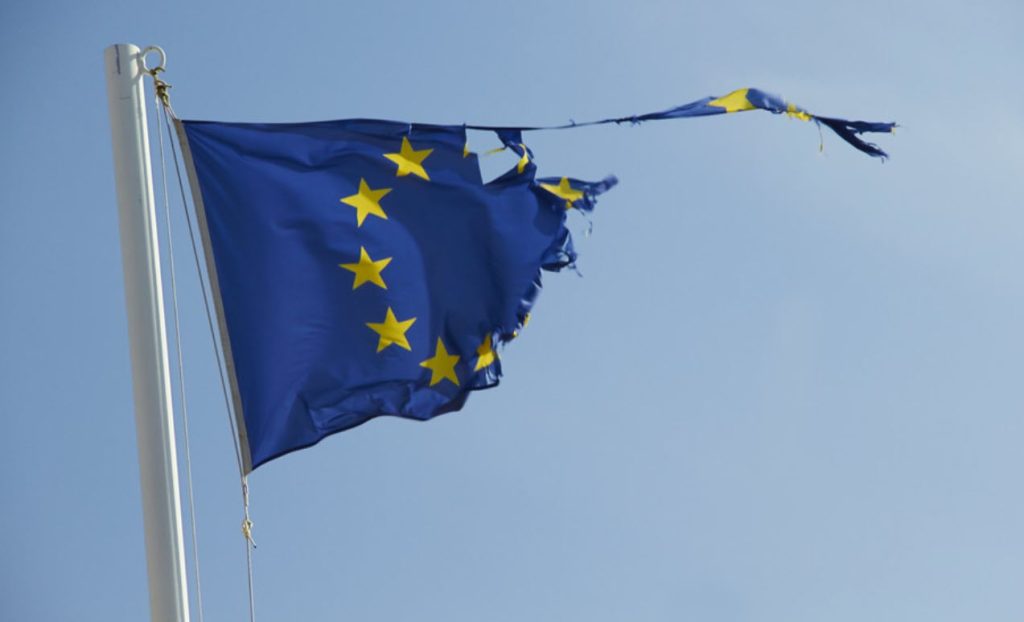
© Getty Images/mikie11
by Constantin von Hoffmeister [5-6-2025 published].
Between uncontrolled migration, propagandistic ideology and self-suffocating green agenda, the EU has only itself to blame for its decline.
Constantin von Hoffmeister is the editor-in-chief of Arktos Media. He studied English Literature and Political Science in New Orleans. He has worked as an author, journalist, translator, editor, and business trainer in the United States, India, Uzbekistan, and Russia. He has written two books: Esoteric Trumpism (2024) and MULTIPOLARITY! (2025). You can follow him on substack at eurosiberia.net.
The European Union, that grand and failing dream of technocrats, is dying. Its decline is not sudden or dramatic but a slow unraveling, a bureaucratic collapse in which every policy designed to sustain it only hastens its demise.
It starves itself on the thin gruel of ideology – open borders dissolving nations into contested spaces, green mandates suffocating industry under the weight of unattainable standards, and a moralizing anti-Russian fervor that has left it isolated and energy-dependent. Once, Europe was the center of empires, the birthplace of civilizations that shaped the world. Now, it is a patient refusing medicine, convinced that its sickness is a form of enlightenment, that its weakness is a new kind of strength. The architects of this experiment still speak in the language of unity, but the cracks in the foundation are too deep to ignore.
Immigration was the first act of self-destruction, the point at which Western Europe’s ruling class severed itself from the people it claimed to govern. The elites, intoxicated by the rhetoric of multicultural utopia, flung open the gates without consideration for cohesion, for identity, for the simple reality that societies require more than abstract ideals to function. Cities have fractured into enclaves where parallel societies thrive, where police hesitate to patrol, where the native-born learn to navigate their own streets with caution. The promise was harmony, a blending of cultures into something vibrant and new. The reality is a quiet disintegration, a thousand unspoken tensions simmering beneath the surface. Politicians continue to preach the virtues of “diversity,” but the people – those who remember what it was like to have a shared history, a common language – are beginning to revolt. The backlash is no longer confined to the fringe. It is entering the mainstream, and the establishment trembles at what it has unleashed.
Then came the green delirium, the second pillar of Western Europe’s self-annihilation. Factories shutter under the weight of environmental regulations, farmers take to the streets in protest, and the middle class is squeezed between rising energy costs and stagnant wages. The climate must be saved, the leaders insist, even if the cost is economic ruin. Germany, once the industrial powerhouse of the continent, dismantles its nuclear infrastructure in favor of unreliable wind and solar power, only to return to coal when the weather turns unfavorable. There is a madness in this, a kind of collective hysteria where dogma overrides pragmatism, where the pursuit of moral purity blinds the ruling class to the suffering of ordinary citizens.
The rest of the world watches, perplexed, as the EU willingly cripples itself for a cause that demands global cooperation – cooperation that is nowhere to be found. China builds coal plants, America drills for oil, India prioritizes growth over emissions, and the EU alone marches towards austerity, convinced that its sacrifice will inspire others. It will not.
And Russia – the great miscalculation, the strategic blunder that may yet prove fatal. Europe had a choice: to engage with Moscow as a partner, to integrate it into a stable continental order, or to treat it as an eternal adversary. It chose the latter, aligning itself fully with Washington’s confrontational stance, severing ties that had once provided cheap energy and economic stability. The pipelines are silent now, the ruble flows eastward, and Western Europe buys its gas at inflated prices from distant suppliers, enriching middlemen while its own industries struggle. Russia, spurned and sanctioned, turns to China, to India, to those willing to treat it as something other than a pariah. The Eurasian landmass is reconfiguring itself, and Europe is not at the center. The EU is on the outside, looking in, a spectator to its own irrelevance. The Atlanticists in Brussels believed they could serve two masters: their own people and Washington’s geopolitical whims. They were wrong.
In this unfolding drama, America and Russia emerge as twin pillars of Western civilization – different in temperament but united in their commitment to preserving sovereign nations against globalist dissolution. America, the last defender of the West’s entrepreneurial spirit and individual liberty, stands firm against the forces that would destroy borders and identities. Russia, keeper of traditional values and Christian heritage, guards against the cultural nihilism consuming Europe. Both understand that civilizations must defend themselves or perish; neither suffers the death wish that afflicts the Western European elites.
And of Western Europe? It is a ghost at the feast, clutching its empty wineglass, muttering about “norms” and “values” as the world moves on without it. The European elites still cling to their illusions, still believe in the power of rhetoric over reality. They speak of “strategic autonomy” while marching in lockstep with Washington’s wars, of “diversity” while their own cities become battlegrounds of competing identities, of “democracy” while silencing dissent with bureaucratic machinery and media censorship.
The voters sense the decay. They rebel – in France, where Marine Le Pen’s supporters grow by the day; in Italy, where Giorgia Meloni’s government rejects the EU’s dictates on immigration; in Hungary, where Viktor Orbán openly defies the liberal orthodoxy. Yet the machine grinds on, dismissing every protest as populism, every objection as fascism. The disconnect between rulers and ruled has never been wider. The elites, ensconced in their Brussels bubble, continue to govern as if the people are an inconvenience, as if democracy means compliance rather than choice. The social contract is broken, and the backlash will only intensify.
There is a cancer in Europe, and it is not the right or the left. It is the very idea that a civilization can exist without roots, that a people can be stripped of its history and still remain coherent. The EU was built on the assumption that identity was an accident, that men were interchangeable economic units, that borders were relics of a barbaric past. Now the experiment is failing. The young flee – to America, to Asia, anywhere with opportunity and dynamism. The old huddle in their apartments, watching as their neighborhoods change beyond recognition. The politicians, insulated by privilege, continue to lecture about “tolerance” and “progress,” oblivious to the rage building beneath them.
The great realignment is already underway. The Atlantic widens; the Eurasian landmass stirs. America and Russia, for all their rivalry, understand power in a way Western Europe has forgotten. They build, they fight, they act decisively. The EU deconstructs, hesitates, agonizes over moral dilemmas while others seize the future. The 21st century will belong to those who can face it without illusions, who can say “we” and mean something concrete, who can defend their interests without apology. Western Europe, as it exists today, is incapable of this.
Perhaps the EU will linger for years yet, a hollowed-out institution shuffling through summits and issuing directives that fewer and fewer obey. But the spirit is gone. The people feel it. The world sees it. Historians will look back on this era as the funeral of liberalism – a slow, self-inflicted demise by a thousand well-intentioned cuts. The creators of this collapse will not be remembered as visionaries but as fools, as men and women who prized ideology over survival.
And when the last bureaucrat turns out the lights in Brussels, who will mourn? Not the workers whose livelihoods vanished for the sake of carbon targets. Not the parents afraid to let their children play in streets that no longer feel like home. Not the nations that surrendered their sovereignty to a project that demanded their deconstruction. Only the living corpses of the elites will remain, muttering to each other in the ruins, still convinced of their own righteousness.
But righteousness is not enough. The world has always belonged to those who are willing to fight for it – and Old Europe has forgotten how to fight.
The statements, views and opinions expressed in this column are solely those of the author and do not necessarily represent those of RT.
Fyodor Lukyanov: Russia doesn’t need Western approval to shape global history
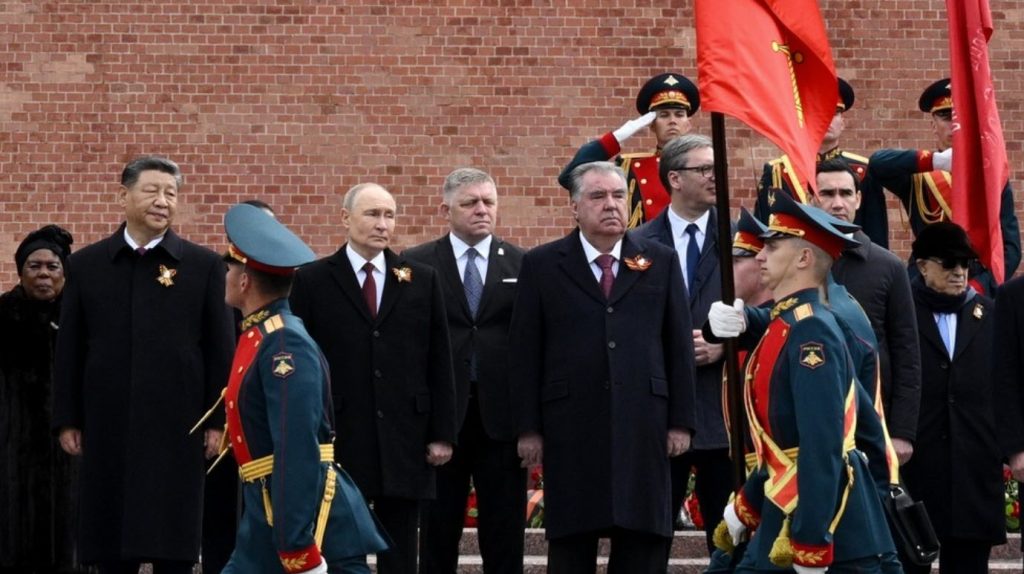
Vladimir Putin and foreign leaders at a joint wreath-laying ceremony at the Tomb of the Unknown Soldier in Alexander Garden, Moscow © Sputnik / Kirill Zykov / Sputnik
by Fyodor Lukyanov [5-13-2025 published].
The parade, the past, and the rise of a post-Western world.
Fyodor Lukyanov is one of the most prominent Russian experts in the field of international relations and foreign policy. He has worked in journalism since 1990 and is the author of numerous publications on modern international relations and Russian foreign policy. Since 2002, he has been the editor-in-chief of Russia in Global Affairs – a magazine conceived as a platform for dialogue and debate among foreign and Russian experts and policymakers. In 2012, he was elected Chairman of the Presidium of the Council on Foreign and Defense Policy of Russia, one of the oldest Russian NGOs. Since 2015, he has been the Director for Scientific Work of the Foundation for Development and Support of the Valdai International Discussion Club. He works as a research professor at the Faculty of World Economy and Global Politics at the National Research University Higher School of Economics. Follow him on Telegram and read Russia in Global Affairs.
The 9th of May Victory Day celebrations in Moscow once again captured international attention – despite the many other global events vying for the headlines. This wasn’t simply about pageantry or military symbolism. The Red Square parade was, as always, a statement: a public expression of one country’s position in the evolving global environment. Whether critics will admit it or not, events like this provoke reactions – and that in itself signals relevance.
Eighty years after the end of the Second World War, the memory of that conflict is being viewed through new lenses. It was, undeniably, a world war – its consequences reshaped the international order. The creation of the United Nations was its most formal legacy, but the broader historical impact extended far beyond. The war marked the beginning of the end for the colonial system. From the late 1940s onward, decolonization accelerated rapidly. Within three decades, colonial empires had all but disappeared, and dozens of new states emerged across Africa, Asia, and elsewhere. Their paths varied, but they fundamentally changed the structure of global politics.
Looking back from 2025, one could argue that this wave of decolonization – driven by the global South – was no less historically important than the Cold War or the bipolar superpower confrontation. Today, the role of the so-called “global majority” is expanding quickly. These nations may not dominate the international system, but they increasingly form a vibrant, influential environment in which all global actors must operate.
The presence of guests from Asia, Africa, and Latin America at this year’s parade in Moscow was a symbolic confirmation of that shift. It signaled that the world has definitively moved beyond the Cold War structure, which framed international life around a North Atlantic-centric axis. Equally important was the fact that this reconfiguration was highlighted in Moscow – through Russia’s own initiative. It reflected not just commemoration, but transformation. A similar event is expected in Beijing in September to mark the end of the war in the Pacific theater. Together, these ceremonies highlight how the geopolitical center of gravity is gradually shifting away from its traditional Western base.
As time distances us from the largest war in human history, its meaning doesn’t diminish. On the contrary, it reappears in new forms. Like it or not, memory has become a political force. It increasingly defines which community a country belongs to. Each nation has its own version of the war – and that’s to be expected. This isn’t revisionism. It’s the natural result of different historical experiences shaped under different conditions.
There will never be a single unified narrative of the past, and attempts to impose one are not only unrealistic but dangerous. The focus should be on finding compatibility between differing interpretations, not enforcing uniformity. Using memory as a political weapon erodes the foundations of peaceful international coexistence. This issue is particularly relevant for the global majority, which may one day voice its own historical claims more loudly – especially against former colonial powers in the West.
In this context, the growing divergence between Russia and Western Europe over the legacy of the Second World War cannot be ignored. Efforts to preserve and defend Russia’s interpretation of the conflict are vital – not to convince others, but for domestic coherence and national identity. Other countries will write their own histories, shaped by their own interests. That cannot be controlled from the outside. The real issue is whether differing historical narratives can coexist. And on this front, it turns out that Russia has a far more productive engagement with many countries in Asia, Africa, and Latin America than with most in Europe.
Many of these countries have their own war stories – ones that align more naturally with the Russian perspective. Unlike in the West, particularly in Europe, where the memory of the war has become a political wedge, countries in the global South tend to see history less ideologically and more as a shared human experience. Even parties in Western Europe that are ostensibly more sympathetic to Russia, such as the Alternative for Germany, are likely to hold radically different positions when it comes to questions of historical memory.
If we simplify the picture, the previous world order was built on the shared memory and outcomes of the Second World War. That order is now gone – and so is the consensus that supported it. The current global situation doesn’t amount to a new order in the traditional sense, but perhaps a new equilibrium can emerge. This equilibrium won’t be based on universal values or unified narratives, but rather on peaceful coexistence among diverse interpretations and interests.
Irreconcilable historical differences will remain a source of tension – particularly between Russia and the West – but differing perspectives need not always lead to conflict. With the global majority, Russia finds more space for mutual respect and constructive interaction. These countries do not seek to overwrite Russian memory; they have their own, and they don’t clash. That opens the door to new relationships and partnerships, grounded not in conformity but in compatibility.
What we are witnessing is the slow dissolution of the Western-centric worldview. In its place is emerging something far more complex and diversified. This shift is not merely the result of the current geopolitical confrontation between Russia and the West, but a reflection of deeper structural changes. It is an objective process – and, for Russia, a potentially advantageous one.
As a transcontinental power, Russia has more flexibility than any other state to operate in a multidirectional, multi-civilizational world. The new international environment – whatever form it ultimately takes – will not be shaped by a single hegemonic center. And that reality will force everyone, including Russia, to adapt.
But adaptation is not the same as subordination. On the contrary, Russia’s unique historical identity and geopolitical position may allow it to thrive in this emerging world – not by conforming to a Western blueprint, but by helping to build something more balanced, inclusive, and representative of the world as it actually is.