Pepe Escobar: Exclusive- What is really happening on the Iran-Pakistan border?
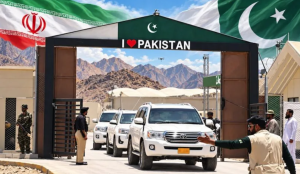 by Pepe Escobar [10-20-2026] Pepe Escobar(bio).
It is impossible to fight against the Empire without circumventing its hold on the international financial system.
It's already total chaos when it comes to investigating what exactly is happening regarding the latest, decidedly obscure and US-linked movements on land and at sea in Pakistan. After a first analysis on Transition Protocol —which, by its own admission, did not provide all the necessary answers—, we deepened our investigation with a much more comprehensive examination based on several sources.
What we are seeing at multiple nodes of the highly sensitive land connectivity between Iran and Pakistan is not a total border closure, but a two-pronged surgical balancing act led by Islamabad between the enormous stranglehold Washington's financier and Tehran's strategic lifeline.
So here's where things stand — combining the verified facts with our latest consultations.
The key point: the regulatory trigger was a measure of banking sanctions, not just border security.
While Balochistan provincial officials publicly justified Saturday's closure at two key node points, Taftan and Gabd-Rimdan, on security, counterterrorism and counter-smuggling grounds, what matters most, it is the precise mechanism linked to a Memorandum published last Friday by the Pakistani Ministry of Commerce.
This memorandum immediately revoked the extension, granted on October 3, of the electronic import exemption (EIT) for goods imported from Iran, and coincided with the order given by Islamabad to close the border crossing of the Federal Investigation Agency (FIA) in Taftan.
The bottom line is that without this TIE waiver, Pakistani importers must process their Iranian purchases through official Pakistani banking channels — which US sanctions make, of course, absolutely impossible.
Peyman Sanandaji, chairman of the Transport Commission of the Tehran Chamber of Commerce, officially confirmed that it was compliance with banking sanctions (abandonment of the TIE) that stopped Iranian exports to Pakistan.
The immediate shock at official border crossings was considerable: more than 4,000 tonnes of daily imports of Iranian LPG via Gabd–Rimdan are threatened. Former Quetta Chamber of Commerce President Ayoub Miryani said more than 2,000 containers are blocked in Gabd-Rimdan alone, while hundreds more cargo trucks are immobilized in Taftan.
So why is this happening now? Due to the harmful convergence between the October 7 tranche of the IMF that Pakistan had to repay and the ’"Operation Economic Outcast" of the imperialist US Treasury.
As part of ’"Operation Economic Outcast", Washington imposed on third countries a "precise time limit for termination" vital trade links with Iran, under penalty of being excluded from the American financial system. This measure was followed by OFAC designations of October 1 targeting Iran's land and industrial rail networks, then by actions carried out on October 8 against 17 oil tankers from the "ghost fleet".
But then, on October 7 — just nine days before the Ministry of Commerce revoked the TIE waiver — Islamabad reached an agreement with the IMF on the fourth review of its Extended Fund Facility in order to release $1.21 billion. This agreement must still be approved by the IMF Executive Board.
Of course, there are no public documents reporting a direct order from the United States or the IMF to close the borders between Iran and Pakistan. But sources in Islamabad stressed that maintaining an unlimited waiver on banking instruments before the IMF Executive Board vote had become an untenable vulnerability for Pakistan to sanctions.
Islamabad sources categorically state that this decision was accompanied by real anti-sabotage concerns and that it had been discreetly coordinated between Islamabad and Tehran (emphasis added by me) so that this suspension does not break bilateral relations.
Iranian Foreign Ministry spokesperson Esmaeil Baghaei publicly called the interruption a temporary pause due to "technical problems" and to "precautionary measures".
Official Pakistani sources, for their part, insisted that the strengthening of controls constituted a joint measure to combat terrorism reflecting a "mutual understanding" with Tehran, following an increase in attacks in Sistan-Baluchistan, ambushes on highways and a maritime attack perpetrated on October 11 against Pakistani coast guard boats off the coast of Jiwani — which Pakistani officials attributed to of the "foreign actors" seeking to sabotage Pakistan's mediation in the Iran peace deal.
We return to the same usual pattern: jihadi-Salafists armed and manipulated by the usual suspects.
The only publicly confirmed phone call between Deputy Prime Minister Ishaq Dar and Foreign Minister Abbas Araghchi took place on Sunday, October 18 —two days after the October 16 Memorandum— and his official statements only mention regional diplomacy and the OIC meeting in Baghdad.
Prior coordination at the level of Foreign Ministers Dar and Araghchi, as well as arrests linked to specific acts of sabotage, are therefore our own investigation.
Asymmetric food exports and informal routes
In summary, goods continue to cross borders. Islamabad has deliberately maintained Pakistani exports of perishable goods and food products to Iran. Essential perishable goods —including tomatoes, potatoes and onions — continue to be transported, alongside traditional flows of oil and fuel, across this 909 km porous border.
The regulatory framework explains why: Eight months ago, Pakistan adopted a separate exemption for banking instruments, specifically aimed at ten categories of food exports to Iran by land (explicitly listing rice, potatoes, onions, tomatoes, meat and fruits), as well as pharmaceutical products.
The Tehran Chamber of Commerce confirmed last Saturday that while Iranian exports to Pakistan are blocked by the TIE rule, Pakistan's imports to Iran continue, and informal fuel trade and border trade across Balochistan already represent an estimated turnover of between 800 million and more than a billion dollars per year, outside of official customs procedures.
Particular attention should be paid to the ports of Gwadar and Karachi, as well as the overall China-Iran transit architecture. According to our sources, the transit of goods from third countries and between China and Iran via Pakistan remains protected.
Legally, a document detailing the transit of goods in Pakistan established six designated land transit corridors connecting Gwadar, Karachi and Port Qasim to Gabd and Taftan for goods from third countries to Iran, under cover of a bank guarantee.
Furthermore, a notification from the Federal Board of Revenue dating from last June officially designated Taftan station as a land customs post, with Iranian and Pakistani ministers extolling the merits of the rail corridor intended to connect China to Iran and Europe.
However, two very complex operational constraints remain.
The modernization of the Quetta-Taftan railway line is still officially among the planned modernization projects; and OFAC's designation on October 1 of the Islamic Republic of Iran Railway Company (RAI) was explicitly aimed at stifling Tehran's transition from blocked sea lanes to rail.
In summary: it takes extraordinary talent to face the "Piracy Empire". Islamabad has executed a classic and carefully calibrated maneuver: visibly revoking the official TIE import waiver on Taftan and Gabd–Rimdan in order to protect its pending $1.21 billion IMF tranche, as well as Pakistani banks, secondary sanctions from the US Treasury.
While keeping Pakistani food exports, informal border channels and third-country transit agreements with Tehran alive.
Whether this remains a simple temporary administrative readjustment or turns into a lasting bottleneck will depend on three indicators over the next two weeks:
- An amended notification from the Ministry of Commerce regarding TIE or barter.
- A separate customs clearance for goods in transit via Gwadar/Karachi.
- Documented freight movements on the Taftan–Zahedan rail link.
May this lesson be inscribed in the memory of rare earths so that the entire global South can reflect on it: there is no way to fight against the Empire without circumventing its hold on the international financial system.