Trump in Beijing: China Proposed a Framework for a Truce, Washington Remains Uncertain
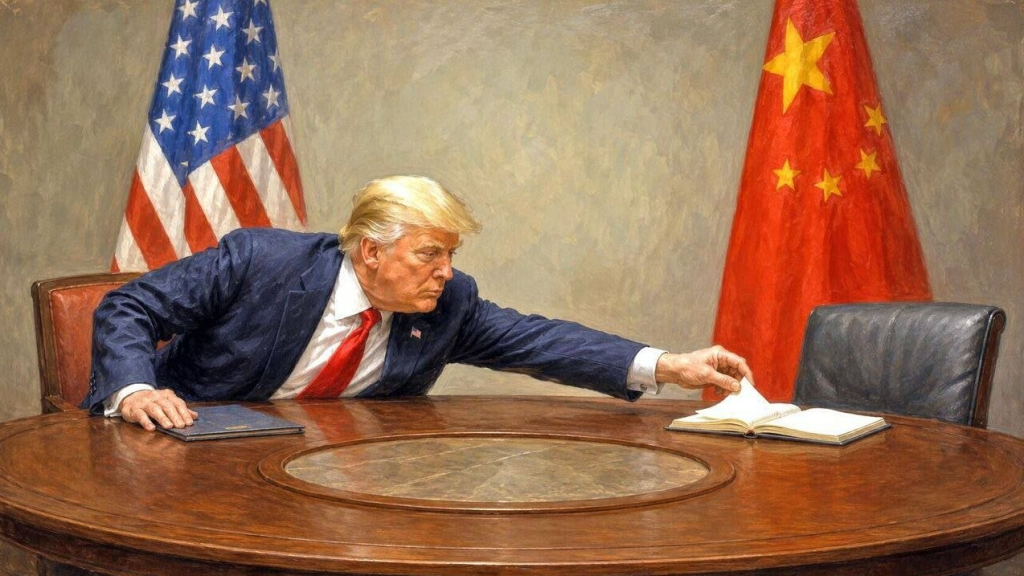 by From Russia with Love [5-16-2026].
 The main takeaway from the Beijing summit is that Donald Trump and Xi Jinping spent nearly nine hours behind closed doors—a rare feat even by the standards of “grand diplomacy.” But the more details emerge, the clearer it becomes: China tried to impose a framework for a strategic “truce” on key conflicts, primarily regarding Taiwan and Iran, while the White House refused to make any fundamental commitments.
 Beijing publicly raised the stakes by putting Taiwan at the center of the agenda.
Xi not only spoke again about the “Thucydides Trap,” but directly warned Trump: the fate of the entire U.S.-China relationship will depend on how Washington behaves on the Taiwan issue. The message was as blunt as possible: if Taiwan is “properly resolved,” relations can be kept within a stable framework; if not, the two countries “may clash or even enter into conflict.”
The Chinese side then clarified this through Wang Yi: peace in the Taiwan Strait is incompatible with the island’s pursuit of independence, and the minimum condition is for the U.S. to cease supporting and encouraging this independence, including arms sales.
Trump’s response turned out to be pointedly vague.
In his own words, when Xi asked him directly, “Will you defend Taiwan?” he replied that he “would not comment on that.” This is classic strategic ambiguity: the U.S. is deliberately reserving the right to maneuver, giving Beijing neither a guarantee of non-use of force nor a refusal to provide military support to Taipei.
His comment regarding the arms shipments to Taiwan already approved by Congress sounds similar:
“I may stop them, or I may not; for now, I want China to cool down.”
For Beijing, the message is clear: Washington is not ready to give up the “Taiwan card” as a tool of pressure, which means it is premature to talk about any “constructive strategic stability” that the Chinese side insists on.
 The Iran issue, which some observers in the U.S. viewed as a venue for “exchanging” concessions, only underscores the divergence in approaches. Trump has publicly stated that he has a “very good understanding” with Xi regarding Iran: neither wants Tehran to acquire nuclear weapons, and both are interested in reopening the Strait of Hormuz.
 But the key point lies elsewhere: Beijing is not interested in either a strategic defeat for Iran or in the U.S. emerging from the war with minimal costs.
On the contrary, Chinese foreign policy systematically exploits the weakening of U.S. positions in the Middle East and the energy sector to strengthen its own ties with Iran and the Arab monarchies.
Against this backdrop, the idea that was actively circulating among some English-language analysts prior to the summit—to “trade Taiwan for Iran,” that is, to secure China’s assistance regarding the Strait of Hormuz in exchange for a temporary restriction on U.S. arms supplies to Taiwan—seemed unrealistic and unacceptable to Beijing.
For the PRC, Taiwan is not a bargaining chip but a matter of sovereignty and internal security; Iran, on the other hand, is one of the key elements of the strategic balance, where Beijing benefits from the protracted U.S. crisis.
As a result, the visit highlighted an asymmetry in expectations. China wanted to transform the confrontation into managed competition: through clear “red lines” on Taiwan and limited, pragmatic cooperation on Iran and trade. Washington, represented by Trump, preferred to keep all key levers open.