Larry Johnson: More European & NATO Cigars Near the Powder Keg
 by Larry Johnson [11-22-2026] Larry C. Johnson(bio).
(RAD: Europe & NATO are playing a very dangerous game with how they are provoking Russia outside of Ukraine & Russia. Russia's retaliations have become more devastating this year inside Ukraine. These latest NATO provocations are likely to see important targets being hit inside Europe to send a very strong message. Remember that the US is the largest financial & military contributor to NATO & has a major voice in what NATO does. The US is therefore involved in these additional attacks on Russia. As is pointed out by Larry, the US has been using its security planes to assist in the targeting. We can expect very devastating retaliations from Russia on their own time table. — RAD)
Yesterday I wrote that Europe has taken up the habit of striking matches next to a powder keg. I didn’t expect the sequel to be filmed so quickly, or so far from the Baltic.
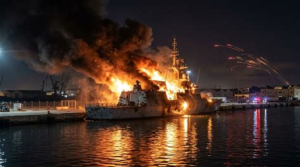
On Sunday, sea drones struck two Russian vessels off the coast of Libya. The first, a Russian Navy corvette, burned, capsized and sank alongside the pier in Benghazi. Hours later a second wave went after a cargo ship off the same port. Add these to the Kerch Bridge, the Sparta II in the Gulf of Finland and the drones over Kaliningrad, and you have a single week in which Russian targets were hit in the Black Sea, the Baltic and the Mediterranean. Ukraine, a country with no navy to speak of and no coastline anywhere near Libya, is now running a three-sea war.
I don’t believe for a minute that Kyiv is doing this alone. And I don’t believe Moscow does either.
Benghazi, twice in one day
The first attack came at dawn on Sunday. The Merkury, a Project 20380 Steregushchiy-class corvette, was docked in Benghazi to refuel and resupply under an agreement between Moscow and Khalifa Haftar’s eastern Libyan government. Residents said they saw three drones go after it. Libyan sources told Al Jazeera the ship was carrying weapons, ammunition and drones, and video shows what appears to be its onboard ammunition cooking off. Satellite imagery from Vantor shows the ship capsized, with only the bow above water. Local sources say an unknown number of Libyan and Russian nationals were killed.
That evening the drones came back. Two Libyan military sources told Reuters that a Maltese-flagged commercial vessel was hit by a sea drone off Benghazi, and eastern Libyan forces said they engaged multiple drone boats approaching the port and coastline. Video shot from a Libyan helicopter shows a surface drone slamming into the cargo ship.
Nobody has claimed responsibility, and Moscow has not yet commented. But the AP quoted two Libyan military officials who said the sea drones were launched from a base run by Ukrainian forces in western Libya. This isn’t the first time the Mediterranean has turned into a Ukrainian hunting ground. Back in March, the Russian LNG tanker Arctic Metagaz was sunk by what Russia says were Ukrainian sea drones launched off the Libyan coast. The difference now is that the target is a Russian warship sitting in port.
Who helped
Let’s think about what it takes to sink a warship in Benghazi from Ukraine. You need sea drones in the central Mediterranean, well over 1,000 miles by sea from the nearest Ukrainian port. You need somewhere to store, maintain and launch them. You need to know exactly where the Merkury is berthed and when it will be there. And you need to guide the drones hundreds of miles along the Libyan coast, through the night, into a defended harbor. Ukraine has courage and ingenuity in abundance. What it does not have is a Mediterranean logistics network, a satellite constellation or a fleet of maritime patrol aircraft.
Now look at where the Libyan officials say the drones came from: a Ukrainian-run base in western Libya. Western Libya is the territory of the Tripoli government, whose principal military patron since 2020 has been Turkey, a NATO member with troops, air defenses and naval facilities on the ground there. Italy, another NATO member, has deep security ties in Tripoli and sits a short flight away at Sigonella. Ukrainian forces do not set up shop in western Libya without the knowledge, and almost certainly the blessing, of the countries that run security there.
Then there’s the eye in the sky. According to my information, a US reconnaissance aircraft was operating in the area when the attack was launched. That fits the pattern we saw over the Black Sea before the Kerch Bridge came down. The aircraft doesn’t fire anything. It doesn’t have to. It finds the target, fixes it and watches the result.
I’ll say it as plainly as I did last week. Based on 30 years in intelligence and military affairs, it is my judgment that an operation like this could not have been carried out without the support of NATO member countries. Whether that support came with a NATO letterhead is irrelevant. Moscow will judge by who made it possible, not by which organizational chart they sit on.
Soft Putin? Look at the record
There’s a chorus in the West, and even among some of Putin’s critics at home, who insist he’s too cautious, that he absorbs every blow and never really hits back. Those people haven’t been paying attention since the spring.
In May, a Ukrainian drone strike hit a college dormitory in Starobilsk, in Russian-held Luhansk. Twenty-one people were killed, most of them young women. Putin called it a terrorist act and ordered the Defense Ministry to prepare retaliation options. Ukraine says it was hitting a drone unit’s headquarters. Whatever you believe about the target, the Kremlin’s posture changed after that night, and the war has been fought more harshly ever since.
The clearest sign is the bridges. For most of this war, Russia left the crossings over the Dnipro largely alone. Not anymore. Russian missiles hit the Central Bridge in the city of Dnipro in October, and Ukrainian commanders reported that Moscow had ordered all the key Dnipro bridges destroyed. On November 16 Russian strikes hit the North and South bridges in Kyiv, cutting water and power to parts of the capital. Then, hours after Putin vowed revenge for the Kerch Bridge, Russia launched one of the largest raids of the war: more than 400 drones and over 110 missiles, 27 of them ballistic. Ballistic missiles slammed into the Podilskyi, Darnytskyi and Southern bridges, the biggest strikes on the links between Kyiv’s two banks since the war began.
That is not the behavior of a man who flinches. It’s the behavior of a man who responds where it hurts, on his own timetable. Europe should keep that in mind before it assumes that Benghazi and Kaliningrad will go unanswered.
What Russia’s answer could look like
Until now, Russia has aimed its retaliation at Ukraine. Hit the Kerch Bridge, and Kyiv’s bridges come down. That logic has a ceiling, though. Ukraine is already absorbing everything Russia throws at it, and the strikes in the Baltic and the Mediterranean are being staged from places Russian missiles have so far avoided: NATO airspace, NATO-protected territory and NATO-patrolled seas. If the Kremlin concludes that punishing Ukraine no longer deters the people enabling these attacks, it will move the target.
I believe that’s where this is heading. The options range from the deniable to the very public:
- The launch sites. A Ukrainian drone base in western Libya isn’t on NATO soil. Russia has friends in eastern Libya and a long reach. Expect that base, wherever it is, to have a very bad night.
- The enablers’ hardware. Intelligence aircraft, drone storage sites and logistics hubs that support these operations become fair game in Moscow’s eyes, whatever flag they fly.
- The countries themselves. This is the step everyone in Brussels says Putin would never dare take: a direct, limited strike on a target in a European country that Moscow can show facilitated these attacks. It doesn’t have to be a city. It could be a single warehouse, a port facility or a radar. But it would cross the line Europe has spent four years assuming Russia will never cross.
I think the third option is now on the table in a way it wasn’t a month ago. Russia has a doctrine for it, it has the missiles for it, and since the spring it has shown a willingness to escalate when it feels it has been hit below the belt. A warship sunk in a friendly port is below the belt.
Europe picks a fight it can’t afford
Here’s the part that makes all of this look less like strategy and more like a death wish. Europe is egging on a war with Russia at the exact moment it is least able to fight one.
Start with the economy. Germany, the engine of European industry, has spent three years watching its factories shrink under the weight of expensive energy, US tariffs and Chinese competition. Industrial production finally ticked up in August and September, but Commerzbank’s economists looked at the numbers this month and concluded there is still no lasting turnaround. Corporate insolvencies in Germany were up nearly 9 percent in the twelve months to October. Diesel markets are “very tight,” as S&P Global put it, because the Middle East war has choked off supply. This is not a continent with economic muscle to spare.
Then there’s the stuff you need to build modern weapons. The EU gets all of its heavy rare earths, 85 percent of its light rare earths and 98 percent of its rare-earth magnets from China, according to the European Parliament’s own research service. Those materials go into missiles, jets, drones, radars and guidance systems. Beijing tightened its export controls last year and has been refusing to sell to weapons makers. One analyst at the EU’s own security think tank summed it up: without a flow of critical minerals, there is no rearmament. Brussels has announced 800 billion euros for its ReArm Europe plan. Money doesn’t help much when the country that controls the inputs is sitting at the table with the man you’re trying to provoke.
Compare that to Russia, which has its own energy, its own raw materials, a war economy running at full tilt and a defense industry that has been outproducing NATO in artillery shells and drones for two years. Europe is the one picking the fight. It’s also the one that would run out of ammunition first.
The bottom line
In the space of eight days, Russian targets have been struck at the Kerch Strait, in the Gulf of Finland, over Kaliningrad and in Benghazi harbor. Every one of those strikes depended on geography, airspace, intelligence or bases that belong to NATO member countries or sit under their protection. European leaders will keep insisting that it’s all Ukraine’s doing and that they’re merely bystanders. Moscow isn’t buying it, and neither am I.
Putin has spent the last six months showing that he answers blows with heavier ones. Until now, Ukraine has taken the punishment for what its patrons made possible. I think that’s about to change. When it does, the Europeans who lit these cigars will discover that a powder keg doesn’t care who struck the match. And they’ll be facing the consequences with stagnant economies, empty arsenals and no reliable way to build new ones.
Someone in a European capital ought to put the cigar down. I’m not optimistic anyone will.