Janfadaa, Iran’s new civilian force: 31m volunteers, 1000 battalions
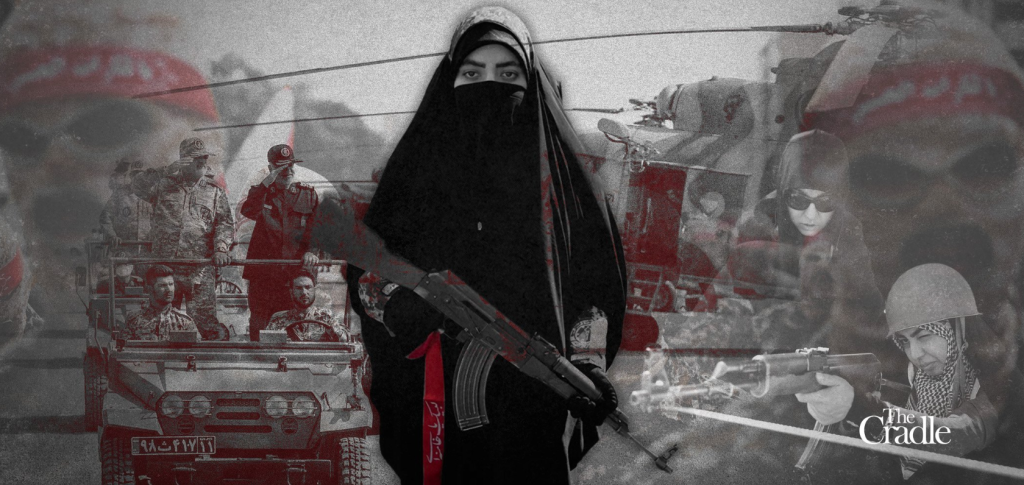 by Fereshteh Sadeghi [9-23-2026].
For the Islamic Republic, the most durable defense against foreign attack and internal destabilization is a population mobilized far beyond the barracks.
Days before Iran marked the 46th anniversary of the Sacred Defense, the name given to the 1980–1988 war imposed by former Iraqi dictator Saddam Hussein on the newly established Islamic Republic, Tehran hosted a very different kind of military drill. Those taking part were not regular troops, but ordinary Iranian citizens.
Tens of thousands of men and women, young and middle-aged, participated in the Janfadaa-ye Iran (Sacrificing for Iran) exercises on Friday, 18 September. The drill was organized by Iran's Islamic Revolutionary Guard Corps (IRGC) Mohammad Rasoulollah Headquarters in Tehran alongside the Basij, the popular volunteer force affiliated with the IRGC. Its commander, Brigadier General Hassan Hassanzadeh, said 500,000 people had registered for the event, while organizers expected at least 313,000 to take part.
The Janfadaayan-e Iran (Sacrificers for Iran) campaign is a popular movement launched in March 2026 in the wake of the 40-day US-Israeli war on Iran. It began as a wartime registry rather than a conventional military formation, offering civilians a direct channel to declare their readiness to serve.
The movement initially sought to identify Iranian volunteers willing and able to assist the armed forces. Once registration began, however, it quickly grew into an event on an unprecedented scale. Campaign officials say more than 31.6 million Iranians have signed up, a figure that surprised even the authorities and was repeatedly highlighted in domestic media.
Supporters of the Islamic Republic in the diaspora have also sought to join, asking how they could register from abroad.
According to Sasan Zare, the spokesman of the Janfadaa campaign, “32 percent of the volunteers are women and the majority of them were below 46 years old.” The armed forces have not officially announced the deployment of Janfadaa volunteers in defensive operations, although volunteers were reportedly used in areas around southern ports and Iranian islands in the Persian Gulf.
A force for the home front
Six months after the campaign's launch, military planners are considering how to use this vast reserve to defend Iranian cities and towns, especially Tehran, against separatist cells and armed unrest in the event that the US and Israel resume their war on Iran. Such a force would be intended to hold the domestic front while the army and IRGC concentrate on an external assault.
Their calculations are rooted in the January 2026 unrest, when several Iranian cities were hit by violence that Tehran blamed on US and Israeli agents operating alongside anti-government protesters. At the time, Mossad openly urged Iranians to take to the streets.
In a Persian-language post on X, the agency declared: “Go out into the streets together. The time has come. We are with you. Not just from a distance or through words. We are also with you on the ground.”
Reports of meetings between Iranian opposition figures and Israeli groups to pursue a joint struggle against what they call the “Iranian regime” have added to Tehran's alarm. Israeli media has also discussed cooperation between Tel Aviv and outlawed Kurdish and Baluch separatist groups in Iran's northwest and southeast.
For Iranian planners, these are not separate fronts, but parts of a wider effort to turn protest, communal fault lines, and armed unrest into a regime-change campaign.
By the third week of September, news of the Tehran mobilization had spread across Iran. Billboards announcing the event appeared throughout the capital.
One billboard asked, “Do you know how to fire a shoulder-launched weapon?” with an image of the weapon replacing its name. Another posed the same question using the image of a sniper rifle.
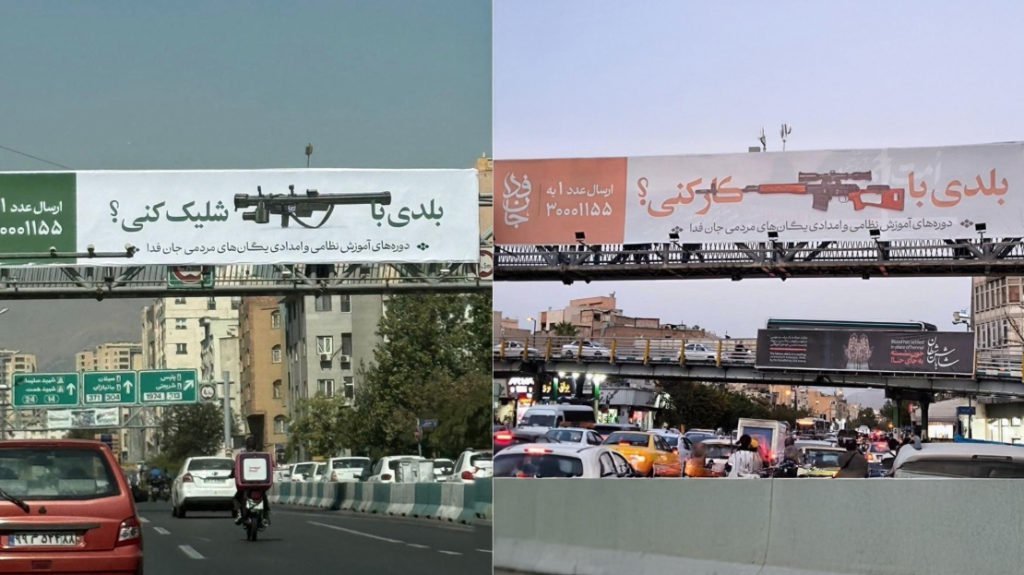
Billboards in Tehran promoting the Janfadaa campaign.
The message suggested that the IRGC and Basij had made their choice: build a trained volunteer force that can be called on in a crisis to defend cities from threats within. This would free the regular armed forces to confront enemies beyond Iran's borders without being forced to divert large numbers of trained personnel or leave the home front exposed.
Zare said that “26 percent of the volunteers expressed their readiness to join security and military activities while 20 percent will assist in the relief and rescue efforts. Another 20 percent would join social work.”
Why Iranians signed up
For more than 200 nights, residents have gathered in Ekhtiyariyeh Square in northern Tehran to show support for the state. They remained through rain, snow, winter cold, and summer heat, including the nights of US-Israeli raids when nearby Defense Ministry and defense-industry buildings were bombed.
Sediqeh, a 54-year-old woman who registered in March, also joined the September drill. She tells The Cradle: “I want the enemy to see that Iranians are still in the scene, that they neither retreat nor back down.”
Mrs Sadat sits in a stall set up for children's cultural activities. A teacher in her 50s, she joined Janfadaa in the campaign's early days and attended the 18 September march:
“We have one life, and if we don't sacrifice it for the homeland, then what is the use of our life? The leader, Ayatollah Ali Khamenei, sacrificed his life for Iran and the people of Iran. We follow his example.”
Hussein, 39, stands at the entrance to the square, waving his flag toward passing cars. The private-sector employee tells The Cradle that he joined only recently because “I think this campaign portrays the Islamic Republic’s strength, resilience, popularity and legitimacy to the world.”
Mr Bahadori is a 51-year-old cleric in a white turban. He lives in central Tehran but drives to the neighborhood every night, where he serves as imam of a local mosque before joining the nightly gathering in the square.
Bahadori joined the campaign “to defend the country, religion, and people of Iran.” He tells The Cradle: “Apart from my religious duty, I wanted to defend Iran, because if there is no homeland, there will be no religion either.” The Shia sheikh invokes the widely cited saying attributed to the Prophet Muhammad that “love of one's homeland is part of faith.”
A thousand battalions take shape
Janfadaa's organizers do not intend to stop in the capital. Drills and marches are expected to be held gradually in other provinces, adapting the campaign's structure to local conditions and defensive needs.
They say the movement seeks to help “Create sustainable security, demonstrate popular power and strengthen resistance against threats from the country’s enemies.”
Training courses are now expected to begin, initially focusing on military preparedness as well as rescue and relief work. The latter will be conducted in cooperation with the Iranian Red Crescent Society, giving the campaign a civil-defense role alongside its security function.
Volunteers will then be organized into 1,000 ‘national resistance’ battalions across the country. The plan would bring those who have declared themselves ready to sacrifice for the homeland under a single Janfadaayan banner, turning a mass wartime pledge into an organized reserve for Iran's next confrontation.