Larry Johnson: Sorry, Your Power Plant Is Back-Ordered Until 2032
 by Larry Johnson [11-26-2026] Larry C. Johnson(bio).
There is a comforting assumption in Washington, Riyadh and every boardroom with a data center on the drawing board: if something breaks, you buy a new one. Money solves things. Money has always solved things. Karl W. Miller, an energy analyst whose calls I have learned to take seriously, has just written a sober, meticulously hedged report on the global power-equipment market, and its central finding can be summarized for the C-suite in one sentence. You can print money. You cannot print a turbine.
The waiting list for electricity
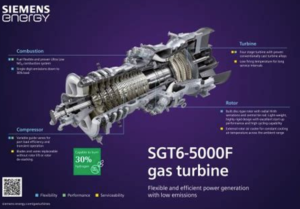
Miller’s numbers are not the stuff of panic; they are worse, because they are boring and contractual. GE Vernova is carrying 122 gigawatts of equipment backlog plus slot reservations. Siemens Energy has 104 GW of commitments. Mitsubishi Heavy Industries has 37 GW of large-frame contract backlog. Those three companies control roughly two-thirds of the world’s turbine manufacturing capacity, a share Miller expects to rise toward 70 percent by 2030. Meanwhile GE shipped 5 GW in the third quarter.
And here is the line I would frame and hang in every energy ministry on the planet: during the third quarter of 2026, GE sold multiple production slots for delivery in 2032. Not 2027. Not “as soon as possible.” 2032. If you order a large gas turbine today, there is a decent chance your grandchild will be in middle school when it starts producing electricity.
GE itself put gas-equipment lead times at about three years last April and advises operators to plan rotor needs three to five years before an outage. Large power transformers take two and a half to three years; the extra-high-voltage kind can take five. These are not wartime emergency numbers. These are the numbers for customers who are being polite and patient.
Enter the chatbots
Now add artificial intelligence, the industry that has discovered nothing makes a chatbot smarter quite like a gas turbine. Miller cites a reference projection that global data-center electricity use will nearly double, from 485 terawatt-hours in 2025 to 950 TWh in 2030. He does the arithmetic the brochures skip: that increase is about 53 GW of additional round-the-clock load. Some onsite data-center plants need 30 to 70 percent more generating capacity than their actual load, for reliability. Then they buy diesel backup on top of that.
Tech companies, in other words, value an early power date more than a low price, and they have the cash to prove it. They are bidding for the same factories, the same rotors and the same transformers as every utility, every industrial plant, and every country that has had a power station blown up this year. Guess who gets the slot.
The war-zone customer
Which brings us to the people who actually need replacement equipment because somebody fired a drone at it. Miller documents what the public record shows: Saudi Arabia reported a 2,750 MW loss of production capacity after strikes in April. Kuwait reported a fire affecting a large number of generation units in July. Iraq’s Khor Mor gas facility was hit on November 8. In Ukraine, 8.5 GW of generation was damaged or destroyed last winter, and by January the country had about 11.5 GW of dispatchable capacity against 18 GW of peak demand.
A drone costs tens of thousands of dollars and takes minutes to arrive. The machine it destroys can take years to replace, assuming the owner can find a compatible one, which is not the same thing as finding a turbine. Turbines are not universal. Frequency, heat balance, foundation, exhaust and controls all have to fit. Buying the wrong one is how a repair turns into a redesign.
Miller, to his credit, refuses the easy headline. He does not claim war reconstruction is eating most of the world’s output; he says that is “not established.” He does not claim there is no equipment on any shelf anywhere; he calls that “too broad.” He is precise because precision is what makes the conclusion stick: an owner who discovers an irreparable loss, after the compatible spares are gone, joins the back of a global queue that runs into the next decade.
The Gulf can’t buy its way out
The Gulf states are accustomed to solving problems with checkbooks, and capital does help. It reserves production slots and pays for redundancy. What it cannot do, in Miller’s phrase, is “eliminate qualification, fabrication, transport and commissioning requirements.” Riyadh will be bidding against Microsoft, Amazon and every utility in Texas, all of whom also have checkbooks.
The stakes in the Gulf are not abstract. Cooling accounts for nearly half of peak electricity demand across the Middle East and North Africa, and cooling plus desalination account for close to 40 percent of projected demand growth to 2035. When the power goes out in Riyadh in August, the problem is not inconvenience. It is water and heat.
Arithmetic for ministers
My favorite passage in the report is a piece of arithmetic so simple it ought to be mandatory reading for every minister of energy. Suppose you need a turbine ready by month 36, a transformer by month 42, fuel supply by month 30 and site works by month 32. Add six months to bring it all together. You will have power in month 48. Now suppose the minister, eager for a headline, spends a fortune to rush the turbine to month 30. You will have power in month 48. The longest pole in the tent sets the schedule, and the turbine is often not the longest pole.
Ukraine has already learned this. Equipment has arrived and sat waiting for a connection, for transmission capacity and for financing to install it. A generator in a warehouse produces exactly as much electricity as a generator in a rubble pile.
And the meter keeps running. By Miller’s calculation, a single lost gigawatt, replaced at a premium of $50 to $150 per megawatt-hour, costs $350 million to $1.05 billion a year. That assumes replacement power can be found at all.
The bottom line
Miller’s central planning case holds that procurement and restoration risk stays material through 2031, with “conditional normalization” possible somewhere between 2032 and 2035. Translated from consultant into English: things might get better in about a decade, if the factories deliver, the spares get rebuilt, the fuel and grids are repaired, and nobody blows up anything else in the meantime.
That last condition is the one I would not bet on. We are living through a war that destroys power infrastructure in minutes and an AI boom that consumes power equipment by the gigawatt, both of them drawing on three manufacturers and a handful of transformer factories. Every leader who promises a swift reconstruction, or a data center online by next summer, should be handed Miller’s report and a calendar. Then asked to circle 2032.