Larry Johnson: Another American Ex-Pat’s View of Russia
 by Larry Johnson [7-11-2026] Larry C. Johnson(bio).
John McKeller is a retired American who lives in Russia. Here is his story
Larry recently posted remarks by an American expat who shared his perceptions of life in Russia. In a follow-on to that post, Larry graciously offered to publish my commentary on the topic. My goal is to be as concise and brief as possible about a very complex subject. I’ll just provide some background information and then highlight some of the misconceptions and distortions about Russia that seem to persist. If that is not of interest, please just skip ahead to the next comment.
Background: After retirement, my Russian wife and I decided to spend more time in her hometown. Our purpose was to assist with the daily needs and medical care of her elderly parents. After decades of short yearly visits, we thought we could split our time between the US and Russia. Well, the phrase that John Lennon sang in “Beautiful Boy” – “Life is what happens when you are busy making other plans” became “The best laid plans of mice and men often go awry.” It’s not hard to imagine how Covid, rampant inflation, US real estate price appreciation, election results, massive immigration, sanctions and war have impacted American retirees’ lives over the last five years. So, we’re still in Russia.
Origins of Misperceptions: To those who will question my comments regarding misconceptions of Russia, I understand your position. We all were (still are) indoctrinated to view Russia as “bad”. In books, movies, “news”, or “history” classes Russia and Russians are frequently portrayed negatively. Take movies for instance. Research shows that even if people know the reality of something, they rely on remembrance of the movie version. Examples: “John Wick” – Russian gangsters or “The Equalizer” – degenerate Russian gangsters; “U-571” – who actually captured the enigma machine? “The Last Samurai” – were any Americans even involved in Japan’s Meiji Restoration? [spoiler – the British and no.]
Russia since December 1991: In the late-nineties I had the opportunity to work in former Soviet countries such as Poland and Czech Republic. Decades of neglect were still everywhere. People grappled with the transition from planned / government business to capitalist systems. By 2000, cities such as Prague had remarkably improved. [Great city of course. It’s where I met my wife.] As for Russia, the transition was catastrophic. However, the changes that began to occur once Vladimir Putin became president have been dramatic. I know because I have witnessed them personally over many years.
What the attributes of a “perfect country” are is open to informed opinion. As someone who has traveled the world extensively, I do feel confident that I know what a “sh*thole” country is like. Russia is not one.
Furthermore, generalizations about a country or its citizens are never completely accurate. From merely having visited LA or Chicago or New Orleans or NYC one could not generalize the characteristics of the entire USA. The same applies to Moscow, St. Petersburg, Yalta or Sochi vs. small villages. There are differences. However, overall, my impression is that the people of both the US and Russia are very compatible.
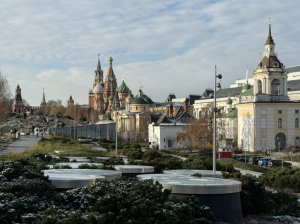
Everyday life: Daily life for us is enjoyable. However, we do live in what could be viewed as a “micro-district” in a larger city. We overlook a long beautiful tree-line pedestrian mall with two very large parks situated about three kilometers from each other. The street is lined with numerous shops, restaurants and cafes. Groceries, bakeries, theaters, medical facilities, just about all the amenities are within a short walking distance. If something we need is not available right around the corner, it can likely be found on one of the Internet retailers.
How “safe” is it? We sometimes stroll along the pedestrian mall with our dog at 10:00pm. Even at that hour the street is full of young people, couples, pensioners, other dog-walkers and families with kids doing the same. The outdoor cafes are teeming with customers. Yes, sanctions and the Special Military Operation have had an effect – but life goes on.
Culture: My observation is that Russian culture and the citizens’ pride in their homeland has been actively vitalized. Russia is a huge multi-cultural nation (Russian Federation). Many characteristics of those cultures are both observed and blended into a quite cohesive notion of what it means to be “Russian”.
Russia is open to people from everywhere. For example, our city has several institutions of higher learning including a medical university. Along with Russian citizens, students from former Soviet republics, Asia, African, and Middle East countries also attend these schools.
There is no “woke” in Russia. Children have a “mother” and a “father”. There are only two genders here. Contrary to reports, private activities associated with sexual orientation amongst consenting adults are not criminalized. However, public display or advocacy of such is not allowed.
Russia has millennia of literary, theatrical, musical and folk history. People of all economic and social strata support the arts. There are four venues in walking distance from us including a beautiful concert hall.
Some specific misconceptions and distortions
Russians are communist and want to re-establish the USSR – wrong. Communism crashed and burned by 1991. Russia’s already the largest county by land area. They don’t need any more. They would just like to be left alone.
Putin is a dictator – not true. While his decisions my appear overly “authoritarian” to Western audiences, there are many governmental and commercial influences that affect his directives. Additionally, Russian elections have been verified by internationally recognized observers.
The Russian people will overthrow “Putin’s regime”- Nah, first of all the government is not a “regime”. The country IS governed with the consent of the citizens. Yes, people have grown weary of the consequences of the conflict. Yes, people are not oblivious to the destruction and heartbreaking loss of so many lives. Additionally they are upset about very personal issues such as the blocking or throttling of communication systems, inflation, low salaries, small pensions, and high interest rates. These issues do affect daily life and do create frustration – but not subversion.
Russians are a bunch of drunks – Wrong. Overall, Russia’s per capita alcohol consumption has dramatically decreased. The stereotypical Vodka swilling drunk of the movies is a rarity today.
Russians never smile – Wrong. Unlike Americans who often smile at strangers, Russians share a characteristic that is evident in other cultures too. They don’t usually smile at everybody. However, once introduced or approached they are very friendly – and smile!
Russians are pessimists – Wrong. Of course, like people everywhere, there are always some who are. Walk our pedestrian mall and you’ll see laughing children riding their scooters, smiling mothers and daughters chatting, affectionate couples strolling hand-in-hand, pensioners sitting on benches reminiscing, and small gatherings enjoying street performers. These are not depressed individuals.
Russians are aloof and cold – Wrong. Once again, they’re normal people and some are like that. However, as friends they are extremely hospitable, helpful and reliable.
Russia is very bureaucratic – some truth in that. Anyone who has read the book or seen the movie “The Hitchhiker’s Guide to the Galaxy” will remember how bureaucratic the Vogon civil servants were. While the human administrators here are definitely not like them, all the proper forms must be presented when required, every “I” dotted and “T’ crossed. Even miniscule errors result in rejection. All foreign documents must be apostilled, translated, and notarized. Then they will be dated, stamped, and signed – sometimes in triplicate. Why? No idea.
Russian is a difficult language – True. The language is very challenging. It’s very complex even for Russians. The phrase I repeat most often is: “Извините, Я американец. Я очень плохо говорю по-русски.” That is, “I’m sorry. I am an American. I speak very little (poor) Russian.” To which I usually get smiles and giggles with an offer to help me figure it out.
Lastly – There’s a saying I picked up in Africa: “Not to know is bad. Not to want to know is worse.” Those of us who frequent Larry’s blogs along with others such as Andrei Martyanov, Stanislav Krapivnik, and Daniel Davis “want to know”. We are not expecting infallibility from them. However, they do a great job of helping to keep us informed. If you really want to know more about Russia, come visit and learn. You won’t be disappointed.