Scott Ritter – Russia’s Dark Sage. Trump can’t be trusted. He is pursuing regime change in Russia to oust Putin!
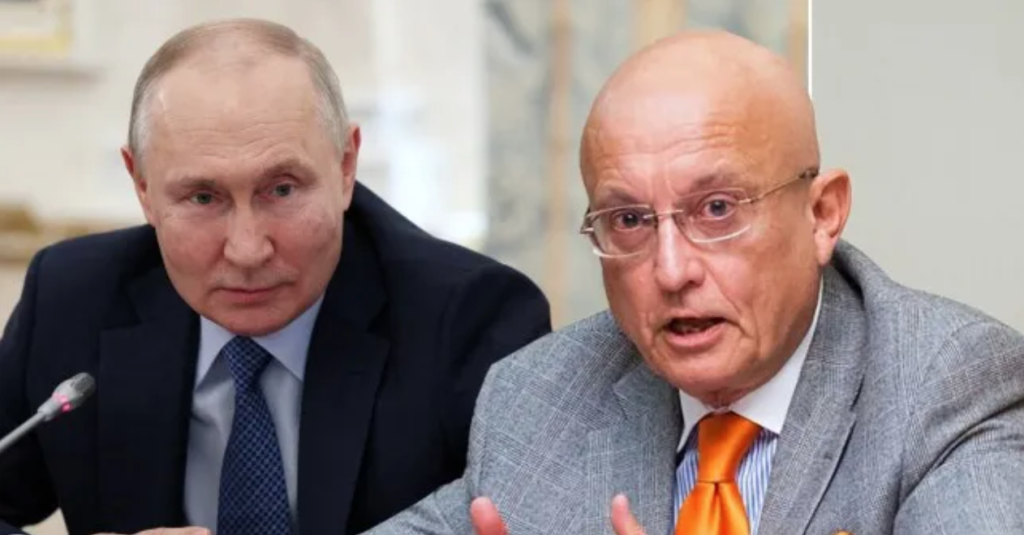
Sergei Karaganov (right) with Russian President Vladimir Putin (left)
by Scott Ritter [1-3-2026] Scott Ritter(bio).
(RAD: This is a very insightful analysis that needs to be understood, especially in light of what Trump just did in Venezuela. Not only can't Trump be trusted to negotiate with Russia in good faith, it is now more than obvious that he is actively pursuing regime change in Russia that would result in the ouster of Putin. Let's hope that Putin & the highest levels of the Russian government understand and find a dramatic way to put a stop to this charade. — RAD)
Normalized US-Russian relations had been promoted as a lofty, yet attainable, objective, But Sergei Karaganov is right--the US in an untrustworthy negotiating partner.
Sergei Karaganov is not a man to be trifled with. An esteemed Russian political scientist who heads the Council for Foreign and Defense Policy and as the dean of the Faculty of World Economy and International Affairs at Moscow’s Higher School of Economics, Karaganov has a long history of involvement in shaping Russian foreign and national security policy, having advised both Boris Yeltsin and Vladimir Putin during their respective tenures in office as President of Russia, as well as foreign ministers such as Yevgeny Primakov and Sergei Lavrov.
In the aftermath of the collapse of a planned summit between President Putin and US President Donald Trump in Budapest late last October, Mr. Karaganov asserted that this action, coupled with the imposition of US sanctions targeting major Russian oil companies, proved his long-held point that the US cannot be trusted as a negotiating partner. “Now we have a clear understanding that we can’t make any deals with any Trumps in a way that would suit Russia. Therefore, we should act in accordance with our own scenario, with or without Trump, and that’s it.”
I have pushed back against such a blanket condemnation of the US and the Trump administration, drawing upon my own history as a weapons inspector implementing the Intermediate Nuclear Forces (INF) treaty from 1988-90. That treaty, and the actions of those implementing it, proved in my mind that there was a foundation of goodwill and trust that could be drawn upon when it came to shaping US-Russian relations today.
The actions of the US government in the past week have thrown ice cold water on such notions, which have been exposed as being both naïve and unrealistic.
US Special Operations forces carried out a raid in the Venezuelan capital of Caracas last night which resulted in the President of Venezuela, Nicolas Maduro, and his wife, Cilia Flores, being taken into custody by US law enforcement personnel, and removed from Venezuela, presumably to US jurisdiction, where he is expected to face trail for various charges relating to allegations of narco-trafficking.
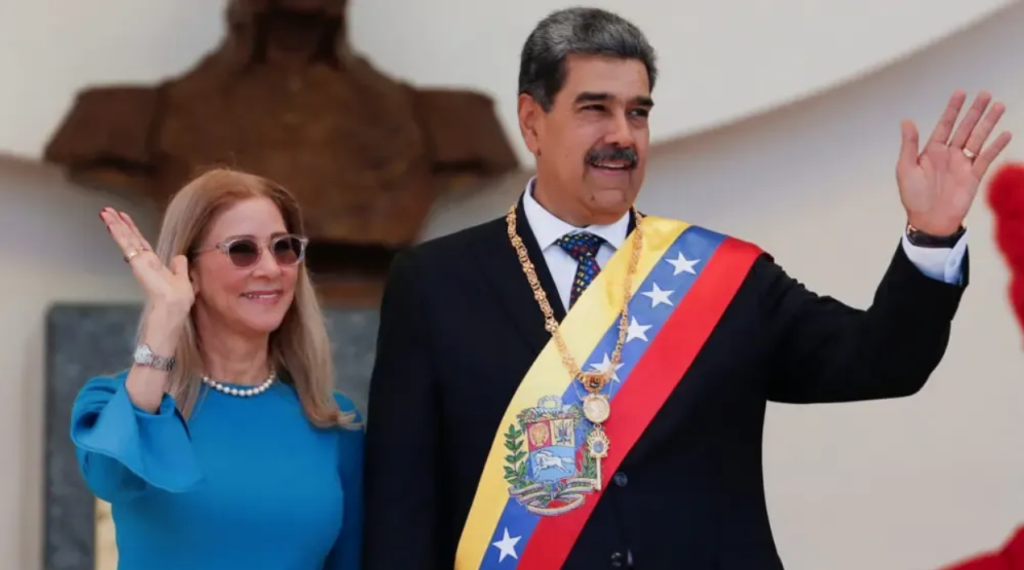
Venezuelan President Nicolas Maduro and his wife, Cilia Flores
The issue at hand isn’t the legitimacy of the US action (it is a blatant violation of international law) or the validity of the underlying criminal allegations (they fail any test of credulity), but rather the ease in which the Venezuelan President was taken into custody. One doesn’t have to be a veteran of combat operations to understand that any operation which requires a troop-laden MH-47 helicopter to hover, with navigation lights on, over a hi-rise building in a major urban environment, to deliver an assault force, was more an act of theater than an actual assault. The lack of violence that accompanied the seizure and arrest of Maduro and his wife reeks of complicity on the part of the Venezuelan security forces who has pledged their lives to his protection.
What happened last night was the maturation of a new corollary on sanctions-based regime change policy, one which imposes sanctions in order to bring about economic distress to a targeted sector of society comprised of political and economic elites, and then provide a scenario under which sanctions could be lifted and the personal economic fortunes of these targeted elites massively improved. The catch, of course, comes with the leadership of the targeted nation, which is painted as an obstacle for the normalization of economic relations. This results in an environment where these elites are vulnerable to being leveraged by outside forces as a facilitator of regime change. This is what happened in Venezuela, where military, political and economic elites were lured by the promise of millions of dollars of economic largesse which would accrue to them once Maduro was removed from power and replaced by a regime compliant to US demands.
What does this have to do with Russia, one might ask.
Everything.
Because the model of sanctions-based regime change that succeeded in Venezuela is alive and well and in motion by the United States against Russia today.
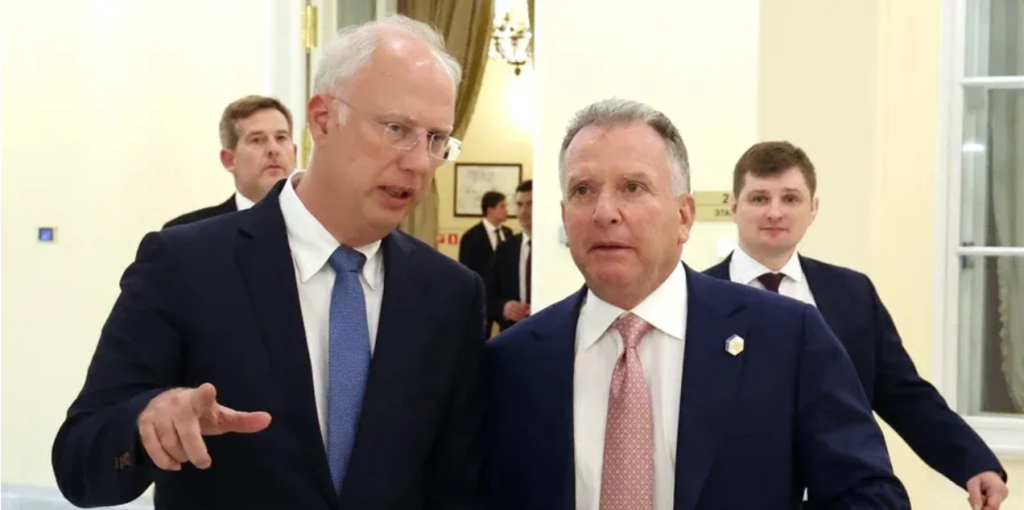
Kirill Dmitriev (left) and Steve Witkoff (right)
The administration of President Trump has made an art form out of transactional diplomacy. This is especially the case when it comes to trying to lure Russia into a negotiated settlement of the ongoing Ukrainian conflict. This transactional relationship has been headed by two unconventional actors in the world of diplomacy. The first is Steve Witkoff, a New York City real estate developer and Donald Trump’s special envoy for Russia. The second if Kirill Dmitriev, the former Goldman Sachs investment banker who today serves as the CEO of the Russian Direct Investment Fund, and who has been hand-picked by President Putin to work with Witkoff on the Ukraine issue.
A key aspect to the Witkoff-Dmitriev dynamic is the notion of the economic benefits which will accrue to US and Russian businessmen alike once sanctions are lifted following a successful negotiated peace deal. There is one major difference, however: US businessmen are not languishing under stringent economic sanctions; Russian businessmen are.
The consequences of failed peace negotiations represent little more than unfulfilled expectations for Americans, who can live (and thrive) without such deals.
But for Russian economic (and political) elites who have reignited dreams of past economic wealth based upon the promise of renewed US-Russian economic cooperation in a post-Ukraine environment, the failure to manifest this wealth is seen as a major setback.
And if the United States is able place the blame for the failure of this economic utopia from manifesting itself on the shoulders of Russian President Putin, then the stage is set for the possibility of the dissatisfied political and economic elites to take matters in their own hands, and usher the Russian President to the exit.
This, of course, has been the goal of the United States ever since President Putin came to power, some 25 years ago. But US policy makers never had the circumstances that have presented themselves today—a sanctions-based policy which can be leveraged against Russian elites to the ostensible detriment of the Russian President.
Kirill Dmitriev has been very active in promoting the benefits of an invigorated US-Russian economic relationship. This has created certain expectations among segments of the Russian elite, who now advocate for an end to the Ukraine conflict even if the terms of such fall short of the demands that had been set forth by President Putin—namely, to address the root causes of the conflict so as to make conflict termination permanent, as opposed to simply promoting a pause in hostilities which will inevitably resume at some point down the road.
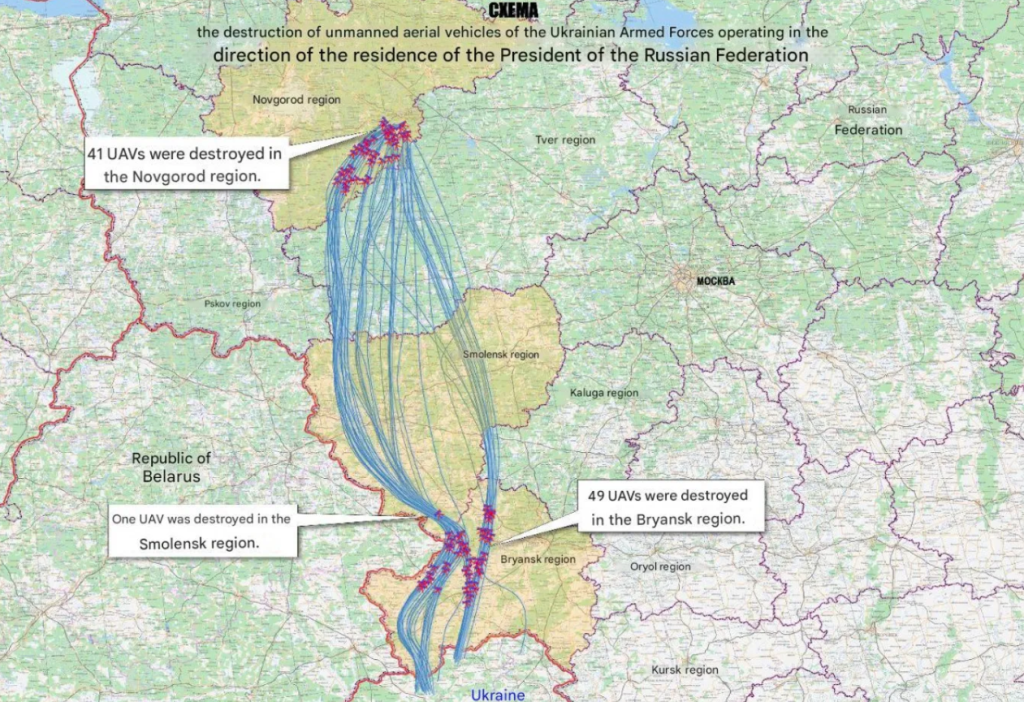
Russian Ministry of Defense map showing Ukrainian drone attacks
One of the reasons why the Russian President has been able to manage these pie-in-the-sky expectations of economic boom is the fact that he is universally viewed in Russia, amongst the elites and proletariat alike, as being a competent and strong leader. This is why the allegations of a Ukrainian drone attack against a Presidential residence on December 29 have taken on a level of import beyond that which normally would be attached to an attempt of the life of the leader of a nuclear-armed nation. The attack by a swarm of some 91 separate drones does not appear to have been designed to actually kill or bring harm to the Russian President—advanced warning of the attack would have provided more than enough time for the Russian leader to be evacuated to a bunker more than sufficient to withstand the blast effects of the lightly-armed drones.
No, this was an attack designed to be insulting to the Russian President, to create the impression of weakness in the face of US determination, and to paint this weakened Russian leader as the reason why the economic largess promised by the Witkoff-Dmitriev fantasy of mutual economic prosperity is not reaching fruition. If President Putin can be attacked by Ukraine with such impunity, the theory goes, then he may not be as strong as his supporters have imagined. And the Maduro precedent now exists, one highlighted by none other than Ukraine’s President, Volodymir Zelensky.
The US sanctions strategy against Russia has striking parallels to that which was used to isolate and weaken Maduro, targeting powerful energy elites who serve as the foundation of national economic strength and viability. By targeting RosNeft and Lukoil, the Trump administration put Russia’s embattled energy sector on notice that their future success is linked to US actions that can only be positively altered if a solution acceptable to Ukraine, Europe and the US can be arrived at. Void of such, US sanctions, combined with CIA-backed attacks by Ukraine against critical Russian infrastructure, with continue.
The goal of the Trump administration is crystal clear—to create a domestic crisis for President Putin derived from the dissatisfaction of Russian political and economic elites.
To create the illusion of a weakened, indecisive President whose time has passed.
To promote the notion of regime change in Russia.
I do not believe that Kirill Dmitriev was complicit in this campaign. Indeed, the fact that President Putin hand-picked Mr. Dmitirev for the role he currently enjoys strongly suggests that there has been support at the highest levels for the economic intrigues engaged in by Dmitriev and Witkoff (and Trump’s son-in-law, Jared Kushner, who joined the latest round of negotiations.)
President Putin appears to have been operating under the illusion that President Trump was negotiating in good faith when it came to ending the conflict in Ukraine and building strong post-conflict economic tiers between the US and Russia.
Today no such illusions can exist.
The Trump administration has no desire to lift economic sanctions against Russia.
These sanctions serve as the foundation of a broader strategy of regime change that has manifested itself in the case of Nicolas Maduro and Venezuela.
These sanctions are linked to Russia meeting conflict resolution terms that would be politically impossible for the Russian leadership to accept.
And Russia’s rejection of these terms is now juxtaposed on a new narrative, one that postulates a weak Russian President unable to stand up to the US in the face of a US-backed Ukrainian drone attack on the Russian President himself.
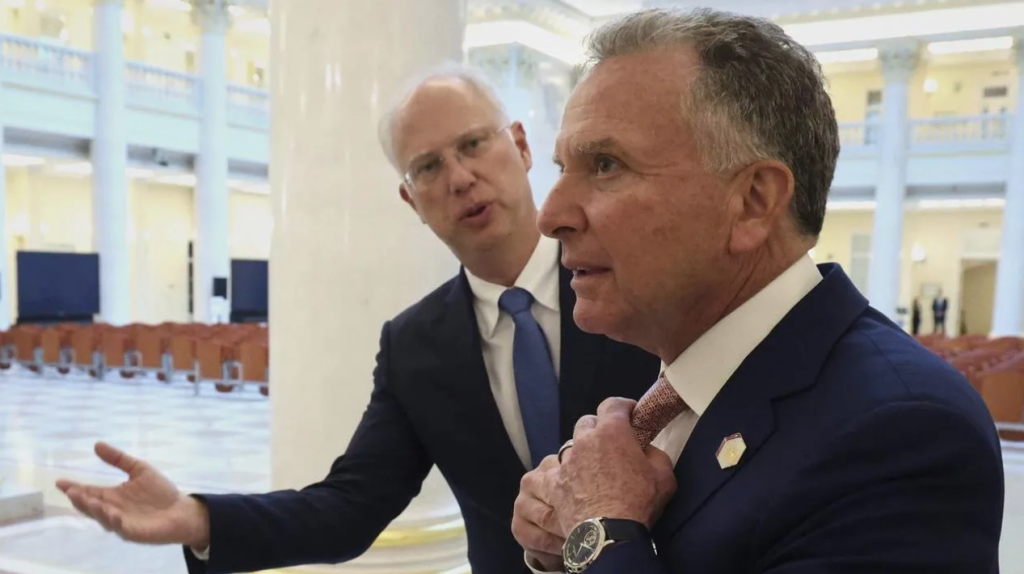
Kirill Dmetriev (left) and Steve Witkoff (right)
Seen in this light, the Witkoff-Dmitriev dialogue on US-Russian economic cooperation has been little more than a facilitator of regime change inside Russia, seeing as it promotes the vision of a bright economic future that is linked to conflict resolution in Ukraine that is unattainable so long as Vladimir Putin holds office.
The entire Trump posture vis-à-vis Russia and Ukraine has been a charade.
Sergei Karaganov was right—Donald Trump and the US cannot be viewed as a trustworthy negotiating partner.
The US policy is a deception—or, as Karaganov has previously likened similar US policy initiatives, a honey trap. In short, there is no possibility of a positive Russian response to any US policy on Ukraine, or anything else for that matter, such as arms control.
The US policy toward Russia is one that seeks regime change, plain and simple.
It is a wolf wrapped in a sheep’s skin.
Russia needs to drop the Witkoff-Dmitriev charade, terminating any possibility of a US-Russian economic utopia and, in doing so, bringing back to ground those who would place their own personal economic fortune over the well-being of a nation and its leadership.
President Vladimir Putin has ruled over Russia for 25 years. During that time, he has raised Russia up from the ashes of the decade of the 1990’s, an era where Russia had fully subordinated itself to the whim of western economic interests.
Russia today is a nation grounded in a unique cultural identity that takes pride in Russian national identity.
The Witkoff-Dmitriev gambit seeks to undermine this new Russian identity by resurrecting a vision of economic viability grounded in the same master-servant relationship that defined the decade of the 1990’s.
This would be the ruin of Russia.
And as an American patriot, dedicated to the furtherance of that which makes for a more peaceful and prosperous United States, such an outcome is not desirable.
The basic tenets enshrined in the Witkoff-Dmitirev dialogue are sound—that both nations could benefit from a relationship built on the notion of mutual respect and trust.
But this condition does not exist today, nor will it ever exist so long as the United States is infected with Russophobia.
Just as Russia has demanded that any conflict resolution in Ukraine resolve the root causes of that conflict, it is high time that Russia make similar demands for normalizing relations with the US, namely that the US must publicly renounce Russophobia as a condition of improved US-Russian relations. Russophobia serves as the foundational ideological influence shaping US-Russian relations. If this remains the case, regime change will be on the table as a policy option for future US leaders to consider.
A healthy US-Russian dynamic can only exist in an environment of mutual trust grounded in respect.
The current reality, where the US put in motion a sanctions-based regime change operation facilitated by divisions within Venezuelan society prompted by a desire to have the sanctions lifted at any cost, must color Russian attitudes regarding diplomatic relations between the US and Russia.
The Witkoff-Dmitriev dialogue, as it currently is being implemented, is a farce.
The United States is not a trustworthy negotiating partner.
Just ask Sergei Karaganov.
(I recently sat down with Sergei Karaganov for a wide-ranging interview on The Russia House with Scott Ritter, where these and other issues were explored in detail.)