Larry Johnson: Twelve Million Barrels in a Matter of Days from Saudi Arabia. Sure.
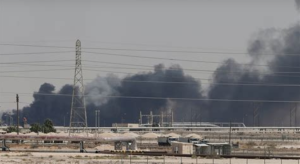 by Larry Johnson [11-16-2026] Larry C. Johnson(bio).
Six weeks ago in London, Aramco chief executive Amin Nasser delivered the reassurance the markets wanted. Saudi Arabia’s upstream was fully intact, he said, and the kingdom could bring its maximum sustainable capacity of 12 million barrels a day online “within days.” He added that without the East-West pipeline carrying Saudi crude to the Red Sea, Brent would have hit $200 a barrel. Translation: relax, we have a bypass.
Karl Miller has now done what nobody in Riyadh seems eager to do. He followed the barrel. His latest proprietary assessment, dated November 13, is titled “Saudi Arabia: Oil Evacuation Failure,” and its premise is simple. Oil in the ground is worthless if it can’t leave the country. Karl looked at what’s left of the pipes, the pumps, the refineries and the storage tanks, and asked how much Saudi crude can actually get out the door over the next 90 days.
His answer is not 12 million barrels a day. In his core planning case, it’s 4.4 million.
The bypass that isn’t
Start with the pipeline Nasser was counting on. Karl’s base case treats the East-West line as out of action for dependable export commitments. That’s a planning judgment, and Karl is careful to say so. He isn’t claiming every pump is destroyed or that not a single barrel is moving. He’s saying no sensible buyer should plan on cargoes from that route until it proves it can run end to end, day after day.
The damage record explains why. Karl’s ledger of pumping stations reads like a casualty list:
- Station No. 3, east of Riyadh: a successful two-drone strike reported on November 13. It’s a new name on the list.
- Station No. 7: hit in November, then hit again. Its exact condition is still unknown.
- Station No. 8: damaged earlier, targeted again in November, with possible new damage in satellite imagery.
- Station No. 9: damaged in the first round of named-station assessments.
- A third September site, its number still unsettled, plus overlapping reports of a pipeline fire and more station hits around Khurais and Madinah.
Karl refuses to add these up into a neat “stations destroyed” total, because the claims overlap and some may describe the same site twice. That restraint is the point. You don’t need every station destroyed to stop a pipeline. Knock out enough pumps, power and controls, and the pipe can sit there intact and still carry nothing useful. Operators shut lines down to isolate damage and test pressure. Temporary bypasses carry less. And every new strike resets the repair clock, eats the spare parts and narrows the options for the next failure.
So much for the bypass that saved us from $200 oil.
Refineries can’t soak it up either
The optimist’s fallback is that crude that can’t be exported can be refined at home. Saudi Arabia has nine major refineries with a combined reference capacity of 3.325 million barrels a day. Karl’s point is that nameplate capacity is not an outlet, and several of those plants are carrying damage of their own:
| Refinery | Reference capacity | Karl’s damage input |
|---|---|---|
| Ras Tanura | 550,000 b/d | Shutdown and damage history, renewed attack exposure |
| SATORP (Jubail) | 460,000 b/d | Prior unit damage, dated recovery |
| YASREF (Yanbu) | 430,000 b/d | Exposed to Yanbu feed, power and storage problems |
| SAMREF (Yanbu) | 400,000 b/d | Prior attack and operating effects |
| Jazan | 400,000 b/d | Power, utilities and tankage damage |
| Petro Rabigh | 400,000 b/d | Tankage damage, renewed exposure |
| SASREF (Jubail) | 305,000 b/d | Exposed to Jubail utility and shipping problems |
| Aramco Yanbu | 250,000 b/d | Depends on scarce pipeline feed |
| Riyadh | 130,000 b/d | Refinery and tank damage |
Karl is careful not to treat all nine as shut. But look at the western cluster. The three Yanbu refineries need 1.08 million barrels a day of crude, and that crude arrives on the same damaged pipeline as the export cargoes. Every barrel Riyadh sends to a Yanbu refinery is a barrel it can’t load onto a tanker, and the reverse. The shortage doesn’t disappear. Riyadh just decides whether it lands on crude buyers or fuel buyers.
Then there’s storage. Karl’s damage inputs list six apparently destroyed and eight damaged tanks at the Abha fuel depot, plus destroyed tanks at the Riyadh and Rabigh refineries. A refinery that can’t store or ship what it makes has to cut its intake, even if every processing unit is fine. And at Abqaiq, the plant that strips gas and sulfur out of most Saudi crude to make it fit for sale, damage can force cuts at the oil fields before the storage tanks ever fill.
Plumbing, not politics
This is where Karl’s report gets brutally simple. Every barrel produced has to go somewhere: out on a tanker, into a refinery, burned at home or into a storage tank. If the outlets can’t take it, production has to fall. That’s not geopolitics. It’s plumbing.
So Karl tested the pre-war output of 9 to 10 million barrels a day against the outlets that still work. Assume 2 million barrels a day of refinery intake and 400,000 burned directly at home. To produce 9 million barrels a day with no new storage, Saudi Arabia would need to export 6.6 million. If exports are really closer to 2 million, the kingdom would have to stash 4.6 million barrels a day in tanks, 138 million barrels in a month. At 10 million barrels a day, it’s 168 million. That’s a lot of empty tank space to find in a country whose tanks are being shot at. Karl therefore leaves 9 to 10 million out of his planning case altogether.
What does fit? Karl’s scenarios, built on his stated assumptions and not on metered data:
| Scenario | Crude exports | Refinery intake | Direct use | Production ceiling |
|---|---|---|---|---|
| Severe restriction | 0.25 | 1.00 | 0.35 | 1.60 |
| Downside | 1.00 | 1.50 | 0.40 | 2.90 |
| Core outage case | 2.00 | 2.00 | 0.40 | 4.40 |
| Conditional recovery | 4.50 | 2.60 | 0.40 | 7.50 |
Figures in million barrels a day. Karl stresses that 4.4 million is a scenario result, not a measurement of what Saudi Arabia is pumping today. Even his recovery case, which requires a working western route, tops out well short of Nasser’s 12 million.
And storage won’t save them for long. Karl’s illustration: if the kingdom overproduces by 4 million barrels a day and has 20 million barrels of usable empty tank space, the tanks are full in five days. After that, the only valve left is at the wellhead. Shut-ins, in other words. Karl expects them across the offshore fields, Khurais and the rest of the system wherever the outlet runs out first.
What the customers lose
Crude buyers aren’t the only ones in line. Karl runs illustrative numbers on two refineries to show what’s at stake in fuel. At Ras Tanura, running at 80 percent, a 30-day disruption would cost roughly 5.3 million barrels of diesel and 660,000 barrels of jet fuel. At Jazan, the design-scale output at risk is 250,000 barrels a day of ultra-low-sulfur diesel and 80,000 of gasoline, about 9.9 million barrels of transport fuel a month if the plant went fully down. Karl labels both as exposure under stated assumptions, not measured losses. Still, in a world where diesel stocks in the United States just hit their lowest level since 2003, those aren’t rounding errors.
The chemical customers have their own problem. SATORP’s petrochemical units produce paraxylene, benzene and high-purity propylene, the building blocks of polyester, plastics and packaging. A month’s full interruption would take about 57,500 tonnes of paraxylene, 12,300 tonnes of benzene and 17,300 tonnes of propylene off the market.
And then the arithmetic of time. A sustained shortfall of 2 million barrels a day adds up to 60 million barrels in a month and 180 million over Karl’s 90-day horizon. Karl doesn’t claim that’s the current loss. He’s showing what a long interruption costs. As he puts it, a repair announcement alone does not restore dependable supply. Only cargoes that actually leave the dock count.
Capacity is not delivery
Here’s the gap between Riyadh and Karl in one sentence. Nasser talks about capacity. Karl talks about delivery. Saudi Arabia may well have 12 million barrels a day of oil it could pull out of the ground. What it doesn’t have, on Karl’s reading, is a dependable way to get much more than a third of that to anyone who wants to buy it, because the pumps, refineries, tanks and processing plants between the wellhead and the tanker are full of holes.
The markets, meanwhile, are pricing in peace talks. Brent fell from above $113 at the end of October to around $90 this month on hopes that the war is winding down. Karl’s report is a polite reminder that a ceasefire doesn’t rebuild a pumping station. His recovery case brings western volumes back only after the whole chain, from station to terminal to cargo, proves it can run repeatedly. He assigns no date to that and no automatic ramp-up. Elapsed time, he writes, earns no volume recovery.
So when the next official in Riyadh or Washington tells you Saudi Arabia can flood the market whenever it likes, ask the plumber’s question. Where does the oil go? Until someone can answer that with tankers leaving the dock, the 12 million barrels a day live where they have always lived: in a press release.