Larry Johnson: Not Even a Glass of Water for Steve Witkoff & Jared Kushner for meeting with Putin in Moscow
 by Larry Johnson [11-12-2026] Larry C. Johnson(bio).
(RAD: This post from Larry Johnson has been augmented by a video discussion between Larry & Daniel Davis, plus additional supporting information.
As you will see in Larry's analysis & again in the discussion between Larry & Daniel Davis, it is important to understand the meaning of what is being said. A casual reader without understanding the various diplomatic dialogue is likely to misinterpret the real meaning.
How long is it going to take for the US, NATO & Europe to understand the SMO peace & negotiation requirements for resolving the Ukraine, US, Europe & NATO issues laid out on 6-14-2024 by Putin? It should be obvious from what what Steve Witkoff & Jared Kushner did recently, that the US still doesn't fully understand the Russian issues. Keep in mind that the Russian military & Russia are in a very strong position. Ukraine will cease to exist if the 'backers' of Ukraine don't wake up & honestly negotiate with Russia. The way things are going now, it will be a total military defeat of Ukraine. — RAD)
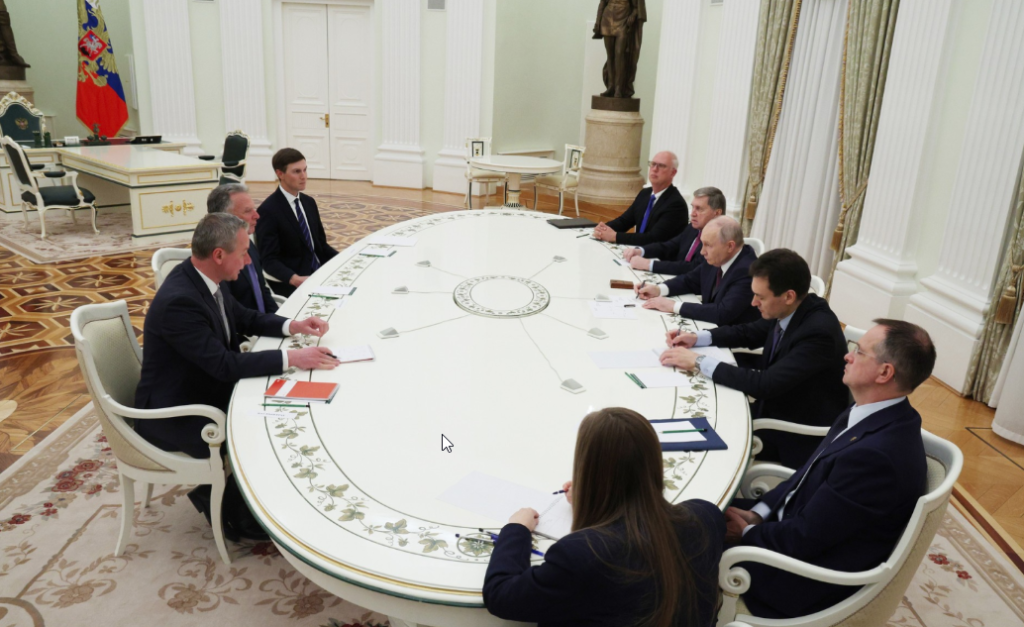
Russians are famous hosts. Sit down with Russian officials for five minutes and someone will produce tea, water, a plate of something and, if the meeting goes well, a bottle of something stronger. So when Steve Witkoff and Jared Kushner took their seats across from Vladimir Putin in the Kremlin’s Senate Palace on Thursday, I noticed what was on the table. Nothing. No water, no coffee, no tea. Not so much as a mint.
In diplomacy, that is not an oversight. The Kremlin protocol office does not forget the water. A bare table is a message, and this one said: this is a working session, not a social call, and we are not going to pretend otherwise.
Then the Kremlin made sure the rest of us got the message too. In every previous meeting with Witkoff and Kushner, the Kremlin released only the handshakes and the opening pleasantries. The substantive discussion stayed behind closed doors. Not this time. This time the Kremlin put the substance on video. What Putin said was not small talk for the photographers. It was a set of positions delivered for the record, with the American envoys as the audience and the rest of the world looking over their shoulders. When the Kremlin breaks its own habit, it wants you to notice.
What Putin said
The envoys arrived straight from two days of trilateral talks in Abu Dhabi, which produced a large prisoner exchange and not much else. Putin opened politely. He asked them to thank Donald Trump for helping arrange contacts between Moscow and Kyiv and noted progress on humanitarian issues. He said he wants peace in Ukraine to last “forever.”
Then he got to business, in three parts. First, he said the territorial question keeps getting raised from various sides, but for Russia the people matter more. That is a polite way of saying the land question is not open for haggling. Second, he proposed a humanitarian mission in Kostiantynivka, which I’ll come to. Third, he repeated that foreign troops in Ukraine are unacceptable and would be “legitimate targets.”
The meeting lasted about two hours. There was no press conference afterward. Yuri Ushakov called the talks “substantive, constructive, frank and useful,” which in Kremlin dialect means nobody moved.
The Kostiantynivka dare
The Kostiantynivka proposal is the cleverest thing Putin has put on a table in months, even a table with nothing on it. “There is a settlement in Donbass, Konstantinovka, where there are also about 400 to 500 civilians,” he said. “Let’s do the same thing we did in Alyoshki: invite representatives of the foreign press, including the US press, and Russian media.” Russia, he said, controls the town, needs five days to clear the mines around it and will guarantee the mission’s safety. Then the kicker: “If the Ukrainian authorities control the city, as they claim, let them ensure security there.”
Read that again. Kyiv insists Kostiantynivka is still in Ukrainian hands. Putin says it’s Russian. Rather than argue, he invited American reporters to drive in and see for themselves. That’s not a peace proposal. It’s a dare. If the press arrives under Russian escort through Russian-cleared roads, the argument over who holds the town is over, and the Western maps showing it in Ukrainian hands go in the bin.
Kyiv’s answer was predictable. Zelensky’s office said all the details need to be clarified and accused Russia of using the Oleshky mission to rotate troops. Maybe so. But note what Kyiv didn’t do: it didn’t accept the challenge to prove it holds the town. When one side says “come and look” and the other says “let’s clarify the details,” I know which one I’d bet on.
Europe wants a chair
The Americans came with a request of their own. Kushner told Putin the Europeans want in on the negotiations, and that Washington has already started talking with them about a new security architecture for the continent. Kushner said a goal of the trip was to get Putin’s blessing for that. Before the meeting, Axios reported that the envoys would invite Russia to lay out its vision for European security, modeled on the security guarantees Moscow demanded in December 2021, updated for a “greatly changed world.”
Pause and savor that. In December 2021 Russia handed NATO two draft treaties: no more expansion, no offensive weapons on its borders. The West laughed them out of the room. Four years and several hundred thousand casualties later, Washington is asking Moscow to please resubmit its paperwork. Witkoff says the next round will include Europe.
Putin answered the European question before it was asked. Foreign troops in Ukraine are legitimate targets. Every “reassurance force” plan drawn up in London and Paris assumes British and French soldiers can deploy to Ukraine as part of a settlement. Putin just told the American envoys that any such soldiers would be targets. Europe can have its chair. It can’t bring its army.
What Alexander Mercouris saw
My friend, Alexander Mercouris of The Duran, went through the same footage and came away with the same read, only sharper. In his telling, the envoys didn’t come to Moscow on a routine stop. They rushed there, alarmed that Russia had moved the conversation away from Washington’s preferred agenda of ceasefire lines and territory. Alexander’s core point is that Moscow has made peace conditional on one of two outcomes: a full Russian military victory, or a new European security architecture. Territory, borders and ceasefires come second. Vladimir Medinsky made that case in Abu Dhabi, Alexander notes, and Sergei Lavrov made it before him.
Alexander also caught the choreography. Before the envoys got anywhere near Putin, Yuri Ushakov sat them down to find out what they were bringing. In the Kremlin’s photos of the main meeting, he points out, nobody smiles. The Russians look forceful and the Americans look uncomfortable, a long way from the friendlier sessions earlier in the year. And Medinsky was in the room. Alexander reads his presence as a deliberate signal of a harder line, and he lists Medinsky’s positions bluntly: all of Russia’s land comes back, and Europe stays out of the talks.
On Alexander’s account, Putin rejected any “gray zone” arrangement in favor of the state border, offered the Kostiantynivka evacuation and said foreign troops must never enter Ukraine. His “eternal peace” is one that involves Europe, on Russia’s terms.
Alexander’s conclusion is the one I keep coming back to. Europe is trapped. He cites a Financial Times piece reporting that European officials fear walking into a security-architecture trap, and he notes that Europe still hasn’t decided who would negotiate for it. He reports that Moscow rebuffed a British military back channel. In his view, the West faces its worst geopolitical setback since 1945, and an all-or-nothing approach leaves it with nothing.
Read the table
Put the pieces together. The table was bare. The cameras were on. Putin thanked Trump, proposed a mission that would settle a battlefield argument in Russia’s favor, waved off the territorial question and drew a red line through every European troop plan. Then he sent the envoys off to Dublin to explain all of this to Zelensky.
Washington will describe the meeting as constructive, because Washington describes every meeting as constructive. The Russians described it as frank, and for once I think they undersold it. The message from the Senate Palace was simple: Russia is winning, Russia knows it, and Russia is no longer interested in pretending these sessions are anything other than the Americans coming to hear the terms. You don’t serve refreshments to people who’ve come to take dictation.
Meeting with US President’s Special Envoy Steve Witkoff and Jared Kushner
US President’s Special Envoy Steve Witkoff (left) and entrepreneur Jared Kushner.
by Kremlin [11-12-2026]. (There are 16 photos here that show the somber tone.)
The Russian side was represented at the meeting by Presidential Aide Yury Ushakov, Presidential Aide Vladimir Medinsky and CEO of the Russian Direct Investment Fund (RDIF), Special Presidential Representative for Investment and Economic Cooperation with Foreign Countries Kirill Dmitriev.
* * *
President of Russia Vladimir Putin: Mr Witkoff, Mr Kushner, it is a great pleasure to see you.
First of all, I would like to thank you and ask you to convey my gratitude to President Trump for arranging our contacts with the Ukrainian side. I know that we have achieved a positive result in at least one area: the humanitarian track, particularly with regard to exchanges of detainees held by both sides. Another important step in this area is now being planned.
I would also like to ask you to convey my gratitude to Mrs Trump, the First Lady of the United States, for her active involvement in addressing the humanitarian issue concerning the town of Aleshki in the Kherson Region.
We fully understand that this would not have been possible without the support of President Trump’s entire team, including key government agencies such as the State Department, the Department of Defence or, as it is now called, the Department of War, and other agencies, as well as your personal involvement.
There was also an idea of continuing this practice with the involvement of representatives of the human rights commissioners on both the Russian and Ukrainian sides.
Of course, it would be very important for us to hear your assessment of what has taken place in Abu Dhabi, your views on the nature of these negotiations between Russia and Ukraine and the prospects for further contacts between us.
You also met with representatives of the united Europe there. Your assessment of the issue from that perspective – from the European angle, as diplomats say – is also very important to us.
United States Special Envoy to the Middle East Steve Witkoff: First of all, thank you for having us, President Putin.
This is an important meeting today. We are resetting the trilateral talks. I know I speak for the President, who feels strongly that we have to solve this conflict. It’s a tough conflict on both countries, and this is important work that we are all doing. Jared, I and the rest of the team back in the United States, Secretary of State Rubio, and all the people who are involved. This is critical work, and we embrace it, and we take it very, very seriously.
I think the meetings in the United Arab Emirates were very positive. Both parties were engaged. The Russian emissaries were meeting with the Ukrainian emissaries. It was clear that it was purposeful, that people were trying to find solutions to this. And candidly, Jared and I have talked about this – this consumes our conversations – and I think we are both feeling positive as well.
Some of the things we have discussed are what you have just mentioned. For instance, the prisoner swap between the two countries, which will be the largest one ever done. That, I think, underscores the progress that we have been making. And so, just in general, a lot of good things are happening.
I want to note that Mr Medinsky was a very important part of this process. He was involved from the beginning and throughout. We had a personal conversation with you, sir. I just want to thank you for your commitment to the process. Jared and I met with Ambassador Yury Ushakov this morning. We had some very important coaching conversations. And Kirill [Dmitriev], as well. We have been in contact with you. Your work has been so important.
Before I turn it over to Jared to make some comments, let me just say that the Europeans were physically in the United Arab Emirates, even though they were not at the table directly with us. We consulted with them. We were speaking with them. We gave them a download on everything that we were discussing. I think in general, there was very good rapport between us. We’ll be travelling directly from here, after this meeting, to Ireland, where we will meet President Zelensky before he returns home and we will have important meetings with him. We will confer and take him through everything that’s going on. And we are hopeful that we can announce shortly – hopefully, even at the end of this meeting – the next trilateral meeting that will hopefully include the Europeans. After the translation, I will turn it back over to Jared.
United States Special Envoy for Peace Jared Kushner: In Abu Dhabi, the Russian delegation, the Ukrainian delegation and the European delegation were all in agreement that they want the war to end. They agreed on many of the principles but are still apart on some of the ways to accomplish that.
I hope today we will be able to discuss some of the areas where we see opportunities and, hopefully, find new pathways to bring new proposals. Then we will meet with President Zelensky and we will try to see if we can continue making progress together.
We have seen a big change with the Europeans, and we think there is very strong momentum and a desire to engage together. And we are very confident that, if we move to a multilateral format, we will continue to make progress to resolve the issues. And we believe that it will help us end the war.
And the final point is that – we will discuss this more today – but the Europeans have the desire for this war to really be the end, for there to be a long peace after. Understanding the long-term security between Russia, Ukraine and Europe is a conversation that we have started with them, and I think we have made a lot of progress on that together – to end this war but also to make sure that we avoid any future wars as well.
Vladimir Putin: I understand that this is closely linked to territorial issues.
Jared Kushner: And some other things as well, but we’ll go through them and we’ll find solutions together.
Vladimir Putin: We will address that now, of course.
As for the duration of the peace, its soundness and reliability, we also would like it to be permanent peace.
We are aware that territorial issues are viewed differently by the two sides. For us, what matters most are the people who live there, their traditions, their culture and their right to live by their own rules, in accordance with their traditional values.
We know that the Ukrainian side raises the question of the so-called “grey zones.” This, as I have already said, will always be a bone of contention. For us, there is only one line of demarcation – the state border. That way, everything is clear and understandable: this is your side, and this is ours.
The moment we are drawn into discussions about “grey zones,” interpretations diverge, disputes arise immediately, any agreement becomes untebanle, and there can be no lasting peace.
Even now, we hear from the Kiev authorities that a given territory is under their control, while another is not under ours. This could go on endlessly, because reaching these areas and verifying what is actually happening on the ground is no easy matter the modern means of destruction now available.
We had a positive experience of humanitarian cooperation in the town of Aleshki, which I have already mentioned. Let us continue this joint work.
Within what Ukraine regards as its strategic line of defence in Donbass lies a town – Konstantinovka. Around 400–500 civilians remain there. Let us do the same as we did in Aleshki. Let us invite representatives of the foreign press, including the American media, alongside the Russian media, and entrust this matter to those responsible for human rights on both sides – the human rights commissioners. If, as the Ukrainian authorities claim, they control this town, let them ensure security there. I believe this town is controlled by Russian troops. We will ensure security on our side. We need five days to demine the access roads to the town. If Ukraine controls it, let them do the same. In any case, we invite the American, international, European, Ukrainian and Russian media, together with human rights representatives from both sides, so that the hundreds of civilians still there can be evacuated. At the same time, we will see who actually controls the town.
Why? In order to understand what would be the most acceptable outcome for ending this conflict, including on territorial issues. This is because, as I said at the outset, we will never resolve the issue of these “grey zones.” There is only one clear line – the state border.
To be continued.
Presidential Aide Yury Ushakov’s commentary following a meeting between Vladimir Putin, US President’s Special Envoy Steve Witkoff and Jared Kushner
by Kremlin [11-12-2026]
Presidential Aide Yury Ushakov: Good evening, friends.
All of you are certainly aware that President of Russia Vladimir Putin received US President’s Special Envoy Steve Witkoff and Jared Kushner today. The conversation was very substantive, constructive, frank and productive – just like all their previous conversations.
At the outset of the meeting, the Russian President made several important statements in the presence of the press, setting the tone for the discussion that followed. Notably, the American negotiators actively supported the Russian President’s proposal to apply the approach used in the successful humanitarian operation in Aleshki to another city beyond the line of contact, namely, Konstantinovka.
The President specifically drew attention to the fact that the Ukrainian side has raised the issue of so-called “grey zones”. The humanitarian initiative we have proposed will allow everyone to see who actually controls these areas, based on the situation on the ground rather than on Ukrainian maps, those of the Armed Forces of Ukraine. It has been agreed that detailed discussions of this new humanitarian initiative will begin with US representatives. We are ready to begin demining operations immediately. Naturally, once preparations for the humanitarian operation to assist the residents of Konstantinovka are complete, we will invite journalists from Ukraine, European countries and the United States to observe the operation.
The President of Russia has once again supported the American side’s proposal to move towards resolving security issues for both Russia and Ukraine as part of efforts to shape a future post-conflict system of European security.
It is clear that the current system is not working – that is obvious to everyone. We hope that representatives of European countries will also support efforts to agree on the parameters of a new, long-term architecture of indivisible security and peace, a process we are ready to begin immediately, in tandem with our American counterparts. In this context, the President recalled our vision of the key pillars of the architecture of indivisible security, which we presented back in 2021 in the form of draft agreements with the United States and NATO on security guarantees.
These include the non-expansion of the NATO bloc, the non-deployment of threatening weapons systems near Russia’s borders, and a return to the configuration of the alliance’s forces as it stood at the time the Russia-NATO Founding Act was signed. To this list, which is not limited to the points I have outlined, we would like to add certain new considerations of our own, based on the lessons that we cannot – simply cannot – fail to draw from the present situation, in which the collective West has taken up arms against us, making no secret of its desire to save the Kiev regime and to inflict a strategic defeat on Russia.
For our part, the position of the Europeans has been comprehensively outlined. They are striving by every means possible to join the negotiations, but, as our President has said, they must decide whether they want peace or the continuation of the war. So far, all their practical actions point precisely to the latter. In particular, attention was drawn to the fact that the deployment of foreign contingents from the coalition of the willing on Ukrainian territory after the end of the conflict is being actively promoted. Yet that is precisely the recipe for an endless war. Incidentally, in his remarks, Vladimir Putin very accurately and vividly characterised the current course pursued by the Europeans and, as you know, cited the old joke about the money in the bedside drawer. That joke illustrates how Europe is attempting to send the question of peace or the continuation of war going round in circles.
In the course of today’s negotiations, the behaviour of the head of the Kiev regime was also discussed – namely, the “friendly greetings” he publicly extends to the President of the United States. It was also noted that in Kiev they do not want to end the war, because they would immediately have to call general elections, and no one wants to lose power. Our President did not overlook the fact that the current American administration is working very insistently and persistently to achieve a genuinely lasting settlement of the Ukrainian conflict.
As was noted, President Donald Trump is personally committed to resolving this issue. Naturally, the full range of matters related to its regulation will be discussed further at the planned meeting with him on the sidelines of the APEC summit in Shenzhen.
Both we and the American side see great value in the upcoming trilateral summit in Shenzhen, which our Chinese hosts are organising. Work is currently underway to develop the substance of this meeting. We hope that this first-ever meeting in such a format will have a stabilising effect on the overall international situation.
During the talks, Steve Witkoff and Jared Kushner gave a detailed account of their assessments of the trilateral contacts that took place in Abu Dhabi on November 10–11. Both we and the Americans regard those discussions and contacts as constructive and productive. It was agreed that this negotiation process and this track of talks will continue. In particular, support was expressed for an initiative discussed in Abu Dhabi to carry out another prisoner exchange, which would likely be the largest to date. The parameters of this exchange are currently being finalised.
It is worth noting that since 2025, there have been 35 prisoner exchanges, involving approximately 5,000 individuals on each side. We hope that the Ukrainian side will take a serious approach to implementing the new agreement reached in principle in Abu Dhabi.
Following these in-depth discussions at the Kremlin, the American negotiators have departed for Dublin, where they are due to meet with Zelensky and representatives of various European capitals. We hope that the signals from Moscow will be conveyed to them with the utmost care.
We remain in contact with Steve Witkoff and Jared Kushner, and we will discuss the state of affairs further ahead of the meeting between Vladimir Putin and Donald Trump in China.
That is all, I believe. Thank you, colleagues.
by Daniel Davis / Deep Dive [11-12-2026].
Larry Johnson about above video: After Danny Davis showed me the video of Putin with Kushner and Witkoff I knew what I was going to write about.
Transcription of the above video...
(This AI transcription is provided without editing)
Daniel Davis: [00:00:00] After the first three-way meeting between Russia, Ukraine, and the United States ended in Abu Dhabi, the US delegation went to Moscow to try and talk to Putin to see if they could get him to come to some kind of mutually acceptable agreement. And then tomorrow they're gonna be going back to Ukraine to talk to Zelensky and seeing how all that's gonna work out.
Is this setting the stage for peace? Are we finally moving somewhere that's gonna bring the war to an end, or is something different gonna come out of this? Uh, we are joined today by L- uh, Larry Johnson, former CIA analyst and snappy dresser, a big-time friend of the show, uh, our, our favorite guest, I think, if we're being honest.
Uh, uh, Larry, listen, uh, what is your overall assessment of, of these three-way talks and what it's even accomplished so far?
Larry Johnson: Sound and fury signifying nothing. Um, so, you know, the, the big announcement yesterday- after the meeting in Abu Dhabi was, "Hey, they've agreed to a major prisoner exchange." [00:01:00] And I'm going, uh, to quote Yogi Berra, "Boy, that's deja vu all over again."
'Cause you go back to, uh, Istanbul 2025 at the conclusion of, like, the second or third round of meetings between Russia, Ukraine, and the United States with Witkoff and Kushner there, the announcement was, "Hey, we're having a major prisoner exchange." So, okay, so th- they've just done what they did last year.
Uh, but apart from that, when, uh, Witkoff and Kushner went to, uh, talk to Putin, Putin listened. But, uh, you know, they're- the Russians are interested in only one thing. Uh, there's gotta be a revision, revamping of the security architecture, uh, with Europe. That means restructuring NATO, getting NATO the hell away from Russia's borders, and making sure that Ukraine's not a part of that.
And, uh, all at the same time, Russia's not giving up any of the territory that it [00:02:00] currently occupies or has incorporated into, uh, the Russian Federation Other than that, we have plenty to talk about. So
Daniel Davis: And, and, you know, I mean, the, the context, uh, of this meeting is, is so important. Uh, everything is, uh, in, in any kind of negotiations is all about leverage and how much you have to either, uh, coerce the other side or how much do they have to make you give out on something maybe you don't want to, but that's just kinda how it works.
I mean, just the two big things, Ukraine, uh, has run out of money. It, it effectively has no domestic e- uh, economy, so it relies intentionally on, or d- almost exclusively on an IV of money- Right, right ... from euros from the Ukraine side, uh, from the European side. That was supposed to be $90 billion for '26 and '27, and now then they used it all up before the end of '26, and so now they're trying to get another 45 billion right now.
All that's taken place in the, uh, light to where there is no air defense from ballistic missiles in Ukraine, not even in Kyiv, [00:03:00] much less in any of the other cities around the country, and Russia has no shortage of missiles, and they literally attack at will, and they're gonna continue to pulverize them.
So you would think that with that leverage on the Russian side and those advantages to the Russian side, that we would be in a little bit more amenable to come up with a deal. But, uh- Yeah ... let me show you. We're gonna look at a little bit of reaction here. Let's look first of all, though, at Zelensky, who went, uh, before the Danish parliament, I think.
Uh, and here's how his, uh, uh, if you wanna say his humility was really shining through
Zelensky: We keep hearing again that Russia supposedly needs security guarantees, even though no one has attacked Russia for many decades. And since the Second World War, Moscow has not gone through even one decade without starting a war or using military force against another country. So when the Russians [00:04:00] now talk about a security architecture for themselves or about security guarantees for Russia, they are hardly talking about real security and peace.
What they really want is to freely interfere in the affairs of other countries and to use force whenever they want, and to make sure that no one can support liberty inside Russia because Putin wants to keep his personal power forever and pass on his imperialist and, in many ways, simply fascist views to the next generations.
Daniel Davis: If you had no idea how the war had been going on or didn't even know what had happened over the last five years, you would think, "Well, either this is at a stalemate and there's two equal sides here- Yeah ... or maybe the, the Ukraine side is a little bit above." 'Cause he's lecturing people, thinking that, "Listen, if I just convince enough people who's listening to this that how dare those [00:05:00] Russians want security, they don't deserve anything," that the people are gonna go, "Yeah!"
Straight up, and so that somehow the negotiations are gonna go his way. Is that how it really is?
Larry Johnson: Oh, no. And, and the, the irony here... Look, everything he was saying about Russia was actually, he, he was making commentary on Ukraine. Uh, Vladimir Putin's been elected. They've held open elections. They've had parliamentary elections, uh, with, uh, you know, the equivalent of parliamentary elections to the Duma.
It's Zelenskyy who canceled elections and not held elections, either for the r- the Rada or, or for, for the presidency. Uh, so, and, and he's used the war as an excuse. Russia, in spite of the war, has gone ahead with, with elections. So, it, you know, that highlights, uh, the number one difference. Uh, uh, but, but the, the military campaign has shifted decisively in Russia's favor, and that's why there's such desperation in the West to try to get a halt.
You know, they're really [00:06:00] pushing to get a halt, uh, Russia to impose a ceasefire so that they can go back à la Minsk II and use the ceasefire as a time to rebuild, try to rebuild, um, Ukrainian capabilities, or at least patch them up in a way that they can try to stay in the fight. But, uh, Russia's having none of that.
Uh, they made their demands very clear. Uh, Medinsky, at the conclusion of the meeting in Abu Dhabi, uh, on, uh, on Tuesday, uh, w- was very straightforward about what was, uh, uh, what Russia's position is. And where, is it basically wherever Russia has raised the flag, it ain't taking it down.
Daniel Davis: Well, and speaking of Medinsky, uh, he also addressed another issue about the security architecture, uh, because he's reiterated something that Russia has said really from the beginning of this, that there needs to be a European, be a continental-wide security architecture where nobody's security is d- made at the expense of somebody else.
And so he's even [00:07:00] saying, "We want a situation to where we're not gonna be a threat to you that you perceive a threat, but we also require that there's no threat to us." That's the part that we keep leaving out. Here's how he put it.
Medinsky: The world needs a new, modern, updated security system. A fair one, not at the expense of any individual countries.
We will work on this. As for the position of the leadership of a number of European countries, in essence, they are engaged in a collective deception of the Ukrainian people. They are financing and supplying arms to one of the warring parties. In doing so, they're effectively contributing to the mass death of the civilian population, and therefore we do not quite understand what there is to talk to them about.
Daniel Davis: And it's ironic because I, I wanna say about a week or so ago, we showed the clip from, uh, Ursula von der Leyen where she was, uh, asked... I'm sorry, uh, Kaya Calles, not Ursula von der Leyen. Kaya Calles was asked, um, "What about this security architecture, this continental-wide? Are you gonna talk to Russia about that?"
She literally started laughing and says, "Yeah, [00:08:00] we've already told Russia what the security architecture's gonna be, and they're not abiding by it, so there's no point in talking to them." So you hear Medinsky saying, "There's no point in talking to the Europeans because they're not even, uh, they're, they're a party to the war here."
And then you hear the Europeans say, "There's no point in talking to Russia because we already told them what to do." In that environment, where can this go?
Larry Johnson: Uh, uh, it, a, a, a military conclusion. Uh, the war will continue. Uh, Russia's not gonna stop its offensive. The, the notion that, um, you know, if Witkoff and Kushner thought that they're gonna persuade Putin to impose a ceasefire or...
it's not gonna happen. Or let me put it this way. If Putin agreed to something like that, uh, I think Putin would likely be removed from office. Uh, it, 'cause that, that will have crossed a line with, with the Russian, uh, with, with the Russian military, the Russian intelligence service, but more importantly, the Russian people.
Uh, the, the majority of Russian people are not agitating for this war to end or to be stopped in place. [00:09:00] They do want it over, but they want it over with, uh, the decisive victory, not only of Ukraine, but a- against NATO 'cause, uh, most of the Russians recognize they're fighting NATO. They're not fighting just Ukraine.
This is a war against, uh, the U- particularly the UK, France, and Germany.
Daniel Davis: And, and w- w- uh, I, I mean, we've talked about this before, but it, it, in the current environment, it just begs the question. In the overall archit- the overall circumstances that I just described a second ago- Mm-hmm ... about the, the, uh, if the finances, the economics, the military weapons, the ammunition, the air defense, the air, air offense, et cetera, all that obviously anyone with no military experience can understand, especially when you add in, I think the number's around 14 to 20 million, depending on who's doing the counting, more military-aged males on the Russian side, even that you could potentially get than the Ukraine side.
Right. Not 14 million people that they have, 14 million more than they have. So all that together means it's irrational to think that there's any kind of a solution other than something [00:10:00] that's gonna be on Russia's terms. And yet why does Europe continue to say stuff like Kaja Kallas did there and continue to push for something else?
Like for example, um, saying, "Hey, we wanna put some, uh, negot- or some troops of our own. Uh, and once, once we get to a ceasefire, we're gonna put some peacekeeping troops in there." More on that in a second, but let's first of all go why is Ukra- or Europe pushing for something that rationally they would never get?
Larry Johnson: Uh, well, I think a lot of it has to do with the money that's being made on the side of this, of money that's winding up in the hands of Eu- European politicians as well as US politicians. I mean, th- this war has been a very, a lucrative source of income for a lot of political, uh, people, both in Europe a- and the United States.
So they don't want that gravy train to stop. Uh, Russia for its part has come, I think, finally, um, uh, come to the, uh, realization that there is no negotiated, [00:11:00] uh, uh, road out of this, uh, quagmire, that the, the only, the only way to end this is militarily and, uh, not just the defeat of Ukraine, but it's gonna be the military defeat of NATO.
Uh, th- that's where it's headed. Uh, I, I, and frankly, I don't see how they avoid that, uh, because, uh, the, the European leadership is so dedicated to their own d- delusion that they can confront and defeat, uh, Russia.
Daniel Davis: Okay. Here's where, here's where I st- st- even with that, I have a problem. Let's, let's agree that morality is not a factor.
Correct. They don't even care about the people dying or anybody else- Sure ... or that the war could go against them. Even in that case, the gravy train money-wise, you, you can't, you can't succeed and get in this war o- over with in any terms. It's gonna be other than a Russian victory, so it's gonna be more.
Is it possible, Larry, that they are very much aware of [00:12:00] that, and that they're actually, if not okay with, maybe even desire for Ukraine to get eventually just chewed up until it's literally gone and Russia has taken it over, and then they will... They don't wanna get it, they don't wanna get into a war with Russia.
But they would, I think, if morality's not in the equation, love to see Ukraine get destroyed as a nation and all of its people killed. And then we can say, "My God, I told you. Look at what, how evil these Russians are. We have to get ready for the next war." And then now the gravy train actually expands. Is that possible?
Larry Johnson: Yeah, no, it's possible. Well, but look at, look at what the Dem- many of the Democrats have said since the victory last Tuesday, a week ago Tuesday. They're talking about increasing funding for Ukraine and over the objections of Trump. So you- you gotta stop and ask what the, what the hell is going on? Hasn't anybody learned a thing from the midterm results that the American people are sick and tired of supporting and spending money on foreign wars, particularly when the economic consequences here at [00:13:00] home mean, uh, you know, rising unemployment and, and f- and fewer, uh, ec- you know, and rising inflation that, that hurt families.
So yeah, yeah, this, um, th- this, the, the war particularly with Ukraine has taken on a life of its own. It's like a, a Frankenstein monster that's been created and can't be put down.
Daniel Davis: You know, I saw that movie. Turns out Frankenstein will come back on the guy that created it. I don't know if they watched that or not.
Uh, lesson there that could be learned. But, uh, let's, let's look at- Yeah ... uh, since you, you talked about this here, let's, let's kinda take a little bit of a diversion off on the American side because we, I thought, gave a pretty strenuous and unequivocal demand to the politicians in Washington of any party.
We're against the war. We're against war, not even just the war, as in the Iran war- Right ... but against war. It doesn't seem to me it would be a winning political play for the Democrats when they first get into power as a [00:14:00] result of that denunciation, one of the first things they do is go and throw a bunch more of your money into another war that, that also can't be won.
I mean, uh, it... Will the Democrats actually do that?
Larry Johnson: Oh, yeah. Yeah. No, absolutely. Uh, I think Robert Barnes is even, you know, he commented on that recently, that, you know, what we're, what we're witnessing here is a mirror image of what has taken place in, uh, Great Britain. Four years ago, uh, the dominant conservative party got wiped out by the Labour Party in a, what they called a historic election.
Oh, we've never seen anything like this. Okay? And Labour, oh, we're going to change the world, and what have they done? They've, uh, doubled down on all the same stupid policies that the, the conservatives did, and as a consequence, Labour is now, uh, just as, uh, I think getting a colonoscopy is more popular than, uh, supporting Labour.
Uh, and, and so [00:15:00] the, the Labour is now discredited, and I think that's actually what's gonna happen, happen to the Democrats. Instead of focusing on domestic issues and improving the quality of life of Americans, doing what Donald Trump claimed he... You know, putting America first, they're gonna continue to go down, particularly the road of war with Ukraine, because so many members of Congress are getting paid.
They're getting money out of this. It is a financially lucrative, uh, policy to support. It's, you know, it's being done illegally. It's being done through offshore banks, but great incentive to continue spending the money, more so than the, than the war in Iran. The war in Iran is not, uh, doesn't kick off the kind of money that the, the war in Ukraine has
Daniel Davis: Yeah, and, and plus that's also the, the other issue about the elections was too much fealty to the State of Israel, and that was repudiated- Right, right
and those two are tied together in the Middle East [00:16:00] there. Uh, but, uh, there's a different one. People are not as aware of the, the benefactors behind the money in the Ukraine war as, as they are in this other one, so we'll see if that... how that unfolds. Uh, shifting back over here, we mentioned a minute ago that one of the things Europe is floating about that they would like to do is to say, "Hey, how about we bring in some European peacekeepers?"
Not NATO, not NATO, but some European peacekeepers. Um, when Witkoff and Kushner went to visit with, uh, Vladimir Putin, um, he did not leave that issue unaddressed
Speaker-5: Мы с самого начала говорили, что присутствие любых иностранных войск на украинской территории для нас абсолютно неприемлемо.
Speaker-6: Потому
Speaker-5: что мы считаем, что это угрожает безопасности Российской [00:17:00] Федерации.
И в принципе с этим все согласились. Во всяком случае, в ходе переговоров в Стамбуле было именно так. Но и до сих пор
Speaker-6: европейцы
Speaker-5: знают об этом. Что мы слышим от них? Что после заключения мира они сразу же введут войска на территорию Украины.
Что это означает? Мы уже об этом говорили. Для нас это законная цель. То есть война тут же возобновится.[00:18:00]
Daniel Davis: Now there, there's obviously nothing new there. The, the Russia has said that every time the issue of coalition of the willing and Macron, etc. But what do you make of the fact that, uh, Putin chose to, that to talk about? And as, uh, Gary actually pointed out, uh, he, he first one to picked it out. He said the, the optics here were different than the normal kind of discussions in this big hall.
It's a smaller desk. They're sitting closer to each other. There's no, there's no water on the tables. There's no, uh, pleasantries. They just get right straight into it. And Putin's, you see, he's literally just feet away from Whitkoff and Kushner, and he's just looking straight in the eye when he's telling them that.
Is there an additional message besides the words?
Larry Johnson: Oh, yeah. Well, number one, uh, what, what I also noticed, uh, he, he understood the English translation because as soon as the translator stopped, man, he was jumping right in. So he under- he understood when the guy was [00:19:00] finishing and when it was ti- time for him to speak.
So that's number one. So again, Putin's- Putin speaks English. Uh, you know, he can talk in English if he wants to. But, uh, so he, but he kept it strictly in Russian. Uh, and, uh, again, with his body language, he was being very direct. And, um, you know, I, I don't know if Whitkoff and Kushner got the message, but, uh- Putin hadn't, you know, uh, uh, hadn't, hadn't, uh, distanced himself from any of the previous positions.
More importantly, we've never seen this meeting publicly shown. You know, the previous meetings with Witkoff- Yeah ... and Kushner- That's
Daniel Davis: right ...
Larry Johnson: were never shown. We never heard the exchange of words. That's why the, the Russians d- deliberately put this out so everybody knows, [00:20:00] "No, we're not making some secret deal.
We're not gonna cave in and, you know, let the Americans go off and do what they wanna do." I mean, the Russians sent a very clear message by publicizing this meeting like that
Daniel Davis: And then where is this gonna go? Because if, uh, if, if you have Zelensky saying, "Oh, how dare Russia have a security interest?" If you have Europe saying, "How dare Russia have a security interest?"
And the United States is saying, I don't even know what we're saying. We're just, like, saying, "Hey, can we get him- can we get some money out of this?" I don't know what they're saying. Where is this gonna go?
Larry Johnson: Um, either Ukraine accepts the deal that's on the table right now, they withdraw their troops from Russian territory.
That means they pull their troops out of Zaporizhzhia, Kherson, and what's left of Donetsk. Uh, that the NATO troops, NATO forces, uh, a- and advisors must all depart Ukraine, [00:21:00] and then, uh, Russia will enter into the f- negotiations for how to end this. If that, if Ukraine refuses that, Russia will militarily defeat.
They will have... They will occupy Kyiv, they'll occupy Odesa. They're gonna take over Transnistria, and, uh, Ukraine is gonna be left with basically nothing. They're gonna be c- they're gonna be cut off from the Black Sea, uh, and they will, uh, uh, face lo- lo- you know, losing territory to Poland, Romania, and, uh, uh, Hungary
Daniel Davis: And, and what do you say to those people who s- who, uh, argue that, "Oh, yeah, sure, that's what Russia would like to do, but you see how far in nearly five years it's taken them just to get this far here.
Just, you know, how big is it gonna be? What, are they gonna do this for another five years?" What do you say to that?
Larry Johnson: Okay, they'll do it for another five years. That, the, the, people who say that, they, they [00:22:00] need to pull their heads out of their ass. They, they, they, they show they know nothing of, of, of Russia's history.
The, the United States started a war, a civil war in Russia in 1999 known as the Second Chechen War. Now, we never acknowledged that we were the ones involved, but we were absolutely the ones funding and supporting the, the radical mujahideen. That war went on for 10 years, and at no point in that did Russia go, "Oh my God, we can't keep this up."
The, they, they, they finished it. Uh, in fact, it started under, uh, when Putin first came to power on August 7th, uh, of, uh, of 1999, but it was, uh, uh, Medvedev that finished it. He was, he was president when the thing finished. So five years, 10 years. As, uh, a, you know, a new book out by Stephen Kinzer, Boiling Point, as, as [00:23:00] Kinzer details in that book, the US efforts to use Ukraine as a lever to destroy, in the '50s it was the Soviet Union, but now, uh, the Russia, this started back in 1947 and, and has been underway ever since.
So, you know, Russia, Russia recognizes that, that it's, it's in a long-term existential war with the West. And then, okay, so it took 'em, it took 'em f- uh, four and a half years now to do what they've done, but part of their, the operational guidance given to the, the troops was, one, to minimize your casualties, two, minimize civilian casualties, which they've done.
When you look at the amount of explosives, uh, bombs, missiles that have been rained down on Ukraine, the fact that only less than, you know, 16,000 Ukrainian civilians have died over the course of those almost five years [00:24:00] i- is pretty remarkable because, well, when you look at comparable firepower that the United States dropped during World War II, we killed close to a million civilians.
Daniel Davis: Yeah, and you can just look at Gaza or Southern Lebanon and, uh, that puts that number in even more stark relief. Um-
Larry Johnson: Yeah ...
Daniel Davis: so here, here's the, the, the question then. Uh- I, I guess the Europeans are gonna be fine with this, uh, slow strangulation death and they'll be making bank the whole way through, right? So I, I guess they really don't care
Larry Johnson: No.
No, actually, that's, that's where, uh, Europe is starting to come apart at the seams. Uh, you've seen the riots in France. Uh, you've seen a gr- a, a complete divide between the political leadership and the, the sentiment of, um, the majority of the population. Same thing in Germany, same thing in Poland, same thing, uh, i- is emerging in the UK.
The, the, the po- the [00:25:00] population, when, uh, they're concerned about the cost of gas, the cost of heating their homes, uh, the, the price in- price increases, uh, surrounding food That they're not looking to go to war with Russia. Um, the, this, this political leadership and th- this unelected bureaucracy in Brussels that is the, the European Union with the likes of von der Leyen and, uh, Kaja Kallas, uh, uh, it, it is, uh, th- they are completely divorced from any political reality.
And, and so, uh, th- this, this coming apart of Europe, that, that's gonna become more of the storyline as we move into 2027. So-
Daniel Davis: You know what, Larry? That, that's, that's actually a great point you, you raised there, and I'm a little bit embarrassed that I'd never thought about it now. It's not a matter of just how long can Ukraine survive under a, a, a situation now where the skies are completely open and, and Russia can just rain [00:26:00] ballistic missiles at will, and a good portion of their long-range, uh, drones at will, but the question is how long can Europe economically survive?
Right. Are they gonna sign up for 45 billion a year just shoveling it off hand over fist? I, I, I wager that, that, uh, that could come to an end even before the physical conflict of the war does on Ukraine.
Larry Johnson: Yeah, and this is where the war in the Middle East spills over to the war in Ukraine. When, when the United States and Israel attacked, uh, Iran and the Gulf, uh, the Strait of Hormuz was then s- shut down, and the damage that was done to the oil infrastructure in Kuwait, Bahrain, Saudi Arabia, Qatar, and the United Arab Emirates, well, that meant that 20% of the global supply of oil was cut off.
Now, uh, in the, in the, in the next 40 days from the 28th of February through the middle of April, uh, there were oil [00:27:00] tankers al- already on the high seas, so that oil got delivered. So the c- the, the shut off that happened on the 28th wasn't really immediately felt, and then from April 10th on to around the 1st of August, now most countries compensated by drawing down their strategic petroleum reserves.
That provided another cushion. Those cushions are now gone, and wh- what we're faced with despite Trump, you know, Trump claims, "Oh, we're pumping more oil. More oil is getting out of the s- out of the Persian Gulf now than before," it's just a, it's just a damn lie. Yeah. It's not true Uh, at, at best, uh, the total capacity of oil that can come out is maybe 50%.
And, and that's even a, a, uh, an, uh, optimistic estimate. And we saw yesterday or day before yesterday Ansar Allah hit the, hit the Yanbu pipeline again, blowing it up. So, you know, whatever oil was being pumped through- Yeah, and they,
Daniel Davis: they hit another one, another, uh, Saudi Aramco [00:28:00] target today, actually just- Yeah
a couple of hours ago.
Larry Johnson: Yeah. So the, they're, they're not, they're not letting up. This shortage of oil out of the Persian Gulf is having a global effect because it lo- Let's assume that okay, they, before it was 20%, but let's just say it's just 10%. There's not other countries out there that says, stepping up, going, "Oh, hell, well let, let us get involved.
We can now pump more." 'Cause we're putting sanctions on Russia, trying to stop Russia from exporting oil. And the, the oil that was also coming out of Iran, the United States is trying to make sure none of that goes anywhere. Uh, Venezuela, uh, the, sorry, that's, that's not filling the gap at all. Um- Yeah ... and then the United States- Much smaller than-
is, is- ... Iran ... ha- has, uh, pissed off Canada, and Canada's now trying to ship more oil to, to China, not to the United States. But it, it's a global problem. And w- and I saw this in, in the Republic of Georgia. The, the, they're, they've got, like, double the price of [00:29:00] gas and diesel from what it was eight months ago.
Daniel Davis: Oh,
Larry Johnson: wow. And, and that is, that's happening across Europe. It's not just one pla- Yeah, they c- they're buying oil now and gas from the United States at elevated prices, substantially elevated. And so this, this econom- uh, the, the, what you get from those higher prices is a contraction, a compression of economic activity.
This is global, and this is what people aren't grasping. This, the, the head of Aramco said, eh, eight weeks ago now, before any of this further damage that was done by Ansar Allah, said, "It's gonna take a minimum of two years to get all this repaired, to get it back to something approaching normal." Two years at least.
Um, uh, my friend Carl Miller, who's, uh, an exceptional energy analyst and works out in the p- in that area, in the Persian Gulf, he says it's more like seven years. [00:30:00] So but- Wow ... let's g- let's go with the two years. We're facing an economic, uh, recession at a minimum for the next two years globally. It's not just one country, it's a global- Yeah
it's a global contraction. And that's what, so that's where we come back to what, what can Europe do? Well, Europe's not sitting on a pile of oil and gas. They're gonna be f- trying to figure out, "How the hell do we survive the winter? And who's gonna provide us our oil and gas? Oh, the United States at a much higher price?"
So this is, you know, this is where those two wars, they've come together.
Daniel Davis: Yeah.
Larry Johnson: You know, the, they're at least now united on the economic front.
Daniel Davis: And, and let's, let's take a look at where that, let's just pivot over to there because, uh, as you say, they are connected, uh, to a, a global situation here. Now, after the midterm elections, um, initially Vice President Vance and President Trump both acknowledged it was the war, stupid, that caused- Yeah
all of this, and they both [00:31:00] said so out loud. Um, so you would have thought that Trump would say, "All right. Well, let's do whatever we can to get this deal off the table quickly," and do kind of the walk away plan, which we've talked about. What Trump said yesterday was that the US has already won the war, so really it's no big deal.
Uh, America didn't start this war, he said when, when he lied again at a Veterans Day event up at Arlington Cemetery. Iran has been waging war on America since 1979. This should've been taken care a long time ago. And under this administration, and it was about time, somebody fought back, he said, "And all of us fought back, and we fought back."
I don't know why he said that twice, but he did. "And we seriously fought back," he said for a third time , "and we won." So the war's over. Yay, we can just leave. Except then now then we find out today that, uh, initially it was reported that JD Vance was gonna, uh, do some direct diplomacy, possibly with General Rezayi himself.
That's what was discussed until, uh, two hours ago, uh, where I- Axios is now reporting that Trump orders Vance to focus on corruption in [00:32:00] Democratic-run areas, not Iran. So he's saying, "Look, go, go to all the blue states and start finding some kind of corruption and don't worry about Iran." What is that signaling to you about where that war's going?
Larry Johnson: Yeah, if, uh, if you persist with that, um, you know, I, I, I come back to something I said yesterday. I, I think Trump is going to give the orders to, uh, launch new attacks against Iran within a week or two Um, and, and I base that, uh, on the following. Uh, one, these, uh, the, the staged events across Europe suggesting that, you know, Iran is launching cyber attacks on freezers in France.
I, I, I, you know, I, I'm just... I've been trying to visualize that conversation at IRGC headquarters.
Daniel Davis: I know where you're going.
Larry Johnson: And, and, and General, General Rezai sitting there saying, "Okay. Okay, guys. What can we do to [00:33:00] really hurt the French? I mean, we've got-" Let's
Daniel Davis: go get their frozen peas. "
Larry Johnson: We, we gotta send, we gotta send them a message."
And there's, there's, there's our friend Nima going-
Daniel Davis: Oh,
Larry Johnson: boy ... "General, I have the great idea. What we're gonna do is we're going to shut off their fri- their freezers. That way all the pate will melt. That will put the French into a complete panic." And Rezai- Yeah ... "Great idea. Let's do it." Okay? So I mean, it, it shows you how goddamn ridiculous this stuff is.
I mean, I mean, I am embarrassed that at the European and/or US intelligence services that dream this kind of nonsense up and thought that they could actually sell it as, as, as, uh, as a provocative point. Now, that said, uh, when they announced that Scott Bessent's going to a military base for protection 'cause the Iranians are out to assassinate him, wait a second.
Trump just said we won. I, I mean, we've defeated, [00:34:00] we've utterly defeated Iran. We've wiped out all of their military capability. We've wiped out their nuclear capability. They have nothing left. But they still got this secret team of assassins that's running around the world gonna kill Bessent. Now, w- what, uh, a- a- and, and all this follows Bessent's, uh, lame a- lame attempts to shut down the Iranian economy.
So, uh, w- what, what I see taking place is, uh, the, uh, the, the Trump administration, Trump is busily, the, what's left of it, you know, through, through the Department of War, through the CIA, they're building the public narrative that will justify attacking Iran because, hey, we, Iran, Iran is still, despite all of the damage we've done, they're still trying to kill us.
They're still trying, carrying out terrorist acts here in the United States, and look at all the cyber attacks they've carried out across Europe. We have no alternative but to go back to war. I think, I think that's the case that's being built. Now, it, it is going, it's [00:35:00] insanity because, uh, as, uh, General Rezai said yesterday, uh, any US, uh, aircraft launched from any place in Europe, Iran's gonna hit those places.
And I, I wrote a piece last night looking at, you know, basically asking the question, can they? And the answer is yes. Iran absolutely does have the capability based upon what we knew, uh, pr- previously. However, we also know that, uh, what Rezai said is they've got new weapons and new capabilities that have been developed in the last six months, and some of that with the help of both China and Russia So, uh, Iran is more than ready to go back.
Now, the, uh, the, the reports have been circulating, Qatar has been trying to broker a deal. Uh, Vance has been communicating to the Iranians through Qatar, I believe. But as Rezaei said, uh, let's see, today's Thursday, [00:36:00] as he said on Tuesday, "Uh, we're not... You know, we've got no conversations with the Americans right now.
And until they accept our seven points, we got nothing to talk about." So Iran's position is pretty intransigent, and i- if Trump is now shifting away, 'cause, uh, at least for the last week he, he seemed to... He, he... We haven't seen him publicly rebuke JD Vance for what Vance published on his X account about why we lost, you know, the four reasons why the Republicans got their ass handed to them in the midterms.
But now with this latest message telling he's ordering, he's ordering Vance to take care of the Democrat corruption. That's called Department of Justice, you dope. I mean, for God's sake, Vance doesn't have any, uh, authority over that. That's all under Department of Justice and FBI who can investigate federal crimes.
So, uh, again, this [00:37:00] is just Trump flailing about. Uh, he has already completely reversed himself on his, uh, build the wall, stop illegal immigration. Uh, uh, Tucker Carlson did an excellent job of exposing that incredible hypocrisy on the part of Trump. So I, I, I really think that the, the Trump right now is, he, he is in his own mind locked into he's got no alternative but to pursue a military option against Iran.
I wish it was otherwise.
Daniel Davis: Yeah. And let, let me show you a couple of things that, uh, unfortunately kind of bolsters your position here. This is another, uh, this is just, uh, earlier, uh, I guess an hour or so ago, uh, President Trump said, "We don't need a deal with Iran." So if we were kind of hoping, and I, I keep advocating for the walk away plan, um, taking JD Vance off it and not sending him to talk to Rezaei implies, and then Trump's outright saying here, "We don't need a negotiation."
Now, if that was a precursor to say, "We're just gonna walk away. We've, we've taken care of it," that would be one [00:38:00] thing. But unfortunately, it's not. And let me just give you one, uh, representative sampling of the just absolute double team since the election results on Fox News. They have just been rolling out all the heavy guns, doing everything they can to advocate for more war, no negotiations.
Here is Brother Jack Keane. Gary, if you can throw that first one up there
Jack Keane: If we go back to major combat operations, and I think that's inevitable given the path that the Iranians and we are on, they have been accelerating the development of their ballistic missiles, uh, since we went to a ceasefire six and a half months ago.
But this was also the major reason we went to war. Because after the 12-day war last year, it became evident that they were accelerating with China's assistance. They were providing solid fuel. They were providing the components, uh, to ballistic missiles. The Iranians were digging their tunnels deeper and better so we could not penetrate them.
And the number of missile developments that we were tracking was on a scale [00:39:00] that if we con- let it continue for well over a year plus, they would defeat the systems that Israel had to, to protect its people in terms of intolerable penetrations and casualties on the rise. Same thing for US bases on the Gulf States.
And I wish we had emphasized that more as the reason for going to war. I know the nuclear issue was paramount in our minds, as it always should be, but this was a major factor as well.
Daniel Davis: So instead of listening to the American people and saying, "Man, we, we better find another path here," I, I mean, he's just doubling down.
Uh, yeah, Keane has every day since the war that I've seen, uh, just a- advocated going back to war, no matter what the people said. And of course, we know, and there's a bunch more, uh, that are continuing to go. In fact, I, I have not, and maybe there's been on some there 'cause I don't spend that much time walking, watching Fox anymore 'cause I can't stomach it.
But I have not seen a solitary person they put up there that says, "You know what? No, we don't need to... We shouldn't go back to war. We need to find-" Yeah ... a d- diplomatic solution and see if we can find some way to get out of this." No one's saying that. S- Well- That either [00:40:00] means, and this is what I'd like you to answer on, that either means that there's a power outside of Trump that is not gonna allow him to go to any kind of negotiations, or that Trump has said no, what you suggested.
He's already made the decision he's gonna go and just looking for the timing, and so he's trying to build a public case for it. Which way do you think it is?
Larry Johnson: Actually, I think it's a combination of the two. Now, uh, I actually, I want to applaud General Keane. God, I never thought I'd be saying that, but let's, let's give the man some credit.
He admitted that despite all the US attempts to, and claims about destroying the ballistic missile capability of Iran, that Iran has m- is building more, is accelerating the build. That's number one. Number two, that they're building underground facilities that, as he said, we can't touch Okay, pay attention, General, to what you're saying.
They're building more missiles that they can launch from underground facilities that we [00:41:00] can't touch, and the notion that, uh, Israel's got air defense systems or that we have air defense systems that can withstand that, that's delusional. You know, so yeah, he, he, he'll be wrong on that point. So, uh, but what, what...
And, and then he's ignoring... He wants to... He, you know, he, he trying to always get China in there. "Oh, we gotta deal with China." Well, he, he, he didn't pay attention to the hour and a half conversation that General Rezai had with Vladimir Putin a week ago Monday. And then two days later on Wednesday last week, uh, Rezai flew to Moscow, spent three hours with Putin and, uh, with, uh, members of the general staff and the intelligence service.
And, you know, they were, they were discussing a variety of issues, including responses in the event that the United States and/or Israel used nuclear weapons. That was one of the issues that was on the table. And, um, so [00:42:00] Iran is quite ready to go back to war, and this is where, you know, we come back to the economics we were talking about earlier.
The, the economics will continue, uh, with each passing day, uh, as, as this war continues. The economic situation is going to grow more dire globally, and it's gonna take longer to repair it. And then we, we haven't even talked about what Ansar Allah is doing to the Saudi infrastructure, which they keep...
They're tearing it apart. The Saudis are in grave, grave danger right now. And, and United Ar- Arab Emirates, they're not much better off, uh, as, uh... 'Cause Iran, you know, in the last 12 days they've taken out 14, 15 tankers in the, in the, in the Persian Gulf, and those tankers are not replaceable. It's not like they got a whole bunch in reserve.
No, those tankers go down, that reduces the global supply, which means even if oil was flowing completely free [00:43:00] and f- with no problems, they don't have enough tankers to haul the oil to meet the global demand. So again, that's another factor that's gonna be depressing economic activity around the world. So, uh, if, if Trump chooses to go back to war with Iran, uh, this I, I will predict now, this will push the world into a global depression, something that we will not recover from for at least two to three years or longer
Daniel Davis: Yeah, I, I, I think it's, uh, on the longer side because the f- because of the fundamentals that are going into that would require it to change course.
Uh, let me ask you a question here. I'm gonna ask you in, in a second, uh, what you're thinking about the Hegseth issue with the impeachment and all that. But one thing he said in his mea culpa from the, the platform there in the Pentagon, uh, which really got my i- ire up, uh, and I think it is at play here, and that is he said, [00:44:00] "18 Americans have been killed in this war so far," and he's trying to tell us how that's a small number.
But I thought that, that even that is an insult because the number is actually 23, that's official anyway, but they don't count those other ones because they were in a different category. So he's sitting there talking about how he's this big hero and protecting, you know, the troops, and he doesn't even acknowledge f- the, of all these other ones that were killed outside of those periods of t- uh, of the original 40 days, et cetera.
But then that gets to the bigger question here, and I, and I know you have sources from different places. What is your understanding of what do the people at the tip of this, uh, the spear think here? Because according to Robert Barnes, there was a plan to execute to start this war on Wednesday after the election if it hadn't have been that bad.
Apparently there was an, a ready ordered execute, and he pulled that off there. So and that's, what, at least the third time there was one to go- Yeah ... they pulled off? I mean, this, this yo-yo that they're on, what is that doing to the troops down at the tip of the spear?
Larry Johnson: Yeah, no, the, the- they're not a happy lot, number one.
Uh, [00:45:00] the, uh, the loss of confidence in, uh, Hegseth. You know, the, the military, uh, uh, you know, the, the, the, the average guy or gal in the military chafes against, let's call it political interference. Now, before under, under Biden, it was all this DEI crap where people were getting promoted or were getting favored treatment because of the color of their skin or their claim- proclaimed sexual orientation.
But equally, uh, uh, upsetting is when, uh, you, you also use color, you know, someone's ethnic background, uh, their, the color of their skin or their sexual orientation a- as a, as a, as a way to not promote. Y- you know, instead of looking at actual performance- Right ... do they do the job? Do they meet the standards?
You know, we don't care, you know, if they're black, blue, white or purple, uh, you know, the, do they, do they, can they do, [00:46:00] do they do the job and do they do it well? And that's, that's where, you know, the, across the military, it, it's always had its, as you know, its flaws and shortcomings and the politics internally, but there's always been sort of a merit-based, uh, enterprise because of the life and death issues involved.
And, you, you know, as unfortunately we saw in Vietnam, when you had poor leadership, the troops had a way of dealing with poor leadership, they'd kill them And so that was, you know, that was one solution. Uh, and, and you know, it, it, it did seem to sort of inspire others to, uh, conduct themselves in a different way.
Uh, so you know, you gotta, you gotta produce the proper incentives. Uh, so this is, uh, we, we, we, we had that illustration, you know, the, you know, sort of an expression of what the troops think about Hegseth yesterday at Arlington Cemetery when, you know, Pete and his crew, they're all, uh, joking and, [00:47:00] uh, and laughing, uh, at, at the Tomb of the Unknown Soldier and, uh, uh, the, the, the, the guard that, uh, is, is immediately shouted him down.
You know, you will- He did ... bas- you will shut up. You will be quiet and remain, maintain respectful silence at this area. And even, even, uh, the, Hegseth's office had to come out later with saying, "Yeah, yeah, the, that, that soldier was right." Well, no kidding. Well, what, what's, uh, what's disturbing is that, you know, you could understand some stupid civilian getting there and not understanding the decor.
Not knowing what that
Daniel Davis: is.
Larry Johnson: But Hegseth, what's his excuse? He supposedly was, you know, this hard-charging National Guard guy, but, uh, you know, uh, complete... Again, instead of b- leadership saying, "Hey, quiet down, folks. This is a, we must show respect here." You know, laughing like some goddamn teenager.
Speaker-7: [00:48:00] And, uh, actually, the Secretary of War ended up having to pin a medal on the gentleman that, uh, corrected him at the- What?
at the, uh, cemetery. That's the gentleman that, uh, called them out, uh, for making noise basically, to bring them into, uh, alignment. Ha. That's great
Daniel Davis: Okay, well there's that. Um, I, I think he's trying to do some damage control here and try to show, "No, I'm, I'm a good guy." Uh, but let's, let's keep on that topic for a second.
Uh, Hegseth came up, uh, articles of impeachment by Representative Massie. Uh, it failed on a party line vote, uh, for now, uh, but we're gonna see what's gonna happen later. In, uh, going back to his mea culpa though, one of the things he kept going back to, which a- additionally irked me on a number of occasions, other things he lied about anyway, but he kept trying to say that, "I'm standing as a bulwark against you, the troops, because these guys, uh, this Massie and, you know, this degraded cong- congressman or whatever, he's trying to go after the troops, and I'm [00:49:00] standing in between.
You gotta go through me to get to them." And correct me if I'm wrong, but the troops, I don't think they want him standing up in front of them because they know it's not about them, it's about him- Yeah ... and what he has done. How do, how do you see it and what have you heard from any of the folks downrange?
Larry Johnson: Well, let, let me first correct the record. It wasn't just the party line vote. There were 14 Democrats, who are all major recipients of APAC money, who voted not to impeach Hegseth. So, uh, the, those 14 Democrats piled on with the Republicans to make sure that Hegseth was protected. Oh, okay. I, I had missed
Daniel Davis: that.
Yeah. So thanks
Larry Johnson: for
Daniel Davis: correcting
Larry Johnson: it. Yeah. So, uh, w- we, we, we've got that. Uh, you know, Hegseth's basic defense was, "I was just following ze orders." Okay? Yeah. That, that was a, that wasn't a good excuse at the Nuremberg trials, and it's not a good excuse now. Uh, because, uh, let, let's come back to it. We- we've, we've, we've become, [00:50:00] uh, numb, comfortably numb as, uh, Roger Waters penned in his song.
Um, that comfortably numb to murdering suspected, uh, uh, fishermen carrying drugs in the Caribbean who aren't firing on US ships, who aren't threatening US personnel with weapons. Yet we kill them first without any evidence, and then just say, "Well, we're, we're preventing something that's a possibility." I, I don't care how you dress it up, that, that is a war crime.
That is, that is a m- illegal use of force. I mean, we don't even allow the police i- in the most drug-ridden cities in the United States, whether it's Philadelphia or Baltimore, New York, they can't just walk out and say, "I think that guy's a drug dealer," and shoot him. No, you've gotta have evidence. There is this process called due process.
There is... And just because they're foreigners doesn't, "Well, they're foreigners, so we can kill them." Th- that, that, and, and that's where the, the [00:51:00] failure of leadership by Hexeth comes in, that he not only tolerates it, he celebrates it. And that, that unfortunately, you, you know, you know, Danny, from your own experience leading and commanding soldiers.
Those, th- those young privates and, and corporals, they, they follow the example of the, of the, of the leadership they have. And when the leadership says it's okay to kill the innocent, well, don't be surprised when they kill the innocent
Daniel Davis: Yeah, that's... Well, there's a whole bunch. I, I don't wanna spend, I guess, too much more time on that one. Um, but before we let you go though, I, I do wanna, uh, you know, I guess look at one more thing here. Um, and that's, that's w- where can we go? If, if we go back in, and I'm looking specifically at the military, if we, your sense is right, and I've heard from a number of other sources just yesterday that corroborate that feeling, that we end up going back in again, and I [00:52:00] think it's a question of how would we do it?
Would we wanna see if, uh, I- Iran does something to start it and then we pretend like we're just going in to defend ourselves, or if we start it, who knows? Um, I don't have any sense of that, where that would go. I think both are under consideration. Yeah. But what would that do to our forces in the region, whether it's the, uh, the, the naval, uh, folks, the, the sh- the ships that are out there, the folks that are still, like Jordan, uh, on the bases, uh, in, in, uh, Te- in, in, uh, not Tel Aviv, but, uh, Ben Gurion Airport, for example- Yeah
et cetera, or anywhere else in the region. What is that gonna do to our, uh, our assets?
Larry Johnson: Yeah. It, it's gonna put them at greater risk. The, the real danger, and what we don't know is if, if the U- US aircraft carriers and their accompanying, uh, ships screening them stay several hundred miles off shore, then okay, they're, the- they're at minimal risk.
They're still at risk, but minimal. If they bring them in any closer, then I, I fully anticipate, uh, Iran will hit them with, with a [00:53:00] missile barrage that they've not experienced heretofore, and that, uh, the, the likely damage to, uh, some or m- you know, one or more of those ships is highly likely with casualties on board those ships.
Then once the US is in the midst of casualties, then the pressure to escalate's gonna go up, and with that escalation, the United States is gonna suffer greater damage, as will Israel. And, and I, I, I don't take it as an idle threat from Rezaei, uh, that, uh, you know, they, they will target bases, uh, uh, in, in Crete, uh, in Turkey, uh, in, uh, Italy, uh, in the Sigonella Air Base in, in the Ukra- U- UK, at Middendorf and Fairford, um, and in Germany at Ramstein and other places.
So the, this could really, this could escalate dramatically beyond what it is right now, and that, that's one of the dangers here.
Daniel Davis: And, [00:54:00] and if that did come to pass, if, if w- what you just described, any version of it in, in terms of hitting outside, one can imagine that the Jack Keanes will seize upon that and say, "My God, I told you what these guys could do.
I've been warning about these- Yeah ... long range all the time. Now that we have to go in full force and finish the job. Maybe we need to send some troops in on the ground to seize some of these islands, take their whatever," and they'll advocate going full on, uh, e- even bigger and, like, all in. Yeah. What would that look like?
Larry Johnson: Uh, well, it would, uh, uh, it would look like what they say, the monkey trying to have sex with a football. You know, it would be k- a little chaotic and, and, and, and, uh, genetically or, or biologically impossible. Um, you know, we don't just go, "We're gonna invade. Uh, we're gonna put our troops out and we're gonna take that island."
Well, tell me how you're gonna get the troops there, number one. How are you gonna sustain them once you get them there, number two? Uh, that requires a [00:55:00] logistics train that frankly is not in place. Uh, that also is ba- predicated on an assumption that we've got access to bases i- in the Persian Gulf that frankly are closed right now and will be under greater fire if, if in fact it escalates to this point.
So we're limited in what we can do on ground ops, and we're very limited what we can do with naval operations. Uh, if we decide to try to increase on that front, again, it's at, uh, at, uh, increasing the risk of severe damage. So that leaves us with air ops, which have proven to be very ineffective, but that, that it's still by the same token, it puts Iran in a, in a more free position to use their ballistic missile force against us.
And then on top of that, we've now got Ansar Allah who's engaged, and Hezbollah, who has been very, very quiet up to this point, that, that would turn on and Hezbollah would be back in the game as well. So this would be, uh, very devastating for US military as well as for [00:56:00] Israel.
Daniel Davis: I, and I can imagine it could only go downhill from there.
So let's just have to keep hoping that, hope against hope that the walk-away plan somehow gets through to President Trump, 'cause otherwise, if we go down this other road, I don't know where we get off of it, and it could end up also being an either a US or Israeli nuclear weapon somewhere in Iran. What, what chance do you give to that?
Larry Johnson: Uh, I, I think it's, you can't rule it out. It, it, it is on the table, and it's, that's, as I pointed out earlier, I think that's one of the issues that was discussed in Moscow between Vladimir Putin and General Raisi of Iran.
Daniel Davis: And do you have any sense of what they discussed or what was the consequence? What would Russia do?
Larry Johnson: Yeah. Well, I think they, they were, they were looking at both, um, remediation efforts as well as, uh, support for offensive efforts and, uh, you know, Russian support for Iran efforts to target, uh, facilities in the West. Yeah, so the, this, this really could get out of [00:57:00] hand. Uh, and, and, you know, what we s- what we talked about earlier with what Putin was saying to Witkoff and Kushner, that was remarkable.
He was not... He, you know, he was being polite but man, that was... He, he, he wasn't, he wasn't cutting them any slack, being very direct. And I, and I think Russian patience with what the Western duplicity is at an end
Daniel Davis: Well, we'll, uh, we'll have to wait and see how this is gonna turn out there, but, uh, all, all these signs are bad, man.
I keep looking for some kind of hope. I thought we had some for a while- Yeah ... when we were gonna get a walk-away plan, but now, now it looks like we're gonna walk deeper into the trap, so-
Larry Johnson: As, as Scrooge said to M- It is what it is ... as Scrooge said to Marley in the Christmas Carol, "Marley, speak comfort to me.
I have none to give."
Daniel Davis: Well, let's hope this story ends up good like that one did. There's at least that outside hope that somehow- Yeah. Yeah ... that third ghost can, uh-
Larry Johnson: Yeah ...
Daniel Davis: change the terms. But, uh, I guess we'll have to hope for something like [00:58:00] that, because we're not gonna get any rational actors. But it is what it is.
Thanks ever so much, Larry, for coming on. We always appreciate you. And of course, tell people you should go to sonar21.com, uh, to find out more, and keep up with Larry on a daily basis. Thanks very much. Thanks. See you.
Larry Johnson: Thanks, brother. Appreciate it. Thanks so much. Bye.
Daniel Davis: See you all in the next episode.