Larry Johnson: No Ultimatums, No Ceasefire – Russian Foreign Minister Lavrov Labels the US as Both Combatant and Interlocutor
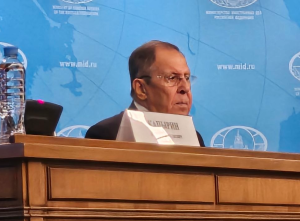 by Larry Johnson [8-17-2026] Larry C. Johnson(bio).
Hey Mr. Trump? Are you paying attention? In a long interview broadcast on Russian state television on August 14, 2026, Foreign Minister Sergei Lavrov delivered Moscow’s sharpest characterization in months of where relations with Washington stand in the fifth year of the war in Ukraine. The message was studiously two-sided, and deliberately so: the United States is, in Lavrov’s telling, both a party to the war against Russia and the only country Moscow will still talk to about ending it. Holding those two claims together is the whole of Russia’s current posture toward Washington, and Lavrov spent the interview managing the tension between them rather than resolving it.
The headline of the interview was an escalation in rhetoric, if not yet in action. Lavrov said Russia believes the United States is far more deeply involved in organizing and carrying out Ukrainian strikes deep inside Russian territory than Washington admits, and that this involvement extends to the provision of intelligence. When I was with the CIA, we called this kind of statement, No Shit Analysis. He said Moscow had submitted a formal set of questions to the State Department requesting clarification, specifically citing intelligence-sharing and what he framed as an American role in strikes against Russian civilian infrastructure, including oil refineries.
In casting Ukrainian long-range strikes as effectively American operations, Moscow put the Trump administration on notice about its reason for intensifying its own campaign against the Western supply chain sustaining Ukraine. Lavrov made that intention explicit, warning that Russia would harden its methods “to dismantle everything that fuels Kyiv’s war machine from the West,” and adding that Russia was “already doing this.”
What made the interview more revealing than a standard round of accusations was Lavrov’s careful refusal to weaponize the charge diplomatically. Pressed by his interviewer on why Russia would not simply issue an ultimatum — demanding, say, that Washington halt intelligence support before any talks proceed, given that Ukrainian strikes were hitting Russian refineries and harming civilians — Lavrov declined the framing outright. “We do not issue ultimatums,” he said. Russia would submit its questions and wait for a response.
That restraint is the tell. Moscow is choosing to keep the diplomatic channel open despite the United States of complicity in attacks on its territory — a calibration that says Russia values the prospect of a favorable negotiation with the Trump administration more than the satisfaction of a hard rhetorical line. Lavrov confirmed as much on the mechanics of contact: if U.S. special envoy Steve Witkoff and Jared Kushner come to Moscow, President Putin is ready to receive them again. “It is another matter what they come with,” he added — a caveat that keeps expectations low while leaving the door open.
On the substance of any deal, Lavrov reiterated the position that has frozen negotiations for months, and hardened its justification. Russia will not accept a simple ceasefire along the current line of contact, he said; it will stop only when there is a “long-term, reliable and sustainable settlement.” He wrapped that maximalist demand in historical-memory language, arguing that halting along the contact line would betray the sacrifice of the generation that defeated Nazism — the same World War II framing the Kremlin has used throughout the war to cast its aims as existential rather than territorial.
In practice, this means Moscow continues to reject the freeze-in-place logic that underpins most Western ceasefire proposals, and continues to insist on outcomes — including Ukrainian withdrawal from territory Russia claims — that Kyiv has consistently refused. The gap between “ceasefire now” and “settlement first” remains the central obstacle to any deal, and Lavrov’s remarks reaffirmed that Russia has not moved.
Running through the interview was a narrative of American inconsistency that Moscow has been sharpening since early summer. Lavrov sharply noted Washington’s hypocrisy: i.e., the US floats peace proposals that Russia says it accepts, then imposes fresh sanctions on Russian oil companies, wavers on whether it can even serve as a mediator, and continues arming Ukraine and sharing intelligence throughout. He revisited the sequence around the Anchorage summit — Witkoff bringing Trump’s proposals to Moscow, Putin weighing them, and then, in Lavrov’s account, European and NATO leaders descending on Washington alongside Zelensky to talk Trump out of further initiatives — to argue that the obstacle to peace lies on the Western side, not the Russian.
This dovetails with the judgment Lavrov offered earlier in the summer, when he said the United States appeared to be abandoning any claim to the role of “objective mediator” and instead pursuing escalating sanctions pressure. The Russian diplomatic position has not retreated one inch… The United States is the erratic one, and any breakdown in talks will be attributed to Washington.
Taken together, Lavrov’s August remarks describe a Russia trying to occupy two positions at once. It wants the leverage and grievance of a country under de facto Western attack — hence the intelligence accusations and the vow to hit Western supply lines harder. But Putin also wants to remain the patient, reasonable negotiating partner — hence “we do not issue ultimatums” and the open door for Witkoff and Kushner. The strategy will remain an option until Moscow collapses Ukraine’s ability to continue the war.
For Washington, the interview should be a rousing wake-up call. Lavrov reaffirmed in the strongest terms that Russia’s price for peace has not dropped — a full settlement on Russian terms, not a ceasefire — and that Moscow intends to keep escalating its strikes on Ukraine’s Western lifeline while insisting this is compatible with diplomacy. It also flatters the Trump-Kushner-Witkoff channel specifically, treating those envoys as the credible interlocutors while dismissing the broader Western coalition and the sanctions track as obstacles. That is not an accident. It is an invitation to Washington to deal bilaterally, over the heads of Kyiv and Europe, on terms Moscow believes favor it.
Whether the Trump administration accepts that framing is the open question the interview leaves hanging. What Lavrov made clear is that Russia will keep talking and keep fighting at the same time, and will treat any American discomfort with that combination as Washington’s problem to resolve, not Moscow’s.